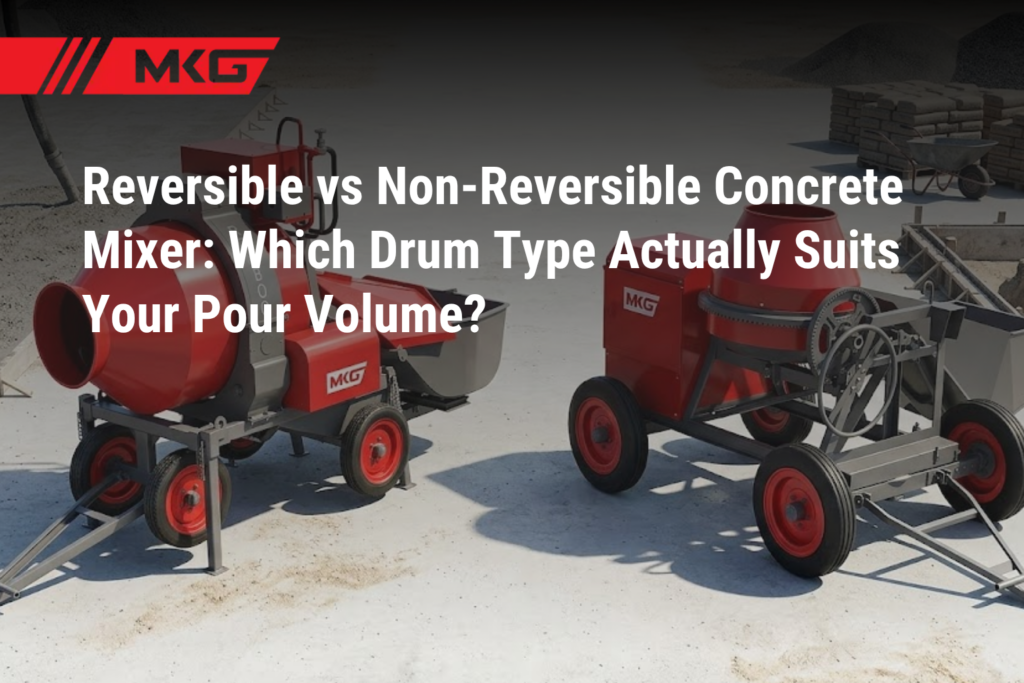
Walk into any equipment showroom in India and ask for a concrete mixer, and within thirty seconds you’ll be standing between two very different machines. On one side, the familiar 10/7 drum on four wheels that every contractor has used since their first slab. On the other, a big reversible unit with a hopper, a water tank and a control panel that looks like it belongs in a small factory.
Both make concrete. Both will work. But one of them will quietly cost you money every single day if it’s the wrong fit for your site.
At MKG, we’ve been building both types for years, and the question we get asked most is not “which is better?” It’s the wrong question. The right one is: how much concrete do you actually need to place in a day, and how fast do you need it? Answer that honestly, and the machine picks itself.
Let’s walk through it.
The Only Mechanical Difference That Really Matters
Strip away the marketing and the difference between these two drum types comes down to one thing: how the concrete gets out.
A standard non-reversible drum mixer spins in one direction. Blades inside lift the material, drop it, lift it again, and once the mix is ready you either tilt the drum or drop a chute in to let gravity do the work. It’s simple, it’s been around forever, and it’s honest about what it is.
A reversible drum mixer spins one way to mix and the opposite way to discharge. A second set of blades, angled differently, catches the mix on the reverse rotation and pushes it out through the same opening it went in through. No tilting, no waiting for gravity. If you want the textbook version, the reversing drum mixer entry on Wikipedia covers the mechanics neatly.
Sounds like a small design change. On site, it isn’t. That powered discharge is what lets a reversible machine empty in seconds instead of a minute, and it’s what makes the whole cycle time shorter. Shorter cycle, more batches per hour, more cubic metres by evening.
There’s a second knock-on effect people miss: because the reverse rotation actively drives material out, a reversible drum handles stiffer, drier, low-slump mixes far better. A gravity-fed drum will sulk with a semi-dry mix and leave residue clinging inside. That residue hardens, eats into your effective drum volume, and you’re scraping it out on Sunday.
Stop Reading Drum Capacity. Read Batch Capacity.
Here’s the number one reason contractors end up disappointed with a mixer they’ve already paid for.
Drum capacity and batch capacity are not the same thing. Drum capacity is the total hollow space inside. Batch capacity is how much usable concrete actually comes out. The gap between them is real and it’s large – typically only 60% to 80% of drum volume becomes finished mix.
Why? Because the material needs air space to cascade in. Blades have to lift and drop the aggregate through open space. Fill a drum to the brim and nothing tumbles, nothing folds together, and you get a mix that looks fine and tests badly.
You can see this reflected honestly in our own spec sheets. Our reversible concrete mixer range is listed as:
Model | Hopper Capacity | Batch Capacity | Output per Hour |
RCM 800 E / 800 D | 800 litres | 600 litres | 9–12 cu.m/hr |
RCM 1050 E | 1050 litres | 750 litres | 12–15 cu.m/hr |
Notice the drop from 800 to 600, and 1050 to 750. That’s not a shortfall – that’s the physics of proper mixing being respected. When you compare machines across suppliers, compare batch numbers. If a spec sheet only shouts about drum size and goes quiet about batch output, that silence is telling you something.
Work Backwards From Your Day, Not From Your Project
This is the part almost nobody does properly, and it’s the heart of this whole decision.
Don’t size a mixer against the total concrete in your project. Size it against how much you need to place in a single working day, then check the machine can deliver that with room to spare.
The rough method:
- Take your daily target in cubic metres.
- Divide by realistic working hours – not 8, more like 6 to 6.5 once you subtract setup, breaks, material shortages and the water tanker being late.
- That’s your required m³ per hour.
- Add a buffer of around 20%, because no machine hits its brochure figure every hour of every day.
Say you need 40 m³ for a slab in one day. Across roughly 6.5 working hours, that’s about 6 m³ per hour. Add the buffer and you’re looking for a machine comfortably rated above 7 m³/hr. Now go look at the spec sheets – the numbers stop being abstract and start being a shortlist.
The Pour Volume Ladder
Here’s how the two drum types map onto real Indian site volumes.
Up to roughly 10–15 m³ a day - a standard drum mixer is the right call.
This is footings, plinth beams, compound walls, small slabs, repair work and staggered pours scattered around a site. Our concrete mixer machine sits in this bracket: a 200-litre drum, 5 HP three-phase electric or 6 HP air-cooled diesel, four pneumatic wheels, available with or without a hydraulic hopper. It moves easily, it starts easily, and one person can look after it.
Buying a big reversible unit for this kind of work is genuinely wasteful. An oversized drum running half-full mixes worse, not better, and you burn fuel or power per cubic metre for output you never use.
Roughly 15–30 m³ a day - the grey zone.
This is where you have to think. A standard mixer can hit these numbers, but only by running flat out with a disciplined loading crew and no gaps. The moment something slips, you’re chasing the pour. Many contractors here run two standard mixers rather than one big machine, especially when the pours are spread across a large footprint and moving concrete is more painful than mixing it.
The other thing to weigh: continuity. Slabs and rafts need concrete arriving steadily so fresh mix meets fresh mix. If your machine can’t keep up, you risk a cold joint where one batch starts setting before the next lands on it. A cold joint is not a cosmetic problem – it’s a plane of weakness through your structure that no amount of finishing will fix.
30 m³ a day and above - this is reversible territory.
Structural slabs, raft foundations, road and bridge work, precast yards, industrial flooring. Our RCM 800 at 9–12 m³/hr realistically delivers 55–70 m³ across a working shift once you apply a sensible buffer. The RCM 1050 at 12–15 m³/hr pushes that towards 80–95 m³.
At these volumes the reversible machine isn’t a luxury, it’s the only thing that keeps the pour continuous.
The Quality Argument (And When It Overrides Volume)
Volume decides most cases. But there’s one scenario where it doesn’t.
If your work is specification-driven – precast elements, ready-mix supply, anything where a third party tests cubes and signs off – batching accuracy matters as much as throughput. That’s where the automation on a reversible machine earns its keep. Ours can be specified with load cell-based digital weighing for precise batching, automatic water and admixture dosing, batch printing through a USB port, and SCADA compatibility for monitoring. There’s a centralised lubrication system too, which matters more than it sounds when a machine runs six days a week.
Why does any of this change the concrete? Because compressive strength is a direct function of the cement-to-water-to-aggregate ratio. Every time that ratio is guessed by eye at the loading point, strength wanders. Load cells and automatic dosing take the guessing out. When someone asks you for batch records six months later, you have them on a printout instead of in someone’s memory.
If you’re mixing M20 for a boundary wall, this is overkill. If you’re pouring a structural raft that gets tested, it’s the difference between passing and re-pouring.
Practical Things People Forget Until It's Too Late
- Power supply. A 10 HP or 15 HP three-phase requirement is not something you assume. Confirm the connection before the machine lands. Diesel variants like our RCM 800 D exist precisely for sites where the supply is unreliable or nonexistent.
- Space and access. A reversible unit weighs 2,050 kg to 2,500 kg and needs level ground, room for the hopper to swing, and a clear path for tipper access to the aggregate stack. On a tight urban plot, that footprint alone can settle the argument. We’ve written before about working around limited site space, and the same thinking applies to your mixing station.
- Aggregate size. Bigger aggregate needs a bigger drum and a machine built for it. Check the rated maximum aggregate size against what your mix design actually calls for, not what you usually get.
- Standards. Batch-type concrete mixers in India are covered by IS 1791. Ask whether the machine conforms. A supplier who can answer that question without hesitation is a supplier who has thought about how the machine was built.
- Cleaning discipline. This applies to both types. Hardened residue reduces your effective volume batch by batch until the machine is quietly underperforming and nobody has noticed. Clean the drum at the end of every shift, without exception.
Don't Judge the Mixer for What Happens After It
One last thing worth saying plainly, because we hear it a lot.
A mixer’s job ends the moment the concrete leaves the drum. Everything after that – how well it’s compacted, how it’s finished, how it cures – belongs to different machines and different hands. Plenty of “bad mix” complaints turn out to be compaction problems. Air voids left behind by poor vibration will weaken a perfectly batched pour, which is exactly why needle spacing during compaction matters so much and why the right vibrator setup belongs on the same equipment list as your mixer.
Same story at the surface. Getting the timing right on power trowelling decides how the slab looks and behaves for the next twenty years, no matter what mixed it.
Buy the right mixer, then make sure the rest of the chain is holding up its end.
So, Which One?
Short version:
- Daily pour under 15 m³, scattered work, tight site, single crew? Standard drum mixer. Buy well, maintain it, don’t overthink it.
- Daily pour above 30 m³, continuous slabs, tested concrete, tight schedules? Reversible drum mixer. The faster cycle and controlled discharge are what keep the pour alive.
- Somewhere in between? Count your working hours honestly, apply the buffer, and lean towards the machine that gives you headroom. Nobody has ever regretted a little spare capacity on pour day.
And if the volume is high but only for one phase of the project, talk to us about our rental options rather than buying for a peak you’ll never see again.
Where MKG Fits In
We build both drum types in India, for Indian sites – dust, monsoon, long shifts, real conditions. Our reversible RCM series uses accurately machined gear rings on heavy-duty twin rollers, Schneider components in the control panel, and hopper configurations from single bin up to four bin depending on how you batch. Our standard mixer keeps things simple and rugged with a heavy-duty balanced chassis that holds steady under full load.
Both are backed by the same thing that actually determines your cost per cubic metre over five years: a service team and genuine spare parts that reach you when a machine goes down mid-pour.
Full specifications for both machines are on our products page, and the detailed brochures are in downloads.
Not sure which side of the line your project sits on?
Tell us your daily pour target and site conditions, and we’ll work the numbers with you honestly – including telling you when the smaller machine is the smarter buy.
Email info@rajat-group.com or call +91 95222 39320. Or just drop us your requirement and we’ll call you back.
Frequently Asked Questions
1. What is the main difference between a reversible and non-reversible concrete mixer?
The discharge method. A non-reversible drum rotates in one direction and empties by tilting or through a chute, using gravity. A reversible drum rotates one way to mix and the opposite way to discharge, with a second set of blades actively pushing the concrete out through the same opening. That powered discharge makes the cycle faster and handles stiff, low-slump mixes far better.
2. At what daily pour volume should I move to a reversible mixer?
As a working rule, below roughly 15 m³ a day a standard drum mixer is the sensible choice. Above roughly 30 m³ a day, a reversible machine is usually the only way to keep a pour continuous. Between those figures, calculate your required m³ per hour over realistic working hours and add a 20% buffer before deciding.
3. Why is batch capacity lower than drum capacity?
Because the material needs empty space above it to tumble properly. Blades lift and drop the mix through that air space, and without it the ingredients never fold together. Usable batch output typically runs at 60–80% of drum volume. Our RCM 800 has an 800-litre hopper and a 600-litre batch capacity for exactly this reason.
4. Can a reversible mixer be used for small pours?
Technically yes, practically no. A large drum running half-full mixes less effectively than a correctly sized smaller drum, and you pay for fuel or power you aren’t converting into concrete. For scattered small pours, a 200-litre class machine – or two of them positioned across the site – is the better economics.
5. Do I need three-phase power for a reversible concrete mixer?
The electric variants do. Our RCM 800 E runs a 10 HP three-phase motor and the RCM 1050 E a 15 HP three-phase motor. Where the site supply is unreliable, the RCM 800 D uses a 16 HP air-cooled diesel engine instead. Confirm your connection before the machine arrives, not after.
6. Which mixer type is better for precast and tested concrete?
Reversible, mainly because of the automation you can specify around it – load cell weighing, automatic water and admixture dosing, and batch printing. Consistent ratios produce consistent compressive strength, and printed batch records give you documentation when someone asks for it later.