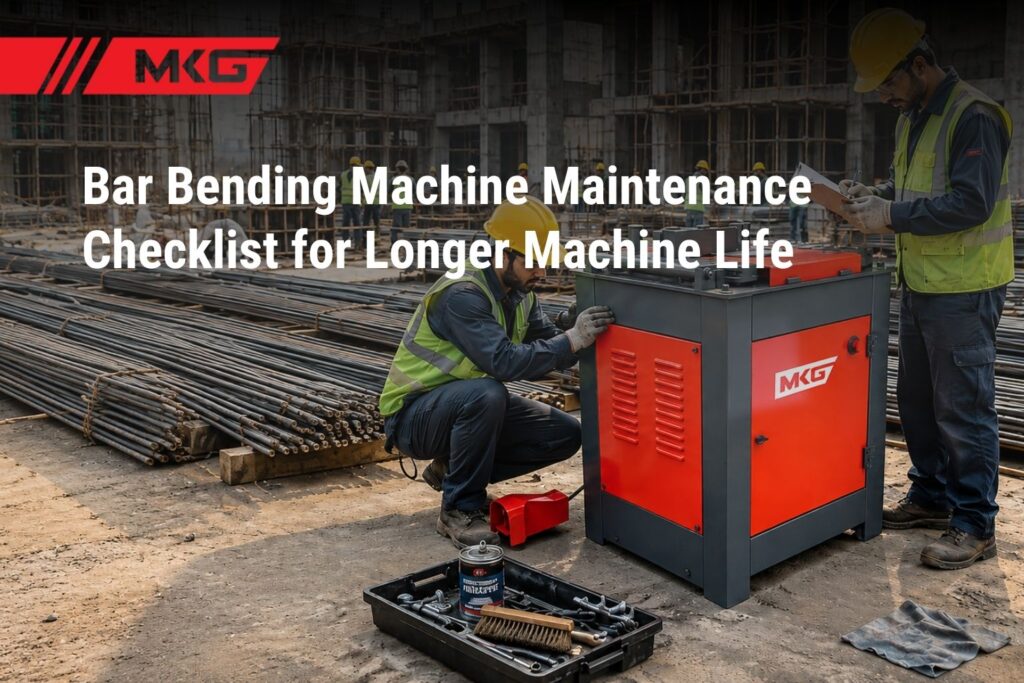
Walk into any rebar yard in India and you’ll hear it before you see it – the steady hum of a bar bending machine shaping steel from morning to evening. On most sites, this machine never really gets a break. It bends thousands of bars a month, sits out in the dust and heat, and often gets switched off only when the shift ends.
And yet, when the machine slows down or stops one day, everyone acts surprised.
Here’s the honest truth we’ve learned after years of building and servicing rebar equipment at MKG: most bar bending machine breakdowns don’t happen suddenly. They build up quietly – a dry gear here, a loose bolt there, a gearbox running on old oil for months. The good news? Almost all of it is preventable with a simple maintenance routine that takes just a few minutes a day.
In this guide, we’ll give you a practical, no-jargon maintenance checklist – daily, weekly, and monthly – that your site team can actually follow. We’ve also studied how leading equipment manufacturers around the world approach this, so you’re getting proven practices, not guesswork.
(If you’re still at the installation stage, start with our Bar Bending Machine Setup Guide first – proper setup is half the battle won.)
Why Maintenance Matters More Than You Think?
Let’s talk numbers for a second. A bar bending machine is not the most expensive equipment on your site, but when it stops, everything downstream stops with it. Bar benders sit idle, the steel yard piles up, slab cycles get delayed, and you end up paying labour for waiting instead of working.
Industry research backs this up. Studies on bending equipment have found that companies that delay maintenance end up paying roughly 60% more in repairs, because one worn part quietly damages the next – like falling dominoes. On the other hand, machines that follow the manufacturer’s maintenance guidelines routinely achieve most of their designed working life.
Put simply: ten minutes of daily care is far cheaper than a week of downtime and an emergency repair bill.
Daily Maintenance Checklist (5–10 Minutes)
These are habits your operator should follow every single working day. None of them need a mechanic.
1. Start with a quick visual walk-around
Before switching on, look at the machine like you’re seeing it for the first time. Is it sitting stable on its base? Any oil stains on the ground below it? Any cracked wires, damaged plug, or exposed cable? Is the earthing connection intact? Site safety checklists across the industry list a firm base, proper earthing, and a healthy 3-core cable as the very first inspection points – because electrical faults are both a breakdown risk and a safety risk.
2. Check the foot switch and emergency stop
The foot pedal takes a beating on site – it gets stepped on hundreds of times a day and is usually surrounded by dust and steel scrap. Make sure its protective cover is in place and it responds instantly. Test the emergency stop button too. If either feels sticky or delayed, don’t run the machine until it’s fixed.
3. Inspect the pins, mandrels, and work disc
The bending pins and mandrels are the parts that actually touch the steel, so they wear the fastest. Look for cracks, flattening, or deep grooves. A worn pin doesn’t just risk breaking – it also produces inaccurate bend angles, which means rejected bars and wasted steel. (Wasted rebar is a silent budget killer – we’ve covered that in detail in How to Reduce Rebar Wastage with Proper Bar Cutting Planning.)
4. Run the machine empty before loading it
Manufacturers like GHM recommend letting the machine run at no load for a few minutes before the first bend of the day – especially in winter, when the gear oil is thick and cold. During this warm-up, listen carefully. A healthy machine has a smooth, even hum. Grinding, knocking, or unusual vibration is the machine’s way of telling you something is wrong. Never ignore it.
5. Clean the machine after every shift
Dust, rust flakes, and metal particles settle on the work disc and slowly work their way into moving parts. A quick wipe-down of the work surface at the end of each shift, followed by a light coat of grease on the disc, keeps grit out of the gears. One golden rule here: never clean or oil the machine while it’s running. Always switch off and unplug first.
Weekly Maintenance Checklist (20-30 Minutes)
Once a week, give the machine slightly deeper attention. Ideally, do this on a fixed day so it becomes routine.
1. Tighten all bolts and fasteners
A bar bending machine vibrates constantly during operation andthat vibration slowly loosens bolts and screws over time. Loose fasteners cause misalignment, instability, and eventually damaged components. Go around the machine with a spanner once a week – foundation bolts, motor mounts, guard fixings, everything.
2. Lubricate the turntable and pin holes
The holes on the work disc where the bending pins sit need regular greasing, along with the pins themselves. SIMA’s maintenance guidance recommends lubricating all the bolts and turntable holes, fitting the pins back properly, and wiping away excess oil so dust doesn’t stick to it. Dry pins are one of the most common and most easily avoided causes of jerky bending and premature disc wear.
3. Test the limit switches and guards
Limit switches control where the disc stops rotating – if they fail, your bend angles go haywire and the machine can over-travel. Check that they trigger correctly at both ends. Also confirm that all safety guards over moving parts are fitted and undamaged.
4. Inspect the electrical panel and wiring
Open the panel (with power disconnected) and look for loose terminals, burnt smell, discoloured wires, or dust build-up. On Indian sites where voltage fluctuation is common, this weekly check catches problems that would otherwise cook your motor or control card.
Monthly & Periodic Maintenance Checklist
This is where the machine’s long-term life is really decided.
1. Check and change the gearbox oil on schedule
The gearbox is the heart of a bar bending machine, and gear oil is its blood. Gute Machinery’s maintenance instructions recommend the first oil change about three months into use – ideally while the machine is still warm so the old oil drains out fully and regular changes after that.
As a general practice followed by most manufacturers, change the oil again roughly every six months, or sooner if it looks dirty, milky, or has metal particles in it. Milky oil means water has entered the gearbox – a common monsoon problem that must be fixed immediately.
2. Rotate the work disc 180 degrees
Here’s a trick most site teams don’t know: after the machine has worked for a few months, rotate the working disc 180 degrees and continue using it in that position. This turns the large gear inside the reduction box as well, so the gear teeth wear evenly on both sides instead of only one – directly extending the machine’s service life. It’s a five-minute job that adds years.
3. Grease the bearings
The main shaft and gearbox bearings should be greased through their grease nipples until fresh grease pushes the old grease out. Use a good-quality, high-temperature grease – not whatever is lying around the store room.
4. Verify bend accuracy
Bend a test bar to a standard angle (say 90°) and measure it. If the angle is drifting, check the limit switch settings, pin wear, and disc condition before it starts affecting your actual reinforcement work.
Monsoon and Storage Care (The India-Specific Section)
Most maintenance guides are written for factory floors. Your machine lives on an open construction site in Indian weather, so this part matters.
- During monsoon, keep the machine on a raised, dry platform and cover it with a waterproof tarpaulin whenever it’s idle. Moisture entering the motor or gearbox causes far more damage than daily use ever will.
- Apply rust-preventive oil to the work disc, pins, and any exposed machined surfaces before long idle periods.
- Before restarting after storage, don’t just switch it on. Do a full inspection, check the oil, and run a no-load test first.
- In extreme summer heat, avoid running the machine continuously for very long stretches without breaks – motors that constantly run hot age faster.
work.
Safety Habits That Also Protect Your Machine
A few non-negotiable rules that protect both your team and your equipment:
- Always disconnect power before any maintenance. Lock the plug away or tag the switch so nobody starts the machine while someone’s hands are inside it.
- Never exceed the machine’s rated bar diameter. Forcing a 40 mm bar through a machine rated for 32 mm is the fastest way to destroy a gearbox. Know your machine’s capacity and respect it.
- Use genuine spare parts. Local copies of pins, mandrels, and gears may look identical but rarely have the same hardening and tolerances. This is exactly why we run a dedicated MKG Spare Parts service – so you’re never forced to fit a duplicate part just because the original wasn’t available.
- Keep a simple maintenance log. A notebook near the machine was recording the date, what was checked, and what was replaced. It sounds basic, but it’s the difference between guessing and knowing when the next oil change is due.
- Train more than one operator. The operator is your first line of defence – they’ll notice a strange sound or vibration long before a technician visits. Make sure at least two people on site know these checks.
Signs Your Machine Is Asking for Help
Even with good maintenance, watch for these warning signals and act early:
- Grinding or knocking sounds from the gearbox
- The disc rotating slower than usual or hesitating under load
- Bend angles coming out inconsistent
- The motor getting unusually hot or tripping the breaker
- Visible oil leakage under the machine
Catch these early and the fix is usually small. Ignore them and you’re looking at a major repair. (The same early-warning logic applies to your cutting equipment, too – see Signs Your Bar Cutting Machine Blade Needs Replacement.)
How MKG Helps You Keep Your Machine Running
At MKG, we don’t just sell rebar equipment and disappear. Our bar bending machines – available for 32 mm, 36 mm, and 42 mm rebar, with planetary gearbox options on the latest models – are built rugged for exactly the site conditions described above. Pair one with our bar cutting machines and you have a complete rebar processing setup from a single manufacturer, with a single point of support.
And when your machine needs care beyond the daily checklist, you have options:
- Genuine spares, quickly – through our Spare Parts service, so downtime stays in hours, not weeks.
- Structured servicing – if you’re deciding between an annual maintenance contract and calling a technician only when something breaks, our guide on AMC vs On-Demand Maintenance will help you choose what suits your project.
- A second life for older machines – our Recon Machine service professionally rebuilds worn equipment, and our Buy Back program gives you fair value when it’s finally time to upgrade.
Because we manufacture these machines ourselves, our team knows exactly which parts wear first and how to keep them running – knowledge that goes straight into every service call.
Conclusion
A bar bending machine doesn’t need expensive care – it needs consistent care. A few minutes of cleaning and inspection daily, a weekly round of tightening and greasing, timely gearbox oil changes, and a little extra protection during monsoon. That’s genuinely all it takes to add years to your machine’s life, keep your bend quality consistent, and avoid the one thing every project manager dreads: unplanned downtime in the middle of a slab cycle.
Print this checklist, stick it near the machine, and make it part of your site routine. Your machine – and your project schedule – will thank you.
Need help maintaining your rebar equipment, or looking for a machine built to last?
Talk to MKG’s technical experts today – we’ll help you set up the right maintenance routine for your site.
- Email: info@mkgworld.in
- Call: +91 95222 39320
MKG | Built for safety. Built for the future.