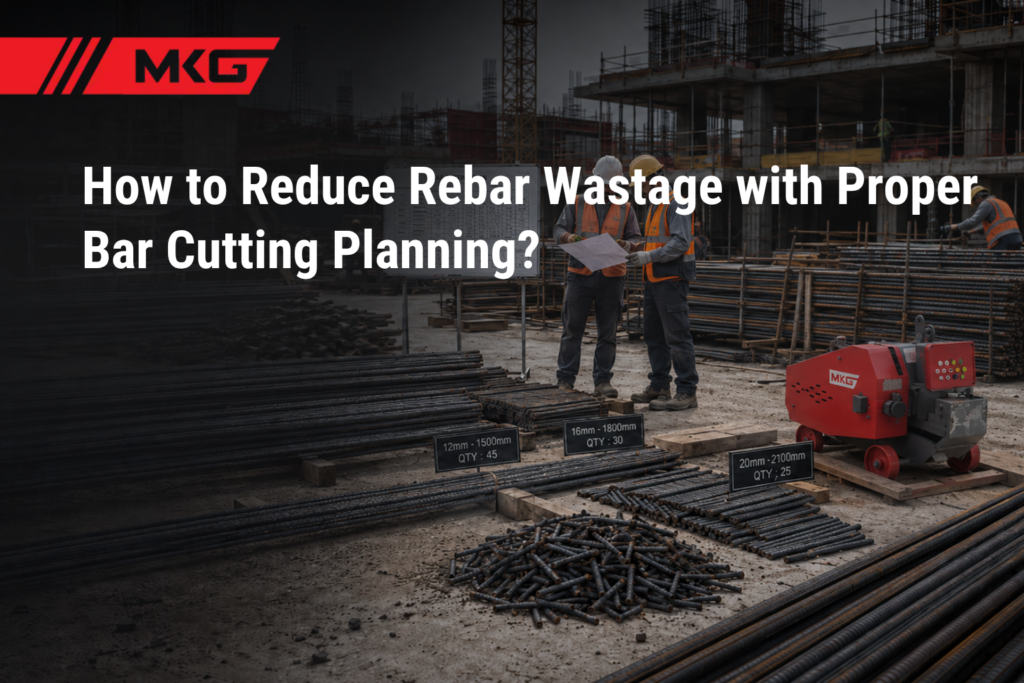
If you run a construction site, you already know steel is one of the heaviest lines on your budget. Every rebar you order costs money, and every offcut lying in the scrap pile is money you can’t get back. Cutting that waste starts with one simple habit: planning your cuts before the machine even switches on.
At MKG, we’ve spent over a decade building rebar processing equipment for real estate and infrastructure projects across India. We’ve walked hundreds of sites, and we see the same thing again and again – good steel turning into scrap simply because nobody planned the cutting properly.
The good news? This is one of the easiest wins on any project. In this guide, we’ll break down practical, no-nonsense ways to reduce rebar wastage through smart cutting planning – so your steel goes into the structure, not the scrap heap.
First, Let's Be Honest About How Much Steel You're Wasting
On most sites, rebar wastage sits somewhere between 5% and 15% of the total steel ordered. That’s a huge range, and where you land on it usually comes down to planning, not luck.
A healthy benchmark is simple: if your wastage is below 2%, you’re doing well. If it creeps above 3%, it’s a red flag that your cutting or handling needs a fresh look.
To even know your number, weigh your leftover scrap and divide it by the total steel delivered. What gets measured gets managed and rebar is no exception.
Where Does Rebar Wastage Actually Come From?
Most waste isn’t dramatic. It builds up quietly, cut by cut. The biggest culprit is offcuts – those short end pieces left after cutting a long bar to size, usually too small to reuse anywhere.
Other losses sneak in too. Bars get cut to the wrong length by untrained hands. Rebar stored out in the open rusts and becomes unfit for structural use. And on bigger sites, steel simply goes missing or gets misplaced.
Once you see waste as a handful of fixable causes rather than “just part of the job,” the whole problem becomes far easier to control.
Start Every Project With a Bar Bending Schedule (BBS)
If there’s one habit that saves the most steel, it’s preparing a Bar Bending Schedule before a single bar is cut. A BBS is a simple table that lists every bar’s mark, diameter, shape, cutting length, and quantity, pulled straight from your structural drawings.
Think of it as the master plan for your steel. It tells your team exactly what to cut, how much, and in what shape – no guessing, no “cut it and we’ll see.”
With a solid BBS, you order the right quantity instead of over-buying “just to be safe.” That single step alone typically trims wastage by 5–10% on RCC projects.
Nest Your Cuts to Kill Off Offcuts
Here’s where real planning pays off. Instead of cutting each bar length on its own, group your required lengths so that one stock bar produces several pieces with almost nothing left over. Engineers call this nesting or cutting-pattern optimisation.
Say a standard bar is 12 metres and you need pieces of 5m, 4m, and 3m. Cut all three from one bar and you’ve used the full length with zero scrap. Cut them randomly, and you’ll bleed short ends every time.
A little arithmetic before cutting can turn a pile of useless offcuts into usable, planned pieces.
Order the Right Stock Lengths
Waste often begins at the purchase stage, long before anyone picks up a cutter. If your required lengths don’t divide neatly into standard bar lengths, you’re buying scrap in advance.
Where your supplier offers them, ask about special or custom stock lengths that match your cutting plan. Combining special lengths with standard ones is one of the proven ways to push cutting waste close to zero.
Match your steel order to your BBS, not the other way around, and you’ll stop paying for metal you were always going to throw away.
Get Your Bend Allowance and Cutting Length Right
A bent bar isn’t the same length as a straight one – steel stretches slightly at every bend. If you cut to the straight dimension and forget the bend allowance, the bar ends up short and heads to the scrap pile.
Common site practice is to add roughly 1d for a 45° bend, 2d for a 90° bend, and 3d for a 135° hook (where “d” is the bar diameter). Deductions for bends work the same way in reverse.
Following recognised standards like IS 2502 keeps these numbers consistent across your team. Get the cutting length right the first time and you avoid both shortages and waste. You can read more about rebar and reinforcement basics on Wikipedia’s rebar reference.
Plan Your Lap Splices Smartly
Long runs of reinforcement need overlaps, called lap splices, where two bars join. Most people treat the splice location as fixed – but codes actually allow some flexibility in where it sits.
That flexibility is a hidden waste-saver. By shifting a splice a little, you can often use up an offcut that would otherwise be scrapped, or avoid an awkward short cut altogether.
On large projects with hundreds of bars, thoughtful splice planning adds up to serious steel savings without touching structural safety.
Cut Accurately - Your Machine Matters
Even the best plan falls apart if the cut itself is sloppy. Hand-cutting and worn tools lead to uneven, off-measure pieces that don’t match the schedule and every mismatched bar is potential waste.
This is exactly why a reliable bar cutting machine earns its place on site. Our MKG models deliver clean, consistent, repeatable cuts, so a 5-metre bar is genuinely 5 metres, every single time.
Consistent cutting means your nesting plan actually works in practice, not just on paper. A blade past its prime causes ragged cuts too, so watch for the signs your blade needs replacing.
Bend With Precision, Too
Cutting is only half the job. Once bars are cut to plan, they still need to be bent to the exact shapes in your BBS and bending errors create just as much scrap as bad cuts.
Untrained hands and manual bending produce inconsistent angles, cracked bars, and rejects. A dedicatedbar bending machine holds the angle and radius you set, so shapes come out right the first time.
If you’re setting one up, ourbar bending machine setup guide covers everything from space to power before you begin.
Store and Handle Rebar the Right Way
You can plan cuts perfectly and still lose steel to bad storage. Rebar left in the open or on wet ground develops rust, and heavily rusted bars often can’t be used in the structure at all.
Keep bars off the ground on supports, cover them during monsoon, and store them in a dry, organised area. Rough handling during unloading bends and cracks bars too, so shift them with care.
Well-stored steel stays usable steel – it’s the cheapest waste-reduction step there is.
Train Your Team and Reuse Smartly
Your cutting plan is only as good as the people running it. A quick briefing on reading the BBS, measuring twice, and cutting once prevents most of the errors that turn full bars into offcuts.
And don’t bin every short piece automatically. Many offcuts are perfectly usable for stirrups, ties, and shorter reinforcement elsewhere on site. A simple “reusable offcuts” bin can quietly recover a good chunk of steel.
Small habits, repeated across a whole project, are what separate a 2% site from a 12% one.
Choose Higher-Grade Steel Where It Fits
Here’s a bonus lever many teams overlook. Higher-strength steel like Fe500 often needs fewer bars than Fe415 to carry the same load, which means less steel cut and less waste overall.
When your design allows it, Fe500 can save around 10% on reinforcement compared to Fe415. Paired with a tight cutting plan, that’s a double win on both cost and scrap.
Always confirm the grade with your structural engineer first – but it’s worth asking the question early.
MKG's Commitment to Waste-Free Reinforcement
AtMKG, we build rebar processing equipment that’s designed, made, and serviced in India for the realities of Indian sites – dust, heat, monsoon, and heavy daily use. Precise, dependable machines are the backbone of any low-waste cutting plan.
From our C-40, C-45, and C-50 bar cutting machines to our bar bending range, every unit is built for the clean, accurate, repeatable work that keeps steel out of your scrap pile. And our service teams are there with genuine spare parts to keep you running.
Cutting rebar waste isn’t a one-time trick – it’s a system. Plan it, cut it right, and store it well, and you’ll see the savings on every floor you pour.
Want help choosing the right cutting or bending machine for your site?
Talk to our experts today. Email info@rajat-group.com or call+91 95222 39320
let’s make your next project leaner, faster, and more profitable.
Frequently Asked Questions
1. What is an acceptable rebar wastage percentage on a construction site?
As a rule of thumb, wastage below 2% of total steel delivered is considered good practice. Between 2% and 3% is workable but has room to improve. Anything above 3% usually points to poor cutting planning, weak handling, or storage problems, and is worth investigating straight away.
2. How does a Bar Bending Schedule reduce steel wastage?
A BBS lists the exact cutting length, shape, and quantity of every bar before work begins. This stops random cutting, over-ordering, and guesswork on site. Because bars are cut to precise measurements and ordered in the right amounts, most projects see steel wastage drop by 5–10% simply by preparing and following one.
3. Can I reuse rebar offcuts instead of scrapping them?
Yes, and you should. Many offcuts are long enough to be reused as stirrups, ties, or short reinforcement bars in other parts of the structure. Keeping a dedicated bin for reusable offcuts and matching them against your BBS can recover a meaningful amount of steel that would otherwise become scrap.
4. Does the cutting machine really affect how much steel I waste?
Absolutely. Accurate, well-maintained machines produce consistent, on-measure cuts that match your cutting plan exactly. Manual or worn-out cutting leads to uneven pieces, wrong lengths, and rejected bars – all of which add to waste. A reliable bar cutting machine is one of the most direct ways to keep your planned savings from leaking away on site.