When you’re building a high‑rise residential complex or a multi‑storey industrial plant, you quickly realise that getting people and materials to the right floor safely isn’t a luxury – it’s a necessity. Modern construction projects soar hundreds of metres into the sky; climbing stairs wastes precious time and fatigues workers, while makeshift lifting solutions create serious safety risks.
A construction hoist is the unsung hero on large sites because it lifts workers and materials vertically, cuts floor‑to‑floor travel time and dramatically improves productivity. Industry estimates suggest a properly installed passenger hoist can reduce travel time by up to 70 percent compared to manual staircase climbing.
As construction activity across India intensifies, the demand for reliable hoists has exploded. Several manufacturers have entered the arena with different capabilities. In this blog, we’ll walk you through what makes a good construction hoist, compare how leading Indian manufacturers approach safety and performance, and then explain why MKG’s Vimaan passenger cum material hoist stands out for large projects.
Even a strong hoist can lose performance when parts face constant stress over time. Motors, brakes, rollers, mast sections, and gears need regular checks to avoid sudden failure. Our blog on component fatigue in vertical hoists explains why this happens and how to manage it.
What to Look for in a Construction Hoist
Before comparing manufacturers, it helps to understand the features that matter most in a passenger or construction hoist:
- Load Capacity and Speed: Large projects need hoists that can carry heavy materials and multiple workers quickly. Our own Vimaan series offers 1 ton, 1.5 ton, and twin‑cage 2 ton configurations with speeds between 20–60 m/min.
- Safety Features: A hoist must include emergency stops, overload protection, interlocking doors and other safeguards. Competitors like Dynamic Crane Engineers emphasise emergency stop buttons, overload protection, interlocking doors and safety harness points. Vimaan goes further with a Variable Frequency Drive (VFD), geared brake motor, limit switches on every door and travel point, rack‑searching limit switches to prevent misalignment and buffer springs for emergency cushioning.
- Structural Reliability: High‑quality materials and durable construction lower maintenance costs. GJJ hoists distributed by Everest Engineering use high‑tensile ST52‑3 steel and a fully galvanised structure that can last 20–25 years. MKG’s Vimaan uses brand‑name components like Schneider control panels and PBL geared motors and is built for long‑term reliability with high‑grade parts.
- Ease of Operation and Maintenance: Smooth, jerk‑free movement matters for worker comfort and equipment longevity. Jaypee’s hoists use Variable Frequency Drives and PLC‑based safety automation. Vimaan’s rack‑and‑pinion mechanism delivers steady travel, while our own blog shows how routine inspections and lubrication extend lifespan.
- After‑Sales Support: Large projects require responsive service networks. Everest Engineering emphasises a pan‑India service network delivering responses within 24 hours. MKG similarly provides dedicated service teams and dealer networks across multiple Indian states.
With these criteria in mind, let’s see how major players in India stack up. Choosing the right hoist depends on your site height, load capacity, worker movement, and project timeline. If you are still comparing different options, our guide on choosing the right hoist for construction projects in India can help you make a more practical decision.
Understanding How Construction Hoists Work (in Simple Terms)
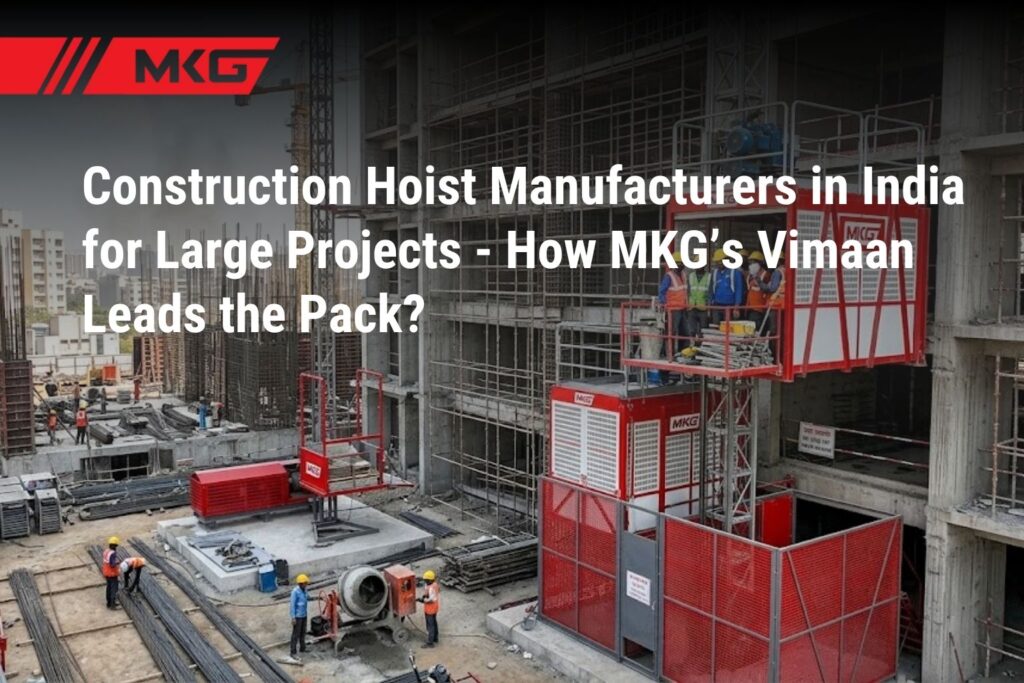
Imagine your project is like a tall apartment building under construction. Workers must travel between floors dozens of times a day, often carrying heavy tools or materials. A construction hoist is like a temporary outdoor elevator that uses a rack‑and‑pinion mechanism, where a toothed rail (the rack) is anchored along the mast and a gear (the pinion) on the hoist motor engages the rack to climb up or down. This design is simple, robust and doesn’t rely on cables that can slip or fray.
For large projects, rack‑and‑pinion hoists are popular because they handle heavy loads, remain stable in outdoor conditions and offer precise speed control. Vimaan uses this mechanism along with a Variable Frequency Drive to ensure smooth starts and stops, reducing jerkiness and stress on the structure.
Safety Is Non‑Negotiable
When lives and costly materials are moving hundreds of metres above ground, safety features are critical. Let’s break down the main protections offered by modern hoists:
- Emergency stop & overload protection: If something goes wrong, an operator must be able to stop the hoist instantly. Overload sensors prevent the hoist from moving if too much weight is inside. DGOC highlights emergency stop buttons and overload protection, while Jaypee and GJJ hoists provide similar safeguards.
- Interlocking doors & gates: The hoist cage should not move unless doors and gates are fully locked. This prevents accidents like someone leaning into the shaft. DGOC emphasises interlocking doors and safety harness attachment points.
- Limit switches & brake systems: Limit switches stop the hoist if it reaches the top or bottom of its travel range. MKG’s Vimaan adds limit switches on every door and travel point, plus a rack‑searching limit switch to correct misalignment. A geared brake motor ensures secure stops even in a power cut.
- Backup & manual controls: High‑rise projects can’t afford downtime. GJJ hoists include Siemens PLC and VFD systems, while Vimaan offers a manual brake release so the cage can be lowered safely during a power failure.
For large construction projects, safety cannot be treated as an extra feature. Limit switches, emergency brakes, overload protection, and door interlocks all play a direct role in protecting workers. You can also read our detailed guide on passenger hoist safety features you should never ignore.
Why MKG Developed the Vimaan Hoist
At MKG, we started as a small manufacturer in 2010, building on the legacy of Rajat Equipments. Our goal was to create a hoist built for Indian conditions – rugged job sites with dust, rain, heat, and sometimes salty coastal air. Over more than a decade, we’ve delivered equipment for real estate and infrastructure developers across Maharashtra, Gujarat, Karnataka, Kerala and Andhra Pradesh.
We noticed that many imported hoists looked good on paper but struggled with local maintenance and spare parts. On the other hand, some domestic manufacturers sacrificed safety or durability to cut costs. With Vimaan, we decided to strike the right balance:
- Local manufacturing with global components: By sourcing control panels from Schneider and geared motors from PBL, we ensure reliability while keeping costs reasonable and support local supply chains.
- Modular design: Vimaan’s load capacity options (1 ton, 1.5 ton or 2 ton twin cage) mean contractors can choose exactly what they need. Additional safety features can be added based on site risk and regulations.Not every site needs the same type of hoist. Some projects may only need material movement, while others need safe movement for both workers and materials. If you are confused between both options, our blog on tower hoist vs passenger hoist will help you understand the difference.
- User‑friendly operation: We prioritised a clear layout with accessible buttons, limit switches on all gates and a simple manual override. Our training programmes ensure operators know how to conduct pre‑use check.
- For large projects, contractors need more than one machine to manage speed, safety, and productivity. If you are planning your equipment list, our blog on heavy construction equipment every contractor should have in 2026 can help you understand what matters.
A construction hoist is only one part of a well-planned high-rise site. Contractors also need mixers, compactors, cutting machines, platforms, and other equipment to keep the project moving. Our blog on top types of construction equipment used for high-rise building gives a wider view.
Practical Benefits of Vimaan for Large Projects
1. Faster Construction Timelines
Every minute saved on vertical transport adds up over months. With speeds up to 60 m/min and a smooth VFD‑controlled drive, Vimaan helps crews reach their work areas quickly. Even though some competitors claim speeds up to 96 m/min, our design emphasises stable acceleration and controlled braking to prevent material spillages or worker discomfort. In reality, on busy sites, a controlled 60 m/min with minimal downtime often outperforms a higher‑speed hoist that requires more frequent maintenance.
2. Enhanced Safety for Workers and Materials
Safety isn’t just about regulations; it’s about peace of mind. Vimaan integrates eight different safety devices, from limit switches and overload sensors to buffer springs and ground enclosures with hooters. These features work together to reduce the risk of accidents, keeping your site compliant with Indian BIS standards and international norms. For example, our rack‑searching limit switch automatically detects misalignment and prevents the cage from moving, protecting both the structure and passengers.
3. Lower Operating Costs Through Reliability
Downtime on a large project is expensive. We designed Vimaan with durability in mind: high‑grade parts and proper weather protection minimise rust and wear. Combined with our recommended maintenance schedule – daily inspections, weekly lubrication and rust prevention as detailed in our blog – Vimaan can serve reliably for years. This long‑term approach reduces total cost of ownership compared to cheaper models that require frequent repairs.
4. Easy Maintenance and Strong Support
Because we are an Indian manufacturer, spare parts and service engineers are always within reach. Our dealer network spans numerous cities, and we provide training for operators and maintenance teams. We also offer services like recon machine supply, rental business and buy‑back programmes, ensuring flexibility throughout your project lifecycle. Routine checklists, similar to those we share in our blog, make it simple for site teams to keep the hoist running smoothly.
5. Adaptability to Different Sites
Large projects come in all shapes: narrow urban towers, sprawling industrial plants or bridge pylons. Vimaan’s modular mast sections allow installation on varied building geometries, and our twin‑cage configuration doubles capacity without sacrificing stability. We can work with your engineers to plan the optimal mast tie‑in distances and cage sizes, ensuring that Vimaan fits your site without extensive modifications.
Tips for Choosing the Right Hoist for Your Project
- Assess your load and height requirements: Determine how many workers and how much material need to be moved at peak times. If your site rarely moves more than 1 ton at once, a mid‑capacity hoist like Vimaan may be more cost‑effective than a high‑capacity 10‑ton model.
- Consider the environment: Coastal or rainy sites require extra rust protection and frequent inspections. Choose manufacturers that offer galvanised or coated mast sections and provide clear maintenance guidelines.
- Look at after‑sales support: Ensure the manufacturer has service centres near your site and offers training for operators. In an emergency, quick response times are invaluable.
- Check safety certifications: CE and BIS compliance indicate that the hoist meets international safety standards. Ask for documentation and verify that safety devices like limit switches, overload sensors and emergency brakes are included.
Plan for maintenance: A hoist is a long‑term asset. Incorporate daily checklists, weekly lubrication, rust prevention and proper load management into your site routine. A well‑maintained hoist can last 20–25 years.
How MKG Supports Your Project Beyond Equipment
At MKG, we understand that purchasing a hoist is just one piece of the puzzle. That’s why we offer a suite of services to help you get the most out of your investment:
- Rental Business: Not every project needs a hoist permanently. Our rental division provides flexible short‑ and long‑term options.
- Recon Machine Programme: For developers on tight budgets, recon (refurbished) machines offer quality at a lower price.
- Buy‑Back and Upgrade: When your project ends or your needs grow, we can buy back your existing hoist and upgrade you to a newer model.
- Spare Parts and Dealer Network: With dealers across India, you can quickly get genuine parts and technical support.
- Training and Documentation: We conduct regular training sessions and supply detailed manuals. Our maintenance blog, How to Maintain Your Passenger Hoist for Maximum Lifespan, offers step‑by‑step checklists and seasonal tips to keep your hoist operating safely and smoothly.
Conclusion: Moving Upward Together
Large construction projects need more than just strong machines. They need safe, steady, and reliable vertical movement every single day. When workers and materials move smoothly, the whole site works faster. When the hoist stops, the delay affects labour, material flow, deadlines, and overall project cost.
That’s why choosing the right construction hoist manufacturer in India matters. The right manufacturer does not only sell a machine. They help you select the right load capacity, safety features, installation setup, maintenance support, and long-term service plan.
At MKG, we build construction equipment for real Indian site conditions: long working hours, heavy loads, dust, rain, tight timelines, and demanding project teams. With Vimaan, our passenger and material hoist, we focus on safe movement, smooth operation, strong components, and dependable support.
If you are planning a high-rise, redevelopment, commercial, or infrastructure project, talk to MKG’s technical experts today to choose the right construction hoist setup for your site.
info@mkgworld.in
+91 9922 39320
MKG – Built safety. Built for progress.