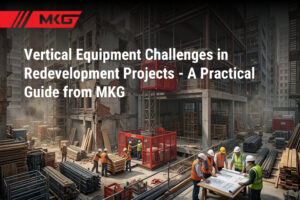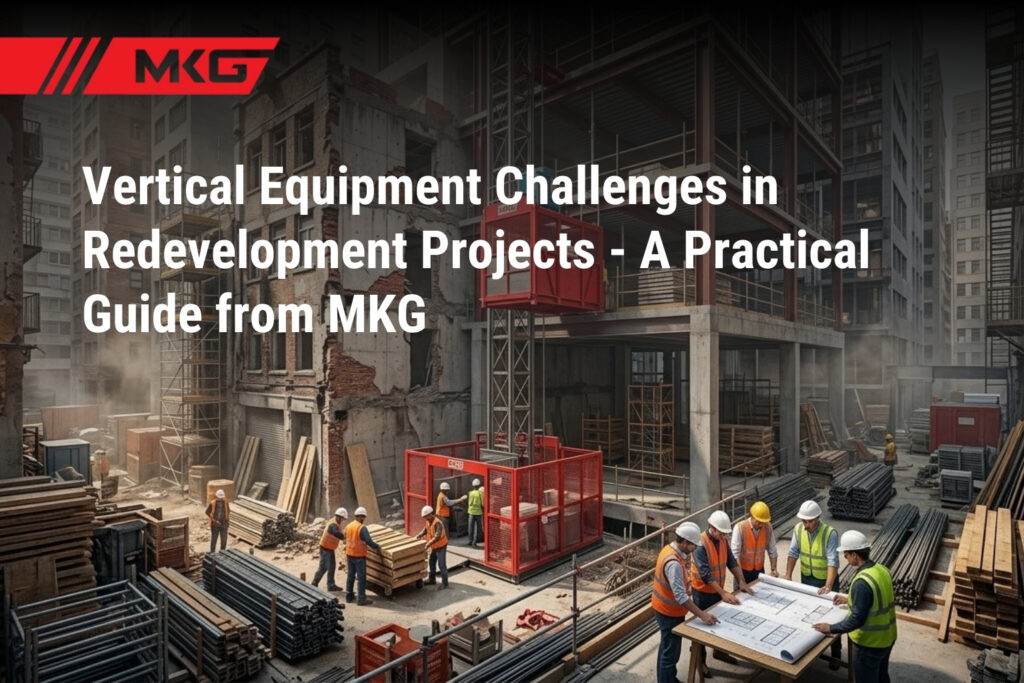
Redevelopment projects are some of the most rewarding yet tricky jobs in construction. You’re not just building from scratch but working within tight urban spaces, alongside existing structures and communities.
That means you need the right vertical equipment to move people and materials safely and efficiently. At MKG we design and build hoists and lifting solutions specifically for these realities, and in this guide we’ll walk you through the biggest challenges and how to overcome them.
What Do We Mean by Vertical Equipment?
Vertical equipment covers everything that lifts people or materials up and down a job site – passenger hoists, material hoists, tower cranes, mini lifts and suspended platforms. These machines are the lifelines of any redevelopment project because they replace back‑breaking manual transport with safe, controlled vertical movement. Without them, your crew spends time carrying bricks up stairwells or waiting for crowded elevators. However, operating vertical equipment in congested redevelopment sites brings its own set of issues.
Challenge 1: Cramped Sites and Material Logistics
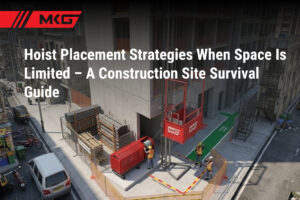
Redevelopment almost always happens on a footprint hemmed in by existing buildings and narrow roads. Deliveries have to navigate one‑way streets and there’s very little lay‑down area. Border states describe how loading docks fill up quickly and narrow streets leave nowhere for trucks to queue. In high‑rise construction the lack of space complicates crane placement and storage, and moving heavy materials vertically is a constant puzzle.
Practical Solution: Consider prefabrication to reduce on‑site staging – many facade panels and mechanical modules can be assembled off‑site and lifted into place. Our MKG builder tower hoist solves the vertical part of this puzzle by lifting up to 1 tonne of material and extending as the building grows. Its modular mast fits into tight courtyards, freeing up ground space.
Challenge 2: Vertical Transportation Bottlenecks
On redevelopment projects, you might share a single freight elevator with multiple trades. Waiting for that elevator wastes valuable time. During construction, limited numbers of hoists can create long queues, slowing down workers and materials. Even after completion, poorly designed lift banks cause tenant frustration and reduce a building’s appeal.
Practical Solution: invest in dedicated temporary hoists and plan their placement and capacity early. High‑speed hoists and destination‑dispatch elevator systems reduce waiting times. We recommend our Vimaan passenger & material hoist because it combines two cages in one tower. Workers can ride in one cage while materials travel in the other, almost doubling throughput. Vimaan also uses variable‑frequency drives and rack‑and‑pinion motors to provide smooth rides and reduce wear.
Challenge 3: Structural and Design Constraints
Redevelopment often means building upwards in areas with existing foundations and varying soil conditions. High‑rise structures must resist wind and earthquakes; as height increases a building behaves like a giant sail. Wind can cause sway and discomfort while seismic forces demand ductile framing. Foundations may need deep piles and caissons to transfer loads. Vertical equipment must integrate with these structural systems without compromising safety.
Practical Solution: work closely with structural engineers to ensure towers and hoists anchor safely into the building core. Modern high‑rise designs use shear walls, braced frames and outriggers to distribute lateral loads. On the equipment side, choose hoists built from high‑strength steel and designed to remain stable under gusts. Our hoists use thick gauge steel sections and secure tie‑ins to maintain stability even when wind gusts hit. Always consult engineers on load paths and anchor locations before installing heavy equipment.
Challenge 4: Safety at Height and Worker Protection
Working hundreds of feet above ground introduces serious risks. Falls, falling objects and fire hazards are major concerns. Inadequate safety measures can lead to accidents, delays and legal liabilities. Even the hoists themselves can pose hazards if operated incorrectly. Common problems include worn components, corrosion and overloading. Operator error or negligence can also cause accidents.
Practical Solution: adopt a comprehensive safety management plan. Equip workers with personal protective equipment and install perimeter safety screens, nets and robust access platforms. Vertical equipment should feature overspeed governors, limit switches and emergency stops – all standard on MKG’s Vimaan hoist. Provide regular training so operators understand safe procedures and emergency responses.
Challenge 5: Selecting the Right Equipment
Choosing a hoist or lift isn’t as simple as picking the cheapest model. Mistakes such as ignoring load capacity requirements, overlooking site conditions or neglecting safety features can lead to breakdowns, safety incidents and costly delays. Oversizing equipment wastes money, while undersizing it risks overloading. Price‑only decisions might lead to equipment that lacks certifications or durability.
Practical Solution: start by assessing your heaviest loads and the maximum height required. Choose a hoist with at least 20–30 % headroom above your average load to reduce fatigue and wear. Evaluate site conditions like weather, available space and power supply. Ensure the hoist includes overload protection, emergency brakes and door interlocks.
Challenge 6: Keeping Equipment Healthy
Vertical equipment works hard. Components endure repetitive stress, bending, tension and torsion. Over time these cycles cause fatigue that leads to cracked wires or deformed gears. Environmental factors like dust, moisture and corrosion accelerate wear. Many common hoist failures stem from lack of maintenance: improper lubrication, delayed repairs, or simply not inspecting components.
Practical Solution: implement preventive maintenance. Conduct daily visual checks of cages, masts, ropes and control panels. Look for broken wires, surface pitting or jerky movement – early signs of fatigue. Lubricate chains and gears to reduce friction and prevent pitting. Follow the manufacturer’s service schedule and document all maintenance. Avoid running hoists at maximum capacity all the time; operating at 75–80 % of rated load reduces stress. Our blog onmaintaining passenger hoists for maximum lifespan offers a detailed checklist that catches 80 % of issues before they become serious.
Challenge 7: Material Handling and Logistics During Operation
Beyond the initial site layout, daily logistics pose ongoing challenges. Loading dock congestion, limited elevators or even no elevator service can delay work. Small elevator cars may not fit large materials like cable trays, and if the elevator fails you might resort to carrying materials up stairs. Night work schedules complicate deliveries because suppliers operate during the day. Redeveloping an occupied building means you’re also working around tenants.
Practical Solution: coordinate with building management to schedule deliveries and elevator use. Break materials into job boxes per floor so crews don’t make repeated trips. Measure elevator size and weight limits early and inform suppliers so they package materials accordingly. Arrange for night deliveries or second‑shift supply if you work at off hours. Where elevators are non‑existent or unreliable, plan to use compact hoists or mini lifts; our MKG mini lift easily fits through tight shafts and lifts up to 250 kg, saving crews countless stair climbs.
Challenge 8: Regulatory Approvals and Compliance
Redevelopment projects are subject to an intricate web of permits, codes and environmental rules. High‑rise buildings require thicker structural elements and more costly foundations, driving up construction costs. Approvals can take months and involve multiple agencies, with extra inspections for high‑risk structures. Developers face zoning resistance in areas prone to earthquakes or with scenic view concerns.
Practical Solution: engage authorities early. Understand local codes for structural stability, fire safety and environmental impact. Assign a dedicated compliance team or consultant to manage permits and documentation. Maintain transparent communication with regulators and the community. When selecting hoists, verify they meet national standards and come with compliance documentation – our equipment adheres to Indian BIS standards and includes safety signage and limit switches.
Challenge 9: Financial and Market Risks
High‑rise redevelopment is capital-intensive. Tall buildings require thicker concrete and additional elevator shafts, leading to steep construction costs. Long project timelines expose developers to market swings; a downturn can erode returns. Examples like San Francisco’s Millennium Tower, which sank and tilted after completion, highlight the long‑term risks.
Practical Solution: build financial resilience into your plan. Use digital tools for accurate budget forecasting and contingency planning. Diversify building use – mixed‑use towers reduce market risk by attracting multiple revenue streams. Opt for durable, energy‑efficient equipment that lowers operating costs over the building’s life. At MKG we offer rental and buy‑back options, allowing you to scale equipment costs to your project’s cash flow. With proper maintenance, our hoists can last 20–30 years, delivering long‑term value.
Challenge 10: Sustainability and Energy Efficiency
Modern cities expect redevelopment projects to be sustainable. High‑rise buildings consume large amounts of energy and materials. Sustainability experts stress using energy‑efficient HVAC, LED lighting and renewable energy. Prefabrication and modular construction reduce waste and on‑site disruption. Vertical equipment itself can impact energy consumption – older hoists with fixed‑speed motors waste electricity.
Practical Solution: design with sustainability from day one. Use green building materials and renewable energy where possible. Invest in hoists with high‑efficiency motors and variable‑frequency drives; our Vimaan hoist minimizes power use and we’re exploring energy‑recovery systems. Prefabrication reduces waste and speeds installation, and off‑site assembly is particularly beneficial for redevelopment sites with limited space. By extending equipment life through maintenance, you reduce the need for new machines, cutting embodied carbon.
Conclusion
Redevelopment projects run on tight timelines, tight spaces, and even tighter coordination and that’s exactly where vertical equipment can make (or break) your daily productivity. When people and materials move smoothly, work flows. When lifts slow down, every trade feels the delay.
The smartest approach is to treat vertical movement like a proper system: plan the right machine for the site, install it correctly, and maintain it consistently. If you want more practical ways to speed up day-to-day execution, readHow to Improve Site Productivity with MKG Machines
If you’re working on taller redevelopment buildings and want clarity on what equipment is commonly used (and why), this guide helpsTop Types of Construction Equipment Used for High-Rise Building
And if your decision is stuck between renting and buying (which is a big deal in redevelopment where timelines can shift), this breakdown makes it simple: Rental vs Purchase – What’s Better for Vertical Construction Equipment?
At MKG, we build machines for real construction conditions – long hours, heavy loads, and challenging sites. With the right planning and the right equipment, your timelines stay intact, your crew stays confident, and your project stays moving.
Talk to MKG’s technical experts today to choose the right vertical equipment setup for your redevelopment project.
info@mkgworld.in
+91 95222 39320
MKG – Built for safety. Built for the future.