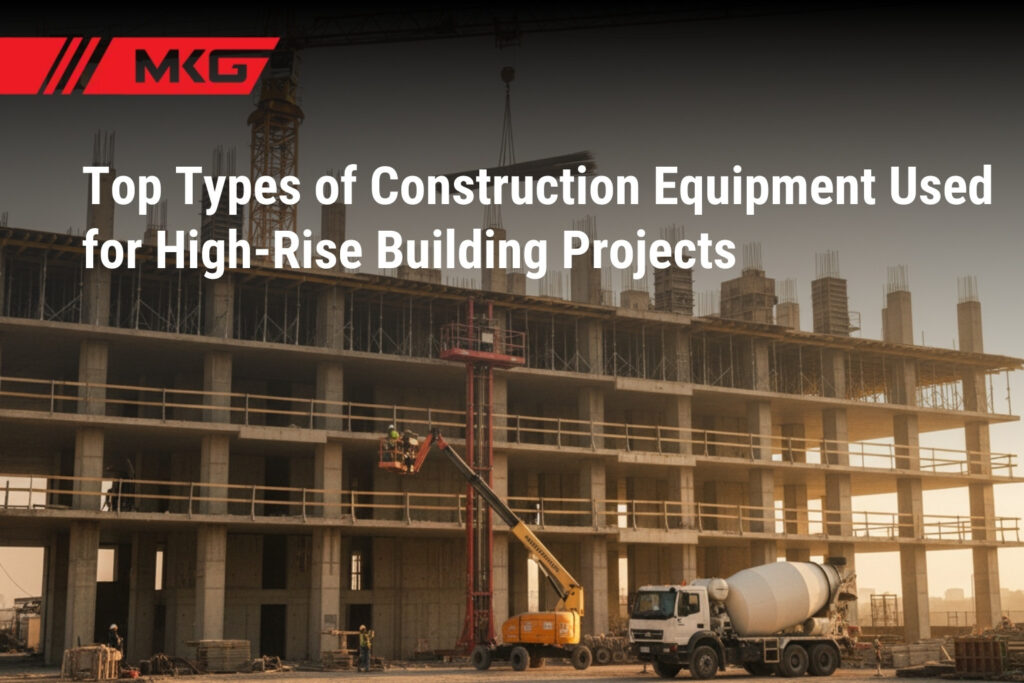
Building a high-rise is not just about stacking floors – it’s a complex engineering challenge that demands precision, safety, and the right machinery. As buildings grow taller, the equipment used onsite needs to be stronger, faster, and more reliable. At MKG, we see this every day while supplying hoisting and lifting solutions across India’s top construction sites.
In this guide, we break down the most commonly used construction equipment for high-rise structures, combining industry insights, competitor research, and real-world experience. You’ll learn what each machine does, why it matters, and how MKG solutions fit into modern high-rise construction.
Why Choosing the Right Construction Equipment Matters
Before we go into the list, here’s the simple truth: Your machines decide your project’s speed, safety, and cost-efficiency.
High-rise projects face challenges such as:
- Moving heavy loads vertically
- Ensuring worker safety at extreme heights
- Maintaining speed without risking structural integrity
- Managing limited space in dense cities
- Avoiding breakdowns that can halt the entire project
Top Construction Equipment Used in High-Rise Building Projects
1. Tower Cranes
Tower cranes are the backbone of any high-rise site. These massive machines handle heavy lifting: steel bars, formwork, concrete buckets, and mechanical equipment.
Why they’re essential:
- They reach incredible heights
- They lift materials precisely where needed
- They manage loads over long horizontal distances
2. Passenger Hoists (MKG Passenger Hoist)
Passenger hoists are a must-have for transporting workers safely to different floors. At MKG, our Passenger Hoist range is engineered for Indian site conditions – reliable, robust, and easy to maintain.
Why they matter:
- Save time during worker movement
- Reduce fatigue on labour
- Improve site safety
- Boost productivity during peak working hours
3. Material Hoists (MKG Material Hoist)
Material hoists are responsible for moving construction materials such as cement bags, bricks, tiles, tools, and reinforcement bars from one level to another.
Why they’re critical:
- Can handle heavy loads without risk
- Faster than traditional pulley methods
- Essential for high-rise vertical logistics
High-rise sites depend on efficient vertical transportation. Without reliable hoists, delays become inevitable.
4. Tower Hoists (MKG Tower Hoist)
Tower hoists are widely used for lifting concrete and other materials vertically. They offer excellent lifting speed and height variation options.
Why contractors love tower hoists:
- Ideal for RCC casting
- Can lift heavy concrete loads
- Easy to set up on congested sites
Concrete loses workability over time (due to hydration). Faster lifting preserves the mix consistency – which tower hoists help achieve.
5. Concrete Pumps
To cast floors at height, concrete must reach upper floors smoothly. Concrete pumps, especially boom pumps, push concrete through pipelines directly to the casting area.
Why they’re important:
- Reduce manual labour
- Faster casting cycles
- Reach heights that traditional methods cannot
6. Excavators
Before building up, every high-rise must dig down for foundations, basements, and utility tunnels.
Excavators handle:
- Soil removal
- Foundation digging
- Demolition in congested areas
- Earthmoving
7. Concrete Mixers
Proper mixing ensures the right concrete strength. On high-rise sites, concrete mixers (transit mixers and self-loading mixers) ensure consistency.
Why they’re used everywhere:
- Uniform mixing improves RCC durability
- Saves time compared to manual mixing
- Supports rapid construction cycles
8. Safety & Access Platforms
High-rise safety requirements are strict, so mobile elevated platforms (MEWPs), boom lifts, and Rope Suspended Platforms help workers perform tasks safely at height.
Used for:
- Glass installation
- Painting
- Exterior cladding
- Façade inspection
9. Concrete Vibrators
After pouring concrete, air pockets must be eliminated to achieve proper compaction. Concrete vibrators ensure structural strength.
Why they matter for skyscrapers:
- Air pockets weaken columns and beams
- Vibrators ensure RCC integrity
- Prevents honeycombing in high-rise slabs
10. Bar Bending Machines & Bar Cutting Machines
Reinforcement work never stops on a high-rise project. Every column, beam, and slab depends on steel bars shaped exactly as the structural drawings require. This is where bar-bending machines and bar-cutting machines play a crucial role.
Why they’re essential:
- Provide perfect bends as per design
- Improve speed of steelwork
- Reduce manpower errorsa
How to Choose the Right Equipment for a High-Rise Project
Here’s a practical, layman-friendly checklist:
1. Check your building height
Machines must match the required vertical reach.
2. Estimate daily material movement
Higher floor heights require stronger hoists and cranes.
3. Consider the site space
Urban areas require compact equipment like tower hoists.
4. Evaluate safety requirements
Ensure machines meet India’s safety norms (IS codes).
5. Look for reliability & easy maintenance
Downtime is the biggest enemy of high-rise progress.
6. Choose equipment supported by service teams
This is where MKG shines – quick service support across India.
Conclusion
High-rise construction demands equipment that doesn’t just perform – it must stay consistent, safe, and reliable every single day. That’s exactly what we focus on at MKG. Our Passenger Hoists, Material Hoists, and Tower Hoists are engineered to handle the tough, unpredictable realities of Indian job sites, from continuous lifting cycles to heavy loads and challenging weather.
Every MKG machine is built with long-term durability in mind. Whether it’s dust, rain, concrete work, or 12-hour shifts, our equipment is tested to deliver stable vertical movement without compromising safety. And with our dedicated service team supporting installations, maintenance, and genuine spare parts, your high-rise project stays on schedule without unexpected downtime.
With proper setup and routine inspections, an MKG hoist can operate smoothly for decades – giving contractors complete peace of mind and dependable performance floor after floor.
If you’re planning a building project and need the right equipment for faster, safer vertical movement, we’re here to guide you.
Reach out to the MKG technical team for recommendations or to request a site visit.
Email:info@mkgworld.in
Call:+91 95222 39320
Let’s build taller, stronger, and smarter – with MKG lifting your project every step of the way.
Frequently Asked Questions
1. What makes equipment selection different for high-rise buildings compared to low-rise projects?
High-rise projects involve greater vertical movement, heavier loads, and tighter safety rules. This means the equipment must be capable of working at higher elevations, handle continuous lifting cycles, and operate safely in limited space. Low-rise projects don’t deal with this level of height-related complexity.
2. How does equipment quality impact the timeline of a high-rise project?
Good-quality machines reduce breakdowns, which is one of the biggest causes of delays in tall-building construction. When your hoists, cranes, and pumps run smoothly, contractors can maintain steady casting cycles and avoid workforce idle time – ultimately finishing the project sooner.
3. Are rental machines reliable enough for high-rise construction?
Rentals can be cost-effective, but reliability depends on the supplier. For high-rise work, contractors should look for machines that come with proper service records, on-site support, and certified safety checks. Poorly maintained rental equipment can slow down entire construction floors.
4. What safety checks are important before using lifting equipment on tall buildings?
Before using any lifting machine – hoist, crane, tower hoist – teams should verify load limits, check wire ropes, inspect brakes, examine electrical systems, and ensure all safety gates and limit switches work properly. These checks are usually quick, but they prevent serious height-related accidents.
5. How does weather affect construction equipment on high-rise sites?
Rain, high winds, and extreme heat can impact machine performance. For example, hoists may need wind-speed monitoring, and cranes typically stop operations beyond certain wind limits. Heat can affect motor efficiency, while rain increases the risk of electrical faults. Planning around the weather keeps work smooth and safe.