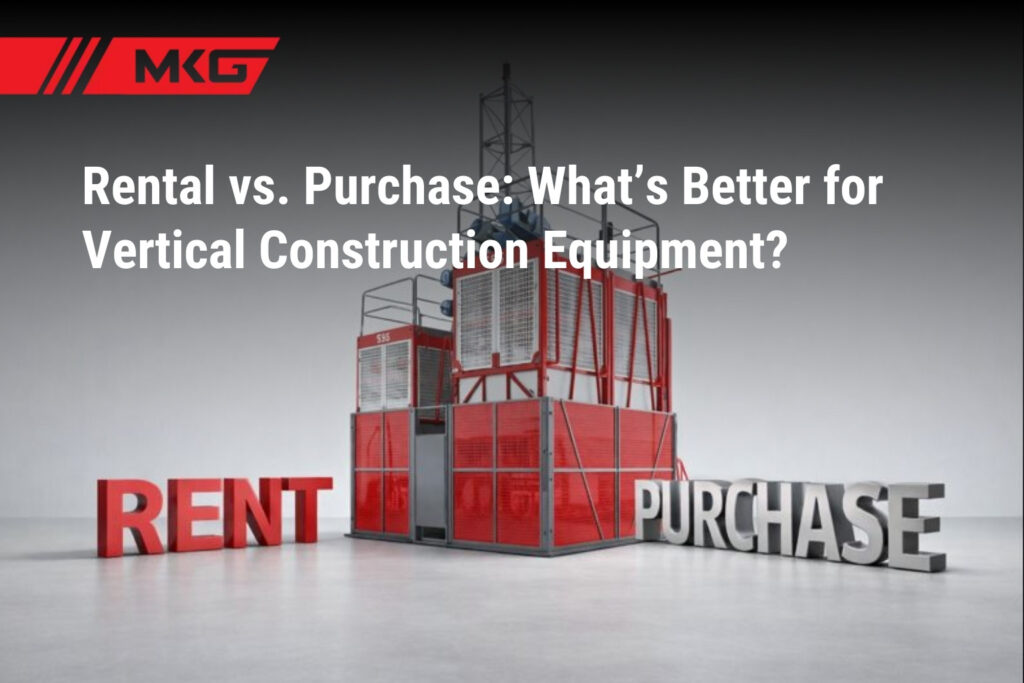
Vertical construction is booming across India. From residential towers in Mumbai to sprawling commercial complexes in Hyderabad, builders are racing upwards. When you’re managing a high‑rise project, the equipment that lifts people and materials becomes your lifeline. Whether you’re looking at passenger hoists, builder towers, or other specialized lifting machines, the big question remains: should you rent or buy? In this guide, we’ll explore both options, using industry research and our own experience at MKG to help you make an informed decision.
Understanding vertical construction equipment
Vertical construction is booming across India. From residential towers in Mumbai to sprawling commercial complexes in Hyderabad, builders are racing upwards. When you’re managing a high‑rise project, the equipment that lifts people and materials becomes your lifeline. Whether you’re looking at passenger hoists, builder towers, or other specialized lifting machines, the big question remains: should you rent or buy? In this guide, we’ll explore both options, using industry research and our own experience at MKG to help you make an informed decision.
Why contractors choose to rent
No large upfront cost
Rental eliminates the need for a significant capital investment. According to AIS Equipment, renting lets you avoid paying the entire purchase price and instead pay only for the duration of use. This is ideal for short‑term projects or when specialized equipment is needed only occasionally. For vertical equipment such as hoists, renting allows smaller contractors to access advanced machines like Vimaan without tying up cash.
Maintenance and repairs are handled for you
When you rent, the rental company is responsible for maintenance and repair. AIS notes that rental firms typically handle servicing, which reduces downtime and ensures reliable performance. This is particularly valuable for vertical equipment, where unexpected breakdowns can halt construction. With our MKG Rental Business, you get fully maintained hoists so your teams can work without worries.
Access to the latest technology
Renting gives you access to cutting‑edge equipment without committing to a long‑term purchase. The same AIS article points out that rentals allow access to the latest models, while Plan Academy highlights that renting can provide information for calculating payback periods and helps you evaluate newer models. If you want to test a passenger hoist with features like Variable Frequency Drive (VFD) and fail‑safe mechanisms, renting a Vimaan unit first could be a smart move.
Tax and cash‑flow benefits
Rental expenses can be deducted as business expenses, reducing tax liability. Carolina Cat’s blog notes that renting turns a large, risky investment into a predictable short‑term operational cost and preserves cash flow for other priorities. This can be especially beneficial if your project pipeline is unpredictable or you need to allocate capital to labour or materials.
Flexibility and scalability
Renting allows you to match the equipment to each job and switch machines when project needs change. Carolina’s article emphasises that rentals offer flexibility to get the right machine and avoid sharing equipment across multiple sites. You can return the equipment once the project is finished and scale up for peak workloads. For vertical equipment, this means adding extra hoists during busy phases and returning them when work slows, ensuring optimal efficiency.
Trial before purchase
Renting gives you the opportunity to test equipment before committing to a purchase. Both Carolina and Machinery Partner highlight that renting allows you to evaluate whether a machine fits your business. If you’re considering buying a Vimaan hoist, you can rent one first to assess its performance under your site conditions and decide whether it meets your long‑term needs.
Drawbacks of renting
Potentially higher long‑term cost
While renting offers short‑term savings, it can be more expensive over the long run. ToolSense adds that renting is better suited for short‑term use and may cost more than buying outright. If you rent a hoist for months on end, the cumulative rental fees may exceed the purchase price.
No ownership or resale value
Renters don’t build equity. Once the rental period ends, there’s no asset to sell, and you miss out on any residual value. Ownership allows you to recoup part of your investment by selling the equipment later, whereas renting leaves you with no asset on your balance sheet.
Limited availability and customization
Rental markets can be competitive. High demand may delay your project if the needed equipment isn’t available. Renting also means you can’t customise the equipment to your unique needs. When you own a hoist, you can personalize the cage, add safety features, or brand it with your company colours. For specialized high‑rise projects, this flexibility can be important.
No control over upgrades and maintenance schedules
Although rental companies handle maintenance, you have little control over when the equipment is serviced or upgraded. If a crucial part fails mid‑project, you must wait for the rental provider to repair or replace it. On the other hand, owning allows you to schedule maintenance around your project timeline and upgrade components as needed.
Why purchasing can be attractive
Asset ownership and long‑term savings
Owning equipment becomes cost‑effective when you use it frequently. Multiple sources suggest a utilization threshold: Plan Academy and other experts say that if a tool is used more than 65% of the time, buying may be the better option. Buying lowers operating costs over time and eliminates rental availability issues. With vertical equipment, if you are continuously running hoists for multiple projects, ownership spreads the cost across years of use.
Full control and immediate availability
Ownership means the equipment is always on hand and ready to use. Purchased equipment offers 24/7 access and lets you dictate how and when it’s used. There’s no need to schedule around rental contracts. For projects with tight deadlines, having your own Vimaan hoist eliminates the risk of equipment shortages during busy seasons.
Lower operating costs and potential resale value
Buying is typically cheaper over the long term if you utilise the equipment regularly. Rental costs can be triple the purchase cost over time. Additionally, you can sell the equipment later and recoup some of your investment. Owning also allows you to rent out your hoist when it’s not in use, generating additional revenue.
Tax benefits and financing options
Purchasing equipment offers tax advantages. Under IRS Section 179, businesses can deduct a large portion of equipment costs. Similar provisions exist under India’s tax laws. Depreciation deductions reduce taxable income over the life of the asset. Financing options can make buying more accessible.
Customization and branding
Ownership allows you to tailor the equipment to your brand or project requirements. Carolina notes that buying gives you the option to modify the machine. You can customize cabin interiors, add communication systems, or apply company branding. For example, customizing a Vimaan cabin with your logo turns the hoist into a moving advertisement on the job site.
Challenges of purchasing
High upfront capital
Buying requires significant capital or financing. This can strain cash flow and limit your ability to invest in other areas, especially if you’re a smaller contractor. ToolSense explains that purchasing is not an option for everyone due to the initial cost.
Maintenance, storage and depreciation
When you own equipment, you’re responsible for maintenance, repairs, and storage. You must budget for regular inspections, replacement parts, and downtime if the machine fails. Carolina emphasises that storage and transportation costs come with ownership【759607748917478†L172-L266】, and BuildWitt reminds us that equipment depreciates over time. If you don’t keep the equipment busy, depreciation can erode your return on investment.
Risk of obsolescence
Technology evolves quickly. ToolSense warns that high‑tech equipment can become obsolete, forcing you to purchase new machines sooner than expected. Renting ensures you always have access to the latest features without worrying about resale value.
Key factors to consider
Frequency and duration of use
Evaluate how often you need the equipment. Conexpo suggests that if a machine is used more than 60–70% of the year, buying makes senseconexpoconagg.com. Plan Academy recommends buying when a tool is required for 22 consecutive days or 176 hours over more than eight months. For vertical equipment, if you have a steady pipeline of high‑rise projects, purchasing may be more cost‑effective. If your projects are sporadic or seasonal, renting is likely cheaper.
Project timelines and cash flow
Short projects with limited budgets favour renting. Rental preserves cash flow and avoids large expenditures during inflationary periods. However, if you have secure cash flow and a long‑term need for the equipment, purchasing may provide better value.
Total cost of ownership vs. rental cost
Compare the total cost of ownership (purchase price, financing interest, maintenance, storage, insurance, taxes) to the projected rental cost over the same period. projecting rental costs for a year and weighing them against purchase costs. BuildWitt illustrates how to calculate monthly amortized payments versus rental rates. Using a simple spreadsheet can help you compare these numbers. Keep in mind that the cost of downtime if your owned machine isn’t busy can erase the savings of ownership.
Technology and market changes
If your projects require the latest technology, renting ensures you have access to modern equipment. Renting provides cutting‑edge machines without being stuck with outdated models. Conversely, if the basic technology of hoists remains stable, buying may be safer because your machine won’t become obsolete quickly.
Availability and logistical considerations
Consider whether rental equipment is readily available in your area and if you have adequate storage. During peak construction seasons, rentals may be scarce. Owning equipment guarantees availability but requires secure storage and transportation resources. Evaluate your site conditions and logistics before making a decision.
Future resale and secondary revenue
If you purchase a hoist, think about its resale value and whether you can rent it out when it’s idle. Machinery Partner notes that you can rent your equipment to others to recoup costs. In markets where demand for hoists is high, owning may provide a secondary income stream. Ensure you have the capacity to manage rentals responsibly.
MKG’s Perspective: Why Not Both?
At MKG, we know every project has different demands. That’s why we offer both purchase and rental options for vertical construction equipment. Our Vimaan passenger hoist is built for safety and efficiency, featuring a rack-and-pinion system, variable speed control (20–60 m/min), and advanced safety devices. Available in 1-ton, 1.5-ton, and 2-ton capacities, it suits both residential and commercial high-rise projects. You can add it permanently to your fleet or rent it for a specific site.
The same flexibility applies to our builder tower hoists. With 500 kg (TH-60) and 1,000 kg (TH-200) capacities and lifting heights up to 200 ft, they’re designed for safe and reliable bulk material handling. Features like a brake motor offer better control, while our Material Hoist Installation Guide helps ensure proper setup and safe operation.
Our Rental Business provides fully serviced hoists and mixers for short- or long-term use. Since we manufacture and maintain the equipment ourselves, you get consistent quality, minimal downtime, and quick replacements if required. And if you later decide to own the machine, our buy-back and recon options make it easy to transition from renting to ownership.
Conclusion
Deciding whether to rent or purchase vertical construction equipment isn’t just a financial choice – it’s a strategic one. The right decision depends on how long the equipment is needed, the scale of the project, site conditions, and long-term business goals. There’s no one-size-fits-all answer, and that’s exactly why flexibility matters.
Renting works best for short-term projects, fluctuating workloads, or when you want to avoid upfront costs and maintenance responsibilities. Purchasing, on the other hand, makes sense for long-term projects, frequent equipment use, and teams looking for full control, availability, and asset value over time.
At MKG, we support both paths. From rental-ready hoists to ownership-focused solutions with buy-back and recon options, our equipment is designed to adapt to real construction needs. Whether you rent, buy, or transition between the two, our focus remains the same – safe operations, reliable performance, and uninterrupted project progress.
Choosing MKG means choosing flexibility, confidence, and long-term value at every stage of construction.
Let’s build smarter, safer construction sites – together.
Talk to MKG’s technical experts today to decide whether renting or purchasing is the right move for your next project.
📧 Email:info@mkgworld.in
📞 Call:+91 95222 39320
MKG | Built for safety. Built for the future.