Construction sites are bustling environments. Workers move up and down floors carrying tools, materials and sometimes their own fatigue. As high‑rise projects become the norm in cities like Mumbai, Bengaluru and Delhi, vertical transportation has gone from being an occasional convenience to a daily necessity. Temporary passenger hoists – those rack‑and‑pinion elevators you see climbing tower slabs – are the unsung heroes that keep sites on schedule.
At MKG, we’ve spent decades designing and manufacturing passenger hoists for the Indian construction landscape. We know that a reliable hoist doesn’t just save time; it protects lives and livelihoods. In this article, we’ll break down the safety features you should never ignore in a passenger hoist and explain why each one matters. This isn’t a technical lecture – it’s a practical guide written in plain language, backed by industry standards and our own experience.
Why safety matters on a construction hoist
Before getting into the features, it’s important to understand what’s at stake. When a hoist lifts a fully loaded cage, gravity is always working against it. If a critical component fails – maybe the motor stops or a cable snaps – the cage can accelerate downward. Without protective systems, workers and materials could free‑fall, leading to injuries, delays and legal trouble.
Overspeed accidents are particularly dangerous. An overspeed governor on an elevator or hoist monitors how fast the cage is moving. If it goes faster than the safe limit, the governor triggers the brakes to stop the cage. This device isn’t part of normal operations; it sits quietly until something goes wrong. When it does, it can be the difference between a scary moment and a catastrophe. Safety isn’t just about preventing accidents – it’s about having layers of protection when the unexpected happens.
1. Overspeed governor and emergency brakes
What it does: An overspeed governor is a safety device that detects if the hoist car is moving faster than its designated safe speed. When it senses an overspeed condition, it activates the emergency brakes to stop or slow the cage. In simple terms, think of the governor as the hoist’s “speed policeman.” It constantly measures the cage’s velocity using a pulley and wire‑rope system. If the cage races down too quickly, centrifugal force pushes weights inside the governor outward. This movement triggers a lever or switch that tells the brake system to clamp onto the guide rails, bringing the cage to a controlled stop.
Why it matters: Without an overspeed governor, a hoist could free‑fall if a mechanical failure occurs. The governor ensures that a runaway cage stops before anyone gets hurt. In fact, international standards like EN 81 and ASME A17.1 require overspeed governors on most elevators and hoists. At MKG we use reliable, regularly tested overspeed devices in our Vimaan passenger hoists so that even if a gearbox fails or a control error occurs, the cage will never plummet uncontrolled.
Practical takeaway: Always check that your hoist has a working overspeed governor and emergency brakes. During daily pre‑use inspections, run the empty cage through a test cycle and listen for smooth braking. If you hear grinding, jerky stops or excessive drift when releasing the control button, it could signal brake or alignment problems – issues that should be addressed immediately.
2. Limit switches - your invisible boundaries
What they do: Limit switches are small sensors or mechanical devices that tell the hoist when to stop. There are several types:
- Door interlock switches ensure that the cage and landing gates are fully closed before the hoist can move. If any gate is open, the circuit remains open and the hoist won’t run.
- Travel limit switches define the upper and lower stopping points of the cage. When the cage approaches a landing, a striker plate hits the switch and signals the hoist to slow down and stop.
- Rack‑searching switches (sometimes called rack alignment or dead‑mast switches) detect misalignment between the cage pinion and the mast rack. If the teeth slip out of alignment, the switch cuts power to prevent gear damage.
Why they matter: Limit switches are the hoist’s sense of direction. Without them, the cage could overrun the top or slam into the buffer springs at the bottom. After you press a travel command, only the green indicator should light. Any other light means a limit switch or safety circuit needs attention.
Door interlocks also protect people standing nearby. If someone forces a gate open while the cage is moving, the interlock will disengage the drive and stop the hoist. This isn’t just convenience; it’s a regulatory requirement under standards like IS 12466 in India and EN 81 in Europe.
Our Vimaan hoists use limit switches on every door and travel point, plus a rack‑searching switch. We also include upper and lower ultimate limit switches that stop the hoist if it travels beyond its normal range. These devices are tested daily during pre‑use checks: open and close every gate, run the cage to top and bottom and confirm the switches cut power when they should.
3. Load limit devices and safe working load indicators
What they do: Load limit devices measure how much weight is inside the hoist cage. They use load cells or pressure sensors to compare the actual load to the rated safe working load. If the cage is overloaded, the system triggers an alarm or prevents the hoist from operating.
In the Scottish Hoist Safety manual, the platform has an overload warning device that prevents the hoist from moving when it is overloaded. A red control light inside the platform illuminates when the platform is overloaded. The same light also warns operators if one of the landing gates is open or if the emergency stop button has been pressed.
Why it matters: Overloading is one of the leading causes of hoist accidents. Exceeding the rated capacity strains the rack‑and‑pinion gears, brakes and mast ties. It can cause sudden drops or structural failures. When weights are unevenly distributed, the cage tilts and rollers wear unevenly. The hoist safety document reminds operators to spread loads evenly from the centre outwards and never allow items to protrude from the sides. It even gives a table of safe working loads (SWL) based on the number of persons plus materials.
We design our hoists with Safe Load Indicators (SLI) that continuously monitor the cage weight. If the load exceeds the limit, the hoist will refuse to move and the operator will see a warning. This not only prevents mechanical failures but also enforces site discipline. Load indicators must be tested regularly; during our commissioning, we calibrate them using certified weights to ensure accuracy.
4. Interlocking doors and gate systems
What they do: Gates and door interlocks ensure that the hoist cage cannot travel unless all gates (at landings and on the cage) are closed and latched. They also prevent gates from being opened when the cage is not at the landing level.
The hoist safety manual shows that the loading and unloading gates must remain closed during movement. If a gate is not closed, the red overload light may also illuminate, indicating a safety circuit is open.
Why it matters: Gate interlocks are crucial because they prevent falls and keep materials secure. Imagine a worker leaning out to grab a tool; if the cage suddenly moves, they could lose balance. Interlocks also ensure that passersby on the ground can’t accidentally step into an open shaft. Without them, the risk of injury or entrapment increases dramatically.
On Vimaan hoists, we use limit switches and mechanical locks on every gate. The cage cannot leave a landing until all gates are closed and latched. The locks are robust enough to handle daily use in dusty, humid job‑site conditions. We also provide self‑closing gates to reduce the chance of human error.
5. Emergency stop buttons and manual brake release
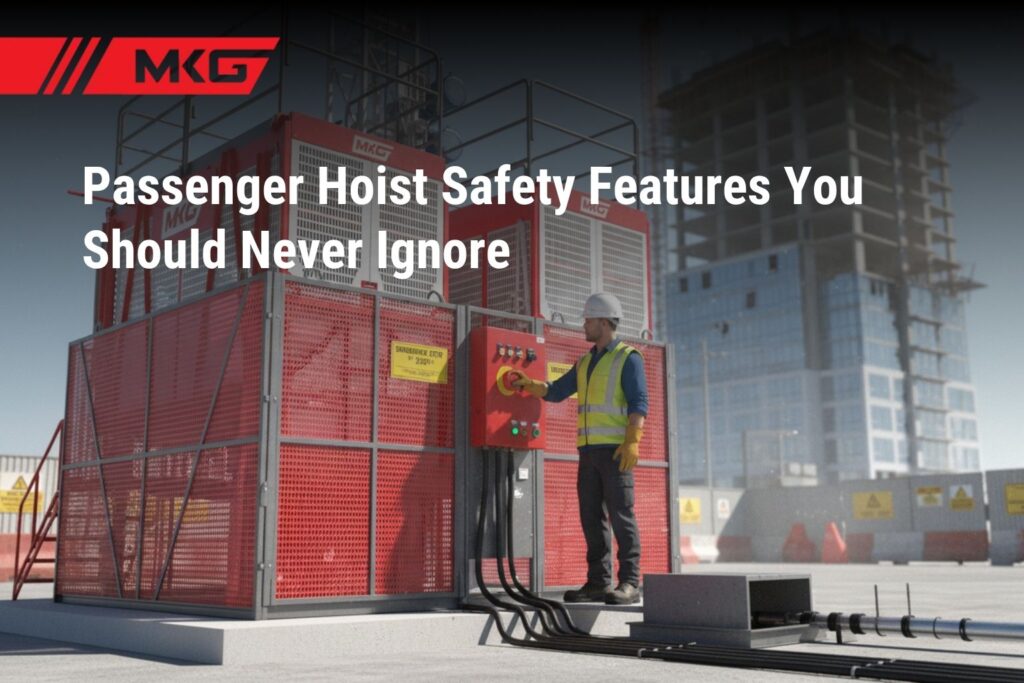
What they do: An emergency stop (E‑stop) button allows anyone inside the cage or standing at a landing to immediately cut power to the hoist and apply the brakes. Once pressed, the button must be reset manually before the hoist can move again.
In the Scottish Hoist Safety manual, pressing the Emergency Stop button instantly stops the platform. To release it, the operator must turn it to the right and pull. This design prevents accidental resets. The manual also instructs users to hold the up or down button only while moving and to release it once the cage reaches the desired level.
Why it matters: Emergencies happen without warning. A stray object might get jammed in the rack, a gust of high wind may shake the mast or a worker might feel unwell. The E‑stop is the fastest way to halt motion and prevent further danger. Without a working E‑stop, there’s no quick way to arrest a malfunction.
Every Vimaan hoist cage has a prominent red Emergency Stop button near the control panel, and we install additional E‑stops at ground level and key landings. We also include a manual brake release system so trained technicians can lower the cage safely in the rare event of a power failure. This ensures that even if the hoist loses electrical power, workers won’t be stranded at height.
6. Buffer springs and dead mast
What they do: Buffer springs at the base of the mast act as shock absorbers. If the cage reaches the bottom unexpectedly, the springs compress and cushion the impact. A dead mast with a half rack is installed at the top above the highest landing. Its purpose is to hold the pinion away from the rack, ensuring that even if the cage over‑travels upward, there’s no rack to engage, and the cage will not climb further.
Why they matter: These mechanical features protect both the hoist and its occupants from rough landings and over‑travel accidents. Buffer springs absorb energy and prevent damage to the platform and base structure. Dead masts eliminate the risk of the pinion running off the rack and causing uncontrolled movement.
7. Variable Frequency Drive (VFD) and smooth travel
What it does: A Variable Frequency Drive controls how quickly the hoist accelerates and decelerates by adjusting the motor’s electrical frequency. This results in smooth starts and stops instead of sudden jerks.
Why it matters: Jerky movements put extra stress on gears, motors and brake components. They also jolt passengers, increasing fatigue and risk of slips. VFDs allow the hoist to ramp up gradually and slow down gently. This reduces wear and tear and gives operators finer control over positioning.
We equip our hoists with advanced safety devices and VFD‑driven motors for secure stops and smooth travel. In our Vimaan hoists, the VFD works in tandem with the load sensor and overspeed governor to maintain optimal speed. This not only extends the life of mechanical parts but also provides a comfortable ride for workers who might be carrying tools or materials.
8. Ground enclosure with hooter and site alerts
What it does: A ground enclosure is a fenced area around the base of the hoist that prevents unauthorized access. A hooter (alarm) sounds whenever the hoist is moving or when a fault is detected.
Why it matters: Keeping unauthorized people away from the hoist base reduces the chance of accidents. Construction sites are busy, and curious workers or bystanders might inadvertently walk into the hoist’s travel path. The hooter provides an audible warning that the cage is moving, so workers can stay clear.
We supply ground enclosures with hooters as part of our hoist package. The enclosure is tall enough to prevent climbing and designed with mesh so supervisors can see inside. The hooter is loud enough to be heard over typical site noise but not so loud that it causes discomfort. We also recommend displaying signage to remind everyone of safe working loads, proper loading techniques and emergency procedures.
9. Manual rescue and training procedures
Safety features are only as effective as the people using them. The hoist safety manual emphasises that operators must acquaint themselves with the way the machine works, the operating controls and the safety equipment. It also notes that safety equipment must never be removed or tampered with and must be inspected regularly
At MKG, we encourage our customers to train operators through accredited programmes and to conduct daily pre‑use checks. Regular drills on how to use the emergency stop, manual brake release and rescue procedures can save precious seconds in an emergency.
Rescue kits: We offer optional rescue kits that include harnesses, ropes and instruction manuals. In the rare event that a hoist becomes stuck between floors and cannot be lowered through normal means, trained personnel can safely evacuate the cage.
10. Compliance with standards and regular inspection
Choosing the right passanger and material hoist from a reputable manufacturer is just the start. Compliance with national and international standards ensures the equipment meets minimum safety requirements. In India, IS 12466 governs passenger and material hoists. It covers design, construction, safety devices and inspection procedures. The National Building Code (NBC 2016) sets additional fire and emergency requirements for high‑rise structures. Globally, standards like EN 81 and ASME A17.1 specify overspeed governors, limit switches and other safety devices.
The hoist safety manual advises that safety and emergency equipment may neither be removed nor altered and must be inspected at regular intervals. It also states that if faults occur outside your area of responsibility, inform your superior immediately. This highlights the importance of accountability – everyone on site has a role in maintaining safety.
We ensure that our Vimaan Passanger and Material hoists are certified according to the latest BIS standards and are tested with third‑party inspectors before delivery. We provide operation manuals and maintenance schedules. For our rental and sale customers, we offer preventive maintenance programmes, periodic safety audits and refresher training.
Practical tips for safe hoist use
- Inspect daily: Before each shift, check for cracks, loose bolts, rust, or damaged cables. Test the door interlocks, emergency stop and limit switches. A quick 10‑minute inspection can catch 80 % of problems before they become serious.
- Clean regularly: Dust, cement splatter and rain can shorten a hoist’s life. Wipe down the cage and controls daily. Clean mast sections and rollers weekly. Lubricate moving parts with the manufacturer’s recommended lubricant.
- Observe weather conditions: Avoid operating the hoist during storms or high winds. Moisture can corrode parts and high winds can destabilise the cage. Follow manufacturer guidelines for wind speed limits.
- Communicate: Use clear hand signals or radios between the operator, ground crew and workers entering the cage. Miscommunication is a common cause of accidents.
- Never bypass safety devices: Do not tape down limit switches or disable alarms to save time. These devices exist to protect you and your colleagues. The hoist safety manual warns that safety equipment must never be removed, altered or made ineffective.
Conclusion
At MKG, we believe safety isn’t just a feature – it’s a promise we build into every hoist. Our passenger hoists are engineered, manufactured, and serviced in India, meeting international safety standards while perfectly suited for Indian site conditions.
From metro projects to high-rise constructions, our MKG Vimaan Passenger and Material Hoists are built to handle dust, heat, rain, and continuous heavy usage – day after day. And we don’t stop at installation. Our expert service team supports you with preventive maintenance, safety inspections, and genuine MKG spare parts, so your hoist continues to perform safely and efficiently for years.
A well-maintained passenger hoist can easily serve your site for 20–30 years, ensuring a reliable return on investment and most importantly – peace of mind.
Talk to MKG’s safety experts today to schedule your next inspection or get guidance on proper maintenance practices.
Email: info@mkgworld.in
Call:+91 9522239320 – Let’s make your construction sites safer, faster, and smarter with MKG hoists.
Frequently Asked Questions
1. How often should a passenger hoist undergo a full safety inspection?
Ideally, passenger hoists should be inspected every 3 to 6 months depending on usage intensity and site conditions. Frequent checks help identify early wear in brakes, gearboxes, and limit switches. At MKG, we recommend routine inspections before every major project phase – it’s simpler, cheaper, and safer than dealing with unexpected downtime.
2. What’s the difference between daily checks and annual hoist servicing?
Daily checks ensure that basic functions like brakes, doors, and control systems are working before operation. Annual servicing, on the other hand, involves deep maintenance – recalibrating sensors, testing overload cut-offs, and lubricating mechanical parts. Both are essential: one prevents small issues, the other prevents major failures.
3. Can overloading a hoist really cause long-term damage?
Yes – overloading stresses the rack-and-pinion system, reduces gearbox lifespan, and increases motor heat generation. Scientifically, it accelerates metal fatigue and increases the chance of mechanical failure. Using a load indicator or adhering to MKG’s rated capacity guidelines ensures safer, longer-lasting operation.
4. How can operators improve safety beyond built-in features?
Even the best hoist features can’t replace trained operators. Conducting short toolbox talks, enforcing PPE usage, and following proper start/stop sequences significantly reduce accidents. At MKG, we also advise keeping a logbook of daily checks – small habits that build a strong safety culture on-site.
5. Why choose an Indian-made hoist like MKG’s for your project?
MKG hoists are built specifically for Indian construction environments – they can handle dust, humidity, uneven power supply, and long operational hours without frequent breakdowns. Plus, spare parts and service support are available locally, ensuring minimal downtime and maximum reliability.