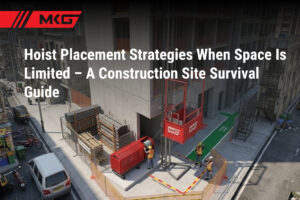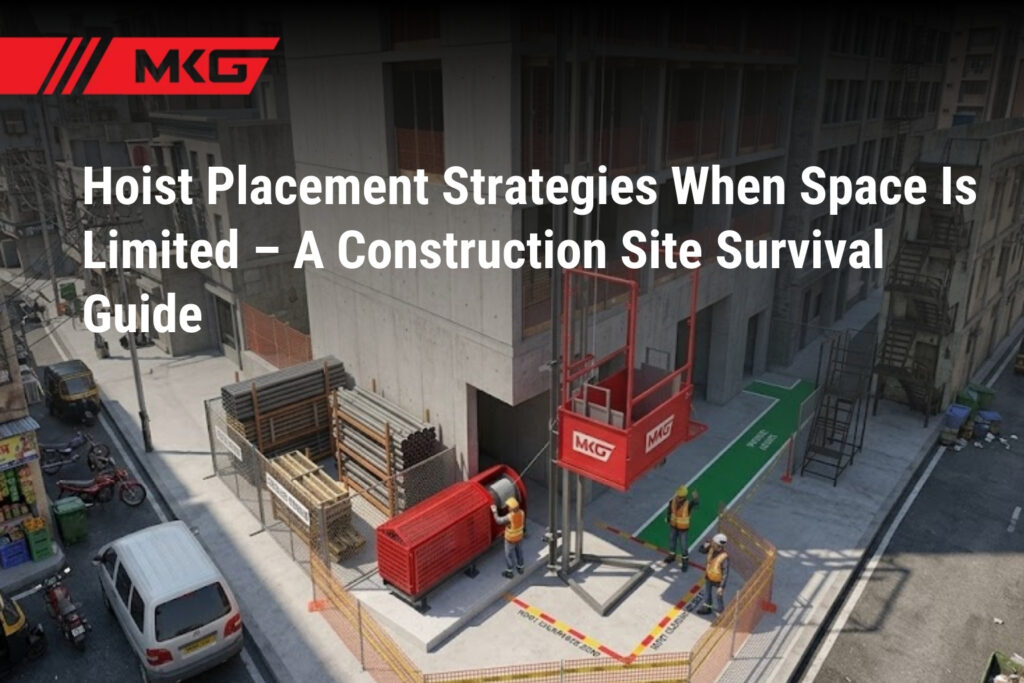
In India’s fast‑growing cities, construction sites are squeezed into ever‑smaller footprints. Skyscrapers in Mumbai or Bengaluru might share walls with existing buildings, leaving little ground space for materials or machinery. As engineers and project managers, we often find ourselves juggling cranes, scaffolding and deliveries in a space the size of a parking lot. How do we keep people and materials moving safely in such tight quarters? An efficient hoist setup is the answer. In this guide we share practical strategies for positioning hoists when space is limited and explain how MKG’s vertical‑lifting solutions make it easy.
When space is restricted, vertical transport becomes the backbone of the project – something we discussed in detail while covering challenges in high-rise construction
Why space matters in hoist selection and placement
Urban construction sites come with strict spatial constraints. United Hoist points out that smaller‑scale projects benefit from compact hoists with lower load capacity because they’re easier to install in cramped areas. Beyond the machine itself, our job is to plan the entire lifting area so materials flow without creating bottlenecks.
MKG tip: Before choosing a hoist, walk the site with a measuring tape, Mark out the hoist’s base dimensions and the turning radius for delivery trucks. If your ground space is less than 3×3 metres, a full‑size tower crane won’t fit. This simple check saves headaches later.
Sometimes a hoist is better than a crane in tight projects – see crane vs construction hoist comparison
Making the most of vertical space
When ground space is scarce, the only way is up. Material hoists can use up to 80 % less ground footprint than cranes and fit easily within building cores or narrow lots. This vertical orientation means the hoist’s mast hugs the structure and leaves your site clear for other trades. Even on small projects, a vertical lift creates a safe “fire‑escape” route for materials and reduces manual carrying.
To maximize vertical space:
- Pick the right type: Ladder and mini‑electric hoists are ideal for low‑rise or interior projects. Ladder hoists are lightweight, portable and fit through tight access spaces. Mini electric hoists offer a low profile yet can handle heavy loads, making them perfect for workshops or sites with low ceilings.
- Use common tower hoists for multiple cabins: On busy sites with limited footprint, common tower systems allow two or more cages to share a single mast. This gives you more lifting capacity without increasing the footprint.
- Opt for single‑cage hoists in very tight spots: Single‑cage hoists occupy less space than twin systems and suit low‑rise or small projects. Save dual‑cage hoists for high‑density sites where traffic is intense.
Consider combination (passenger + material) hoists: For congested urban sites a dual‑purpose hoist saves footprint and handles workers and materials on the same mast. Our Vimaan series offers this flexibility with load options of 1 – 2 tonnes and travel speeds up to 60 m/min.
Plan your hoist location carefully
Before deciding placement, selecting the correct machine matters – here’s how to choose the right hoist for a construction project
A great hoist is only as good as its placement. USPro‑corporations’ guide on compact goods hoists advises locating the hoist where cargo movement is unhindered and operators have easy access. That means clear paths to move pallets from the delivery zone to the hoist bucket without sharp corners or scaffolding in the way. Centenary Hire echoes this advice: pre‑plan your site layout, clear pathways and select equipment that can navigate narrow spaces. Here’s how we approach placement at MKG:
- Assess the foundation: A stable base keeps the hoist upright and safe. Our material‑hoist installation guide stresses verifying that the foundation meets the engineer’s design and has reached the required concrete strength. Weak soil? Cast a concrete slab or use steel plates to distribute the load.
- Allow room for assembly: Even a compact hoist needs space to assemble its mast. Ensure trucks delivering components can access the hoist location and there’s enough room around the base for workers to install tie‑ins.
- Check power and logistics: Construction hoists require three‑phase power or a diesel prime mover. Plan power supply and lighting early. In some cases a battery‑powered mini hoist may be more practical, as 3S Industry’s ladder hoist can be powered by a battery and fits in a van.
- Anchor to the structure: Secure mast ties at intervals specified by the manufacturer – usually every 6–9 metres. For multi‑cab hoists or heavy loads, anchor points must handle the extra force.
- Plan for access: Provide a dedicated loading zone near the hoist that is free from other trades. Integrate walkway barriers to keep pedestrians away from the lifting area. This reduces accidents and speeds up deliveries.
By planning these elements, you prevent the hoist from becoming a bottleneck and ensure materials flow smoothly from truck to floor.
Choosing the right hoist for a limited space
Not all hoists are created equal; the type you select depends on the building height, load requirements and available footprint. Here’s how to decide:
When every square foot counts: choose compact or mini lifts
On small sites or interior renovations, traditional hoists may be overkill. Mini lifts like our MKG MLC‑250 can lift 250–300 kg up to 5–6 storeys. They have a compact footprint, are easy to install and run on an electric motor. Such units are popular when cranes or larger hoists are impractical. Similarly, mini electric hoists in general have a low‑profile design and high lifting capacity, making them perfect for factories, warehouses and small construction sites.
For roof or interior projects, a ladder hoist is invaluable. It’s lightweight and portable, with minimal footprint. Ladder hoists can quickly lift materials to scaffold platforms without needing a large base. They’re especially useful for moving shingles or small loads in confined spaces.
For mid‑rise projects: single‑cage tower hoists
When building mid‑rise apartments or commercial blocks, you need more capacity but still face space restrictions. A single‑cage tower hoist is space‑saving and occupies a smaller footprint than twin‑cage units.
Our MKG Builder Tower Hoist comes in two models: the TH‑60 lifts 500 kg up to 60 ft, while the TH‑200 handles 1 000 kg to 200 ft. These machines use a rack‑and‑pinion system for jerk‑free travel and have brake motors that stop the bucket instantly if power cuts. Modular mast sections allow you to move the hoist as the building grows; the equipment is easy to erect and dismantle. Regular inspection points must be accessible from the placement area – review the tower hoist safety inspection checklist
Single‑cage hoists are ideal for mid‑rise jobs because they’re lighter, cheaper and require less power than twin‑cage systems. They also leave more room for staging materials or mobile equipment.
For high‑density urban sites: dual‑purpose or common tower hoists
In crowded metro projects where hundreds of workers and tons of materials must move daily, using separate passenger and material hoists can clog your site. Combination hoists carry both people and materials in one system, saving ground space and reducing wait times. Our Vimaan Passenger & Material Hoist offers load options of 1–2 tonnes and speeds up to 60 m/min. Safety features include overspeed governors, brake motors, limit switches and buffer springs – all essential when carrying human life.Proper maintenance keeps hoists reliable even in harsh conditions – see how to maintain your passenger hoist lifespan
If you need to run multiple hoists on a small footprint, common tower systems let you mount two or more cabins on a single mast. This centralizes access, reduces impact on curtain walls and improves efficiency. United Cebel’s common tower hoists illustrate how site‑limited projects can get more throughput without expanding the base area.
For heavy or oversized loads: specialized solutions
Sometimes you need to move materials too large for a standard cage – like curtain‑wall panels or long pipes. In that case, luffing‑boom material hoists come into play. The DOC high‑rise hoisting system uses an extendable jib that can rotate and maneuver extra‑long materials directly from the truck to the floor. The material hoist and basket can be mounted on a rooftop or inner floor without modifying the building and have minimal power requirements. Such systems free up tower cranes and elevators so they can focus on other tasks.
Not every site needs the same equipment – understanding tower hoist vs passenger hoist differences helps avoid layout mistakes
Safety features you can’t compromise on
Limited space isn’t an excuse to compromise on safety. Hoists run under heavy loads all day, so your safety systems must be solid and properly documented. When you’re checking any hoist (including ours at MKG), make sure it has:
- Emergency brakes + overspeed governor (auto stop if speed exceeds the safe limit)
- Door interlocks + overload protection (no movement with open doors, alerts/stops on overload)
- Brake motors + limit switches (instant stop on power cut, prevents over-travel)
- Redundant safety systems (backup brakes/limits so one failure doesn’t become an accident)
- Trained operators + regular inspections (daily checks, rust prevention, load testing – this is what helps extend hoist life long-term)
Before finalising a supplier, ask for proof of these features and compliance with relevant standards like BIS, OSHA, or ISO 16368.
Practical placement strategies: case scenarios
Scenario 1: Renovation in a congested market street
You’re converting a three‑storey shop into a boutique hotel. There’s no room for a crane, but you need to lift materials to the top floor. A mini lift solves this. Mount it on the rear wall or even inside the building core. A ladder hoist is another option; its compact profile and battery operation mean you can feed materials through a window without external scaffolding.
Scenario 2: Mid‑rise residential complex with limited staging area
Your site has only a narrow alley for deliveries. We recommend a single‑cage tower hoist like our TH‑60 or TH‑200. Position the hoist near the alley so trucks can unload directly into the bucket. Ensure the foundation slab can handle the load and anchor ties every 6–9 metres. Use the free space for storing materials or setting up mixing stations.
Scenario 3: High‑rise office tower in downtown
The client demands fast worker movement and constant material delivery, but the site is hemmed in by roads. A dual‑purpose Vimaan hoist mounted on a common tower is ideal. One cage carries workers, the other transports materials. To load long glass panels, integrate a luffing‑boom material hoist on the roof. This combination keeps the tower crane focused on structural lifts and eliminates the need for a ground staging area.
Installation and maintenance checklist (MKG’s blueprint)
Our installation steps aren’t just theory. They’re drawn from field experience and industry standards:
- Pre‑installation planning: Choose the right hoist by matching load capacity, speed and duty cycle to your project. Read the owner’s manual and relevant standards. Assemble your team and ensure everyone has proper personal protective equipment.
- Foundation preparation: Check ground conditions, improve weak soil with a concrete slab and ensure the base is level. Follow manufacturer guidelines for ground supports and load distribution.
- Mast assembly and anchoring: Position the base unit, level the mast using a spirit level and attach mast sections using specified bolts. Anchor to the building at recommended intervals to prevent tipping.
- Electrical and safety systems: Provide adequate power supply and install limit switches, safety interlocks and overload sensors. Secure cables and protect them against accidental damage. Overloading is common in tight sites where operators rush lifts – learn the common causes of material hoist overloading
- Testing and commissioning: Conduct mechanical and electrical tests to ensure smooth operation. Engage a third‑party inspector if required by regulations. Only after thorough testing should you start regular operations.
- Routine maintenance: Inspect the hoist daily for loose bolts, cracks, rust and proper lubrication. Our maintenance blog explains that a well‑maintained hoist can last 20–30 years, whereas neglect can shorten its life to 10 years or less. Weekly tasks include checking brake function, limit switches, and cleaning the cabin. Document everything; good records are your defense in case of an audit.
Why choose MKG for space‑constrained sites?
As an Indian manufacturer with decades of experience, we understand the realities of building in crowded cities. Our hoists are designed to deliver maximum lift with minimal footprint. Here’s what sets us apart:
- Compact yet powerful: Our Mini Lift and Tower Hoist range combine small footprints with significant load capacities – ideal for sites where cranes can’t fit. The TH‑200 lifts a ton to 200 ft while fitting into tight alleys.
- Flexibility in configuration: Need a single cage, twin cage or combination unit? We’ve got you covered. The Vimaan series offers various capacities and speeds, along with advanced safety systems like VFD control and manual brake release.
- Robust safety: Our hoists include overspeed governors, brake motors, limit switches and buffer springs. This multi‑layered safety architecture complies with Indian BIS and international standards.
- After‑sales support: We provide detailed installation manuals, training and maintenance services. Whether you rent or buy, our support team ensures your hoist runs smoothly throughout the project.
- Custom solutions: If your project involves unusual materials or extreme heights, we can design bespoke hoists or integrate luffing‑boom options. We’re more than sellers – we’re partners who solve your lifting challenges.
Conclusion
On space-tight sites, the right hoist placement keeps materials moving, reduces waiting time, and prevents site congestion. It’s not only about capacity – it’s about smart layout, safe access, and choosing the right supporting equipment.
For related guidance, check:
- How to improve site productivity with MKG machines
- Top construction equipment used for high-rise buildings
- Rental vs purchase: what’s better for vertical equipment
Talk to MKG’s technical experts today to plan the right hoist setup for your site.
info@mkgworld.in
+91 95222 39320
MKG – Built for real sites. Built for long-term performance.