Heavy‑duty lifting is a daily reality on any construction site. Whether you’re raising steel beams on a high‑rise or moving pallets of bricks to an upper floor, choosing the right equipment can make or break a project’s schedule and budget. At MKG, we’ve spent decades engineering machines that help builders do more with less effort. This guide breaks down the differences between cranes and construction hoists, explains when each solution shines, and introduces the wider family of equipment that supports high‑rise construction.
Understanding the Basics
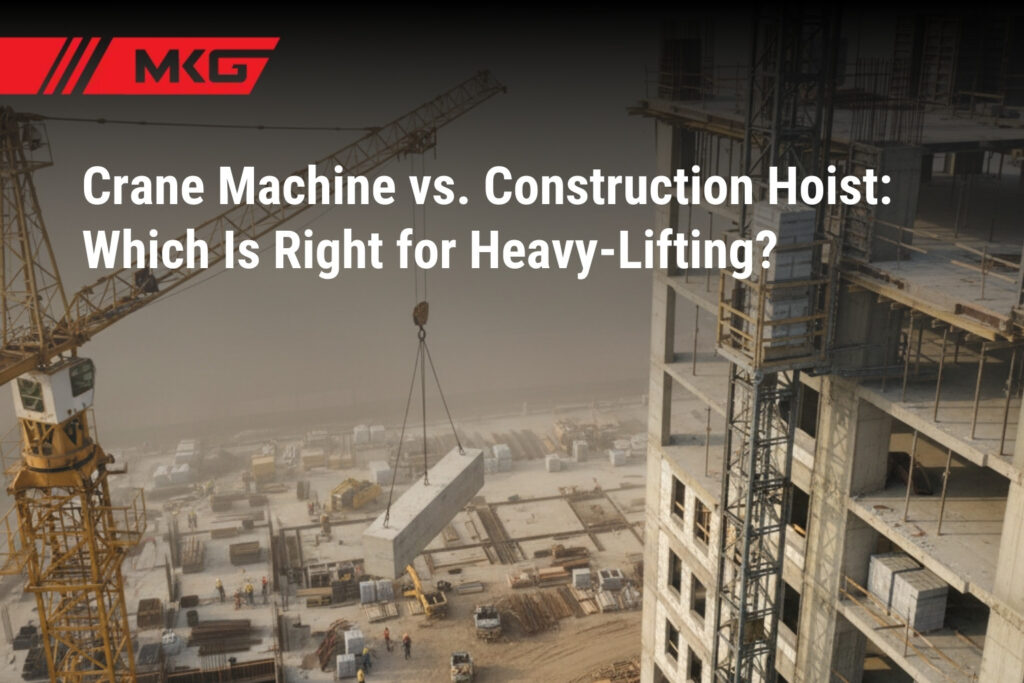
Before diving into comparisons, it’s helpful to define the two machines. A crane is a complex system that integrates a hoist with a trolley, bridge and boom to lift and move heavy loads both vertically and horizontally across a work area.
The boom or bridge gives a crane its long reach, while counterweights prevent tipping when handling heavy loads. In contrast, a construction hoist (sometimes called a material hoist) focuses almost exclusively on vertical lifting. It consists of a lifting mechanism, a rope or chain, and a cage or platform that travels up and down along a fixed path.
Cranes and hoists often work together; hoists are mounted onto cranes to perform the actual lifting. However, confusing the two can lead to costly equipment choices. The key differences lie in their range of motion, complexity, cost and applications.
What Makes a Crane Unique?
Cranes have been indispensable since ancient times because they combine simple machines (levers, pulleys, counterweights) to produce a large mechanical advantage. A modern crane’s main components include a hook, hoist, boom, jib and counterweights. The boom allows the crane to reach out horizontally, while trolleys move the load along the boom or bridge. Cranes come in many forms:
- Mobile cranes (truck‑mounted, rough terrain, crawler) provide flexibility for sites that need frequent repositioning.
- Tower cranes dominate city skylines and can lift heavy loads hundreds of metres into the air.
- Overhead or bridge cranes span factory floors and move loads across a fixed bay.
- Gantry and jib cranes offer portable or localized lifting solutions.
These machines are designed to move heavy loads across large areas, making them ideal for high‑rise construction, shipyards, bridges and manufacturing plants.
Because cranes rely on complex mechanisms and structural supports, they demand significant space and infrastructure. Building an overhead crane, for example, may require steel runways, reinforced floors and regular inspections, all of which add to the initial investment and ongoing maintenance.
What Makes a Construction Hoist Different?
A construction hoist (often called a rack‑and‑pinion or material hoist) is the workhorse that ferries people and materials up and down a building. Hoists consist of a cage, mast, drive motor and safety devices, and they move loads along a vertical path using cables or a rack‑and‑pinion mechanism. Hoists can be manual, electric or pneumatic, depending on power source and application. For example:
- Electric hoists are widely used because they offer smooth, reliable lifting with minimal manual effort.
- Manual chain hoists are portable and economical for small jobs.
- Pneumatic hoists are ideal for hazardous environments where sparks from electrical motors could ignite flammable gases.
Hoists are compact and designed for vertical movement only. That makes them ideal when you need to lift materials or workers straight up to upper floors. They are simpler in construction and typically less expensive to install and maintain than cranes. Because they occupy a small footprint, hoists are perfect for sites with limited space or for contractors who need a temporary lifting solution.
Range of Motion and Complexity
The most obvious difference between a crane and a hoist is mobility. A crane can move loads horizontally and vertically, travelling across an X‑Y‑Z coordinate system via bridges and trolleys. This capability allows contractors to pick up a load at one point and set it down elsewhere without moving the base of the machine. Hoists, on the other hand, lift and lower loads strictly along a vertical axis; any horizontal movement requires separate equipment or manual repositioning.
Because of these motion capabilities, cranes incorporate many more parts – runways, control systems, counterweights and bracing – whereas hoists are comparatively simple assemblies. The additional components increase cost and complexity. Installing an overhead crane may require structural modifications, power distribution for motors and strict compliance with safety standards. Hoists, by contrast, can often be installed without major building changes and require less specialized training to operate.
Cost and Space Considerations
The most obvious difference between a crane and a hoist is mobility. A crane can move loads horizontally and vertically, travelling across an X‑Y‑Z coordinate system via bridges and trolleys. This capability allows contractors to pick up a load at one point and set it down elsewhere without moving the base of the machine. Hoists, on the other hand, lift and lower loads strictly along a vertical axis; any horizontal movement requires separate equipment or manual repositioning.
Because of these motion capabilities, cranes incorporate many more parts – runways, control systems, counterweights and bracing – whereas hoists are comparatively simple assemblies. The additional components increase cost and complexity. Installing an overhead crane may require structural modifications, power distribution for motors and strict compliance with safety standards. Hoists, by contrast, can often be installed without major building changes and require less specialized training to operate.
Applications and Suitability
The most obvious difference between a crane and a hoist is mobility. A crane can move loads horizontally and vertically, travelling across an X‑Y‑Z coordinate system via bridges and trolleys. This capability allows contractors to pick up a load at one point and set it down elsewhere without moving the base of the machine. Hoists, on the other hand, lift and lower loads strictly along a vertical axis; any horizontal movement requires separate equipment or manual repositioning.
Because of these motion capabilities, cranes incorporate many more parts – runways, control systems, counterweights and bracing – whereas hoists are comparatively simple assemblies. The additional components increase cost and complexity. Installing an overhead crane may require structural modifications, power distribution for motors and strict compliance with safety standards. Hoists, by contrast, can often be installed without major building changes and require less specialized training to operate.
Safety and Maintenance
The most obvious difference between a crane and a hoist is mobility. A crane can move loads horizontally and vertically, travelling across an X‑Y‑Z coordinate system via bridges and trolleys. This capability allows contractors to pick up a load at one point and set it down elsewhere without moving the base of the machine. Hoists, on the other hand, lift and lower loads strictly along a vertical axis; any horizontal movement requires separate equipment or manual repositioning.
Because of these motion capabilities, cranes incorporate many more parts – runways, control systems, counterweights and bracing – whereas hoists are comparatively simple assemblies. The additional components increase cost and complexity. Installing an overhead crane may require structural modifications, power distribution for motors and strict compliance with safety standards. Hoists, by contrast, can often be installed without major building changes and require less specialized training to operate.
Key Factors When Choosing Between a Crane and a Hoist
1. Load Requirements
Determine the weight and shape of the materials you need to lift. For heavy, awkward loads or items that require horizontal placement, a crane is usually the better choice. Experts recommend selecting a system rated at least 10–20% above the maximum load to provide a safety margin. If you are mainly lifting pallets of bricks or tools straight up and down, a hoist with appropriate capacity is more cost‑effective and easier to operate.
2. Lifting Height and Distance
Consider how high and how far you need to lift. Tower cranes and gantry cranes are designed for long spans and high lifts – up to hundreds of metres – making them indispensable for skyscrapers and bridge construction.
Construction hoists like our Tower Hoist are ideal for vertical heights of up to 60 feet or more and are less suited to lateral movement. If the job requires both vertical and horizontal movement, pairing a hoist with a crane may be ideal.
3. Duty Cycle and Frequency
How often will the equipment operate? Cranes are designed for continuous or high‑frequency use. Their motors, brakes and control systems can handle heavy workloads over long shifts. In contrast, hoists can be rated for light, medium or heavy duty, so it’s vital to match the hoist to your expected usage. For occasional lifts on a residential site, a smaller hoist suffices; for constant movement of materials, invest in a heavy‑duty, industrial‑grade hoist.
4. Environment and Layout
Project environment affects equipment choice. Hoists are ideal for confined urban sites where space is limited and vertical lifting is paramount. Pneumatic hoists work well in hazardous or explosive atmospheres because they avoid electrical sparks.
Cranes need stable ground, clear swing radii and adequate headroom. When headroom or overhead obstructions limit crane use, consider a hoist or a Hanging Platform (rope‑suspended platform) for façade work.
5. Budget and Maintenance
Initial purchase price and lifetime cost matter. As noted, cranes demand higher capital expenditure and regular professional servicing. Hoists cost less and require fewer mechanical parts, resulting in lower operating and maintenance expenses. When budgets are tight or the project duration is short, renting a hoist can provide the lifting capability without a long‑term financial commitment.
6. Training and Safety
Operators must be trained to use cranes safely. Complex controls, multiple motions and large loads leave little room for error. Hoists, by contrast, are simpler to operate and often require only basic instruction, though all operators should be familiar with load ratings, inspections and emergency procedures. Choose the equipment that matches your team’s skill level and consider including safety training as part of the procurement decision.
Crane vs. Hoist: Summary Table
To help you decide quickly, here’s a concise comparison of cranes and construction hoists. Keep in mind that long sentences are avoided in the table, so you can scan the differences at a glance.
Feature | Crane Machine | Construction Hoist |
Movement | Vertical and horizontal via bridge, boom and trolley | Vertical only; moves straight up and down |
Components | Hook, hoist, boom/jib, trolley, counterweights, operator cab | Cage or platform, mast or guide rail, motor, safety locks |
Complexity | Multi‑component system; requires structural support and precise installation | Simple mechanism; compact footprint; can be installed quickly |
Cost | High capital cost plus investment in runways, power systems and regular inspections | Lower purchase and maintenance cost |
Typical Use | Large‑scale material handling, setting structural elements, moving loads across a site | Repeated vertical lifting of materials or passengers on building sites |
Capacity & Height | Lifts loads from a few tonnes to hundreds of tonnes; heights vary depending on type | Generally up to 1–2 tonnes; heights vary by model (MKG hoists reach 60–200 ft) |
Space | Requires a clear swing radius and structural clearance | Works in confined or narrow spaces |
Operator Skill | Requires trained operator and strict safety procedures | Easier to operate; training still needed but less complex |
When to Choose Each Option
So which tool is right for your heavy‑load lifting? Think of a crane as your best option when you need to lift heavy and bulky loads across a jobsite or place them precisely at different points. On high‑rise projects, tower cranes are indispensable for placing structural steel, precast panels and mechanical equipment. Cranes are also ideal when you anticipate frequent lifts, long spans, and loads that exceed the capacity of standard hoists.
A construction hoist, on the other hand, is perfect when your work involves frequent vertical lifts of materials or crews. For example, transporting bricks, tiles, cement bags, glass panels or maintenance tools to upper floors can become a bottleneck if done manually. Using a hoist reduces strain, speeds up workflow and minimizes the risk of accidents due to manual lifting. If your project is mid‑rise, has limited space or requires temporary equipment, a hoist is likely the smarter investment.
In practice, many sites use both. A crane handles the heavy structural lifting, while a hoist keeps a constant flow of supplies and people moving vertically. Pairing the two not only increases efficiency but also ensures that specialized equipment is used for the right tasks.
Conclusion
At MKG, we understand that choosing the right lifting solution isn’t just about capability—it’s about consistency, safety, and real-world performance on Indian construction sites. Whether you rely on cranes for horizontal movement or construction hoists for fast, repeated vertical lifting, the goal remains the same: smooth, uninterrupted progress from the first floor to the final slab.
That’s why our Vimman Passenger and Material Hoists, Tower Hoists, Mini Lifts, and Hanging Platforms are engineered to meet the daily demands of high-rise work. From dust-heavy environments to long working hours, every MKG machine is built to deliver steady lifting power without compromising worker safety or project timelines.
While cranes play a major role in heavy structural placement, construction hoists step in where precision vertical movement matters most and that’s where MKG specializes. With rugged components, reliable drive systems, and safety-first engineering, our hoists ensure that people and materials reach every floor efficiently, day after day.
And it doesn’t stop at manufacturing. Our dedicated support team handles installation, routine service checks, and genuine spare parts to keep your equipment running at peak performance. With proper setup and periodic maintenance, an MKG hoist can serve your project for decades – giving contractors unmatched confidence on every lift.
If you’re planning a high-rise or looking to upgrade your lifting strategy, our technical experts are here to help you choose the ideal solution for your site.
Email:info@mkgworld.in
Call:+91 95222 39320
Let’s build higher, faster, and smarter with MKG powering every lift, every floor, every day.
Frequetly Asked Questions
1. Can a crane and a construction hoist be used together on the same project?
Yes. Many high-rise sites use both. Cranes handle structural lifting and long-reach tasks, while hoists offer continuous vertical movement for workers and materials. Using both improves workflow, reduces manual handling, and prevents bottlenecks in multi-floor operations.
2. Are construction hoists suitable for emergency evacuation during tower construction?
Construction hoists can be used for emergency evacuation, but only if they are specifically designed with safety features like overload sensors, emergency lowering systems, and dual brakes. Not all hoists qualify, so contractors must check compliance with national safety standards.
3. Do cranes require separate permits compared to construction hoists?
Yes. Cranes often require additional permits related to swing radius, height restrictions, public road usage, and municipal approval because of their wide operational footprint. Construction hoists require fewer permits since they stay fixed to the building and operate in a controlled vertical path.
4. How do weather conditions affect crane and hoist operations differently?
High winds, rain, and lightning impact cranes more because of their height, boom length, and swing movement. Hoists, being enclosed and mast-guided, are less affected but may still require shutdowns during extreme winds or if visibility becomes unsafe.
5. What factors influence the lifespan of a crane or hoist?
Lifespan depends on usage frequency, preventive maintenance, environment, and quality of components. Cranes often face structural fatigue due to horizontal movement, while hoists primarily experience wear on masts, brakes, and drive systems. Correct lubrication and timely part replacement significantly extend life.