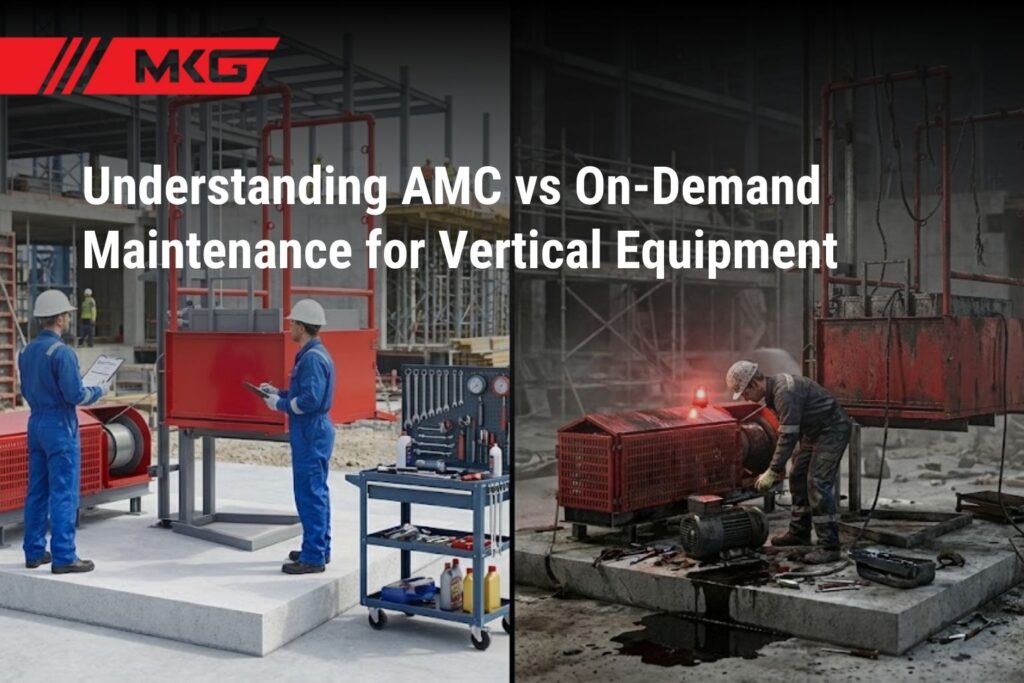
Vertical equipment like construction hoists, rope‑suspended platforms and mini lifts work hard on every job site. They move workers, concrete, bricks and tools day after day, often in harsh weather and dusty conditions. It’s easy to take these machines for granted – until a breakdown stalls your project and costs time and money. As MKG, a brand that designs and builds vertical lifting equipment for construction professionals, we often hear the same question: should you sign an annual maintenance contract (AMC) or stick with on‑demand maintenance when something goes wrong? This solution unpacks both approaches so you can make a confident decision for your site.
Why maintenance matters for vertical equipment
Construction hoists and platforms travel far more than most people realise. A hoist in a mid‑rise project may cover the equivalent of driving a quarter of the way to the moon over its lifetime, carrying families, cement bags and heavy tools. These machines integrate mechanical parts, control software and safety logic, so minor faults can snowball into major hazards if ignored. Industry research shows that nearly 40 % of elevator failures stem from poor maintenance, and the same principle applies to construction hoists. Proper upkeep isn’t optional; it’s a commitment to safety, productivity and long‑term asset life.
If we neglect our equipment, the hidden costs add up quickly. Downtime doesn’t just delay the schedule; it also exposes workers to risks, jeopardises compliance and erodes client trust. Ezone, a facility‑management firm, notes that on‑demand repairs are reactive: downtime hurts more than the repair bill, and clients without a maintenance contract often wait longer for service. Preventive maintenance is like regular health check‑ups – a small effort now to avoid a costly emergency later.
What is an Annual Maintenance Contract (AMC)?
An AMC is a formal agreement between an equipment owner and service provider that outlines a schedule of regular upkeep. It typically covers periodic inspections, lubrication, replacements of wear parts, emergency support and software updates. In material‑handling fleets, AMCs include auditing the equipment, determining the service frequency, scheduling planned visits and offering priority response during emergencies. In essence, an AMC shifts maintenance from a reactive expense to a proactive investment.
Competitors emphasise several benefits:
- Predictable costs – With an AMC, maintenance costs are scheduled and uniform, allowing budget planning.
- Reduced downtime – Regular servicing minimises breakdowns; technicians replace worn parts before failure.
- Priority service – AMC clients receive shorter turnaround times and dedicated service teams.
- Longer equipment life – Consistent care prevents premature wear and extends the life of expensive equipment.
- Compliance and safety – Well‑maintained systems stay compliant with safety codes and audits; the AMC includes documentation and reporting to satisfy regulators.
Strategic value – A maintenance contract reduces risk of catastrophic failure and protects uptime, turning maintenance from a cost centre into a strategic investment.
AMC levels: basic vs comprehensive
Not all AMCs are created equal. A basic contract might include routine inspections and lubrication, whereas a comprehensive AMC covers spare parts, emergency breakdown support and safety inspections. Comprehensive coverage carries a higher fee but eliminates surprise costs; basic plans leave some repairs billable. Understanding the scope helps you compare offers fairly.
What is on‑demand maintenance?
On‑demand maintenance (sometimes called break‑fix service) is a pay‑as‑you‑go approach. You call a technician only when a fault occurs. For small fleets or short‑term projects this sounds attractive because there is no upfront commitment – you pay only when something breaks. Mazda Movers describes on‑demand repairs as reactive and unscheduled; they are typically short‑term interventions to bring a machine back online. The appeal lies in flexibility: small or seasonal operations can avoid fixed fees and switch vendors easily.
However, there are important caveats:
- Unpredictable costs – Emergency call‑outs, replacement parts and after‑hours labour charges make costs volatile.
- Longer response times – Service providers prioritise AMC clients, so on‑demand customers may wait longer for repairs.
- Reactive repair mindset – Faults are fixed, but underlying wear isn’t addressed; issues often resurface.
- Higher risk of downtime – Unplanned failures can halt operations and cost thousands in lost productivity.
In short, on‑demand maintenance is like firefighting – it solves the immediate problem but doesn’t prevent the next one. Choosing this model means accepting more uncertainty in exchange for the freedom to pay only when necessary.
Comparing AMC and on‑demand maintenance
To help you decide, it’s useful to compare these models across several factors. The table below summarises key differences.
Aspect | Annual Maintenance Contract (AMC) | On‑Demand Maintenance |
Service approach | Proactive and scheduled; preventive checks, replacements and records | Reactive; only when a breakdown occurs |
Cost structure | Predictable annual or quarterly fees; budgets known | Variable; costs spike during emergencies and parts replacement |
Downtime | Minimal; routine visits catch issues early | Longer; unexpected failures cause delays |
Service priority | High; AMC clients enjoy faster response and dedicated support | Lower priority; service depends on technician availability |
Equipment life | Extended; preventive care reduces wear | Shorter; repeated breakdowns strain components |
Compliance | Routine inspections ensure safety codes and audit documentation | Compliance checks often neglected until an issue surfaces |
Flexibility | Contract period locks you into one provider; some plans allow customization | High; choose vendors case‑by‑case |
From this comparison, it’s clear why many asset owners view AMC as a strategic safeguard rather than a cost. Yet there are situations where on‑demand maintenance may be practical. Let’s explore both sides.
Hidden costs of on‑demand maintenance
On‑demand maintenance appears cheaper because there is no annual fee, but this view overlooks hidden costs. Ezone cautions that downtime costs often exceed the repair invoice; a silent fire‑alarm panel or disabled CCTV system can halt operations and expose businesses to compliance violations. In construction, a stalled hoist delays the entire project, increasing labour costs and potentially breaching contractual deadlines.
Without a maintenance contract, equipment owners are also “second in line” – service providers attend to AMC clients first. As faults accumulate, reactive repairs become frequent. Technicians fix symptoms but seldom inspect other components, so the same issues recur. Over time, the machine degrades faster, leading to early replacement. For an expensive asset like a passenger hoist or tower hoist, these hidden costs can far exceed the price of an AMC.
AMC as a strategic investment
A properly designed AMC protects more than just machinery – it safeguards productivity, safety and reputation. Mazda Movers points out that planned visits, audits and emergency support are part of the AMC process. Mapcon notes that an AMC establishes a predictable maintenance cycle and reduces the risk of catastrophic failure. For assets critical to operations, the peace of mind alone justifies the contract.
In our experience, the benefits extend further:
- Longer equipment life – Regular lubrication, alignment checks and timely replacement of parts prevent wear. For example, daily inspections of the hoist cage and mast, checking for cracks or rust and testing safety interlocks, can catch 80 % of common issues before they cause damage. Weekly lubrication of rack and pinion gears and guide rollers reduces friction and overheating. An AMC formalises these tasks and ensures they aren’t skipped during busy periods.
- Improved safety compliance – Construction hoists must meet Indian Bureau of Standards (BIS) codes and OSHA guidelines. AMCs include safety audits, limit‑switch tests and overspeed governor checks to ensure compliance. Without regular inspections, these devices may fail unnoticed until an accident occurs.
- Predictable budgeting – Instead of facing unpredictable repair bills, owners can spread maintenance costs across the year. This stability helps with tender pricing and cash flow planning.
- Data and insights – Modern AMCs often include digital tools. Mapcon explains that Computerised Maintenance Management Systems (CMMS) automate scheduling, log every service action and provide performance dashboards. These records prove compliance and help evaluate vendors. Our own service teams use digital logs to track each maintenance visit, ensuring accountability and continuous improvement.
Priority response and genuine parts – OEM maintenance contracts guarantee the use of original components and model‑specific expertise. Third‑party providers may use cheaper, incompatible parts, causing premature failures. AMC clients receive priority support, reducing downtime and ensuring safety.
Factors to consider when choosing maintenance models
Deciding between AMC and on‑demand maintenance isn’t just about cost; it also depends on your operations, equipment and risk tolerance. Mazda Movers suggests considering fleet size, usage intensity and budget control. Here are practical questions to guide your decision:
- Project duration and scale: For long‑term or high‑rise projects with heavy vertical lifting needs, the predictability of an AMC is invaluable. For short‑term or small jobs, on‑demand may suffice.
- Equipment criticality: How essential is the hoist or platform to your workflow? If a breakdown can stop the project, risk mitigation through AMC is prudent.
- Regulatory environment: Are you required to maintain compliance records, as in high‑rise elevators or public works? AMC ensures documentation.
- Budget flexibility: Can you absorb unexpected repair costs? Unplanned breakdowns often cost more than budgeted fees.
Vendor trust: Do you have a reliable service partner? A formal contract can enforce response times and service quality through defined Service Level Agreements, as Mapcon notes.
How MKG’s maintenance services stand out
Deciding between AMC and on‑demand maintenance isn’t just about cost; it also depends on your operations, equipment and risk tolerance. Mazda Movers suggests considering fleet size, usage intensity and budget control. Here are practical questions to guide your decision:
- Project duration and scale: For long‑term or high‑rise projects with heavy vertical lifting needs, the predictability of an AMC is invaluable. For short‑term or small jobs, on‑demand may suffice.
- Equipment criticality: How essential is the hoist or platform to your workflow? If a breakdown can stop the project, risk mitigation through AMC is prudent.
- Regulatory environment: Are you required to maintain compliance records, as in high‑rise elevators or public works? AMC ensures documentation.
- Budget flexibility: Can you absorb unexpected repair costs? Unplanned breakdowns often cost more than budgeted fees.
Vendor trust: Do you have a reliable service partner? A formal contract can enforce response times and service quality through defined Service Level Agreements, as Mapcon notes.
When is on‑demand maintenance the right choice?
While we advocate for AMCs, there are scenarios where on‑demand maintenance may suffice. If you’re renting a mini lift for a short job or running a small site with minimal vertical lifting, paying per repair might be practical. On‑demand service can also be suitable when equipment usage is sporadic and downtime doesn’t seriously affect productivity. However, even in these cases, it’s vital to conduct daily inspections and follow the manufacturer’s recommended care routines to avoid safety issues.
Final thoughts
Maintaining vertical equipment isn’t just a box-ticking exercise – it’s about keeping projects moving, people safe, and costs under control. Whether it’s a passenger hoist, tower hoist, mini lift, or hanging platform, the way you maintain your equipment directly impacts uptime, safety, and long-term value. Choosing between AMC and on-demand maintenance is really about how proactive you want to be.
On-demand maintenance may look flexible at first, but it often means reacting after problems show up. AMC, on the other hand, is about planning ahead – regular inspections, timely servicing, predictable costs, and fewer surprises on site. Over time, that proactive approach usually saves money, reduces downtime, and extends the life of your equipment.
At MKG, we design and build vertical equipment for real construction conditions – heavy loads, long hours, and demanding environments. That’s why we strongly believe maintenance should match the same mindset. A well-structured AMC helps your MKG machines perform the way they were designed to, day after day, without being pushed beyond their limits.
Whether you manage a single project or multiple sites, the right maintenance strategy keeps your timelines intact, your crews confident, and your equipment reliable.
Let’s plan maintenance the smart way – before problems slow you down.
Talk to MKG’s technical experts today to understand whether AMC or on-demand maintenance is the right fit for your vertical equipment and project scale.
info@mkgworld.in
+91 95222 39320
MKG – Built for safety. Built for the future.