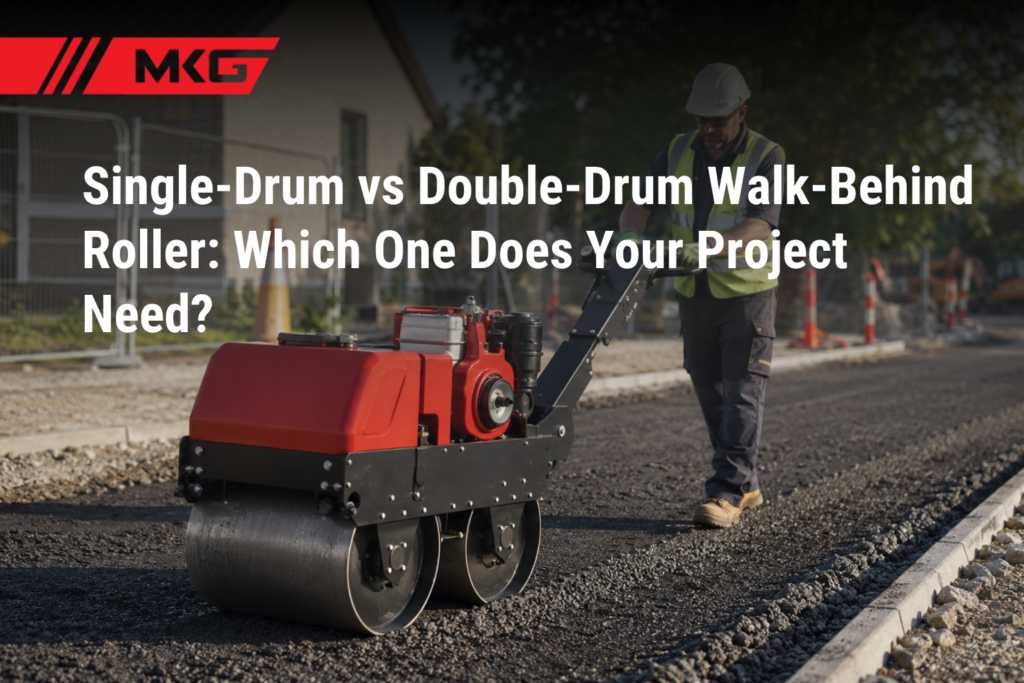
Stand at any equipment yard and ask for a walk-behind roller, and the first question you’ll get back is a simple one: “Single drum or double drum?” And if you’ve never had to answer it before, it can feel like a trick question. Both machines look similar, both compact the ground, and both promise a solid, stable surface. So does the number of drums really matter?
It does – more than most people realise. Pick the wrong one and you’ll either spend extra money on capability you never use, or worse, end up with a surface that fails inspection because the machine simply wasn’t built for that job.
At MKG, we’ve been manufacturing construction equipment in India for years, and our walk behind rollers work on everything from village roads to industrial floors. In this guide, we’ll walk you through the difference between the two drum setups in plain language, so by the end, you’ll know exactly which machine your project needs – no engineering degree required.
First, What Exactly Is a Walk-Behind Roller?
Stand at any equipment yard and ask for a walk-behind roller, and the first question you’ll get back is a simple one: “Single drum or double drum?” And if you’ve never had to answer it before, it can feel like a trick question. Both machines look similar, both compact the ground, and both promise a solid, stable surface. So does the number of drums really matter?
It does – more than most people realise. Pick the wrong one and you’ll either spend extra money on capability you never use, or worse, end up with a surface that fails inspection because the machine simply wasn’t built for that job.
At MKG, we’ve been manufacturing construction equipment in India for years, and our walk behind rollers work on everything from village roads to industrial floors. In this guide, we’ll walk you through the difference between the two drum setups in plain language, so by the end, you’ll know exactly which machine your project needs – no engineering degree required.
The Single-Drum Walk-Behind Roller: One Drum, Deep Punch
A single-drum walk-behind roller has exactly what the name says – one compacting drum at the front, with the engine and drive system balanced behind it.
Because the machine’s entire weight and vibration energy pass through that one drum, the force gets concentrated into a smaller contact area. The result is a deeper punch into the ground. That’s why single-drum machines are the go-to choice for compacting soil, murrum, gravel, and sub-base layers – materials that need force driven well below the surface, not just a smooth top.
There are a few more practical advantages. With only one drum, the machine is generally lighter, simpler, and cheaper to buy. There are fewer moving parts to service, and a lighter body is easier to load onto a pickup and shift between small sites.
The trade-off? Coverage and finish. One drum means the machine compacts only once per pass, so you’ll make more passes to cover the same area. And on asphalt, a single drum struggles to deliver the mirror-smooth, even finish that paving work demands.
The Double-Drum Walk-Behind Roller: Two Drums, Double the Work
Now put a second drum at the back, and you get a double-drum (or tandem) walk-behind roller. Both drums touch the ground, both usually vibrate, and both share the machine’s weight.
Here’s the simple way to picture it: every time the machine moves forward one metre, the ground underneath gets pressed twice – once by the front drum and again by the rear drum. Two compactions in a single pass. That’s why double-drum rollers finish the same stretch in noticeably fewer passes than a single-drum machine.
The second big win is the finish. Because the weight is spread evenly across two drums, the pressure on the surface stays uniform. On hot asphalt, that even, repeated rolling is exactly what produces the tight, smooth, professional finish that roads, parking areas, and pavements need. It’s no accident that almost every asphalt crew you’ll ever see runs a tandem setup.
The trade-offs are the mirror image of the single drum’s strengths. A double-drum machine is heavier, costs a bit more, and has two drums’ worth of bearings, scrapers, and sprinkler nozzles to look after instead of one.
The Real Differences That Matter on Site
Spec sheets are full of numbers, but on the ground, the choice comes down to five practical points.
- Depth vs finish. A single drum concentrates force and drives compaction deeper, which soil layers love. A double drum spreads force evenly and polishes the surface, which asphalt loves. Depth or finish – that’s the heart of the whole debate.
- Passes and speed. Two drums compacting at once means a double-drum roller typically gets a section to target density in fewer passes. On a long pathway or a large patch, those saved passes add up to hours saved and less fuel burned.
- Behaviour on slopes. Compaction work in India rarely happens on perfectly flat ground. Ramps, shoulder slopes, and embankment edges all demand a machine that grips and climbs confidently. This is where gradeability ratings matter – our MKG walk-behind rollers are rated for slopes of 20 to 30 degrees, depending on the model.
- The water sprinkler question. If you’re rolling hot asphalt, the drum must stay wet, or the bitumen sticks to the steel and tears the surface you just laid. Double-drum asphalt rollers are built with onboard water tanks and sprinkler systems for exactly this reason. If a machine has no sprinkler, treat that as a sign it was never meant for serious asphalt work.
- Operator effort. A lighter single-drum machine is easier to muscle around a cramped spot. A well-balanced double drum, though, is self-propelled in both directions, so on longer runs the operator is guiding the machine, not fighting it.
Match the Machine to Your Material
If you remember only one thing from this article, make it this: the material decides the machine.
Working with soil, sand, gravel, or crushed stone base? These granular materials need force pushed deep into the layer so it locks together from the bottom up – classic single-drum territory. (The science behind why loose soil settles and sinks if you skip this step is explained well on Wikipedia’s soil compaction page.)
Working with asphalt, bitumen mixes, or a finished pavement layer? Here the goal shifts from depth to density and smoothness across the surface, achieved in the short window before the mix cools. That’s double-drum work, full stop.
Many projects, of course, involve both – you compact the earth and sub-base first, then lay and roll the asphalt on top. On larger jobs, crews often keep both drum types on hand, or they compact the base with a rammer or plate compactor and reserve the roller purely for the surface course.
Think About Your Site, Not Just the Machine
The second filter is the shape of your workspace, because a roller you can’t position properly is a roller wasted.
Narrow trenches and against-the-wall compaction favour the smallest, lightest machine that still does the job. Long open runs – a housing society road, a factory floor, a parking area – favour the machine that covers ground fastest, which usually means two drums.
Also think about movement between sites. A contractor doing scattered patch-repair jobs across a city moves the machine daily, so loading weight matters. A contractor parked on one township project for eight months barely moves it at all, so productivity per day matters far more than portability.
Cost, Maintenance, and Everyday Running
Let’s talk money honestly, because the purchase price is only chapter one.
A single-drum walk-behind roller usually costs less upfront and has fewer parts that wear – one set of drum bearings, one scraper, a simpler drive. Servicing is quick and cheap.
A double-drum roller costs more to buy and asks for a little extra attention: two drums to lubricate, two scrapers to check, and a sprinkler system to keep clean, especially where hard water clogs nozzles. But weigh that against what it earns you. Fewer passes per job means lower fuel bills and faster job completion, and on asphalt work, it delivers a finish quality a single drum simply can’t match. Over a machine’s life, the double drum often works out cheaper per square metre compacted.
Whichever you choose, insist on genuine parts when service time comes – our spare parts support exists precisely so a ₹500 scraper blade never sidelines a lakh-rupee machine. And if your workload doesn’t yet justify owning one, our rental programme lets you put the right roller on site without the capital cost.
A Simple Rule of Thumb
Still on the fence? Run your project through this 30-second checklist.
Choose a single-drum walk-behind roller if your work is mostly soil and granular base layers, your sites are tight or scattered, your budget is the deciding factor, and surface finish isn’t your headache.
Choose a double-drum walk-behind roller if asphalt or pavement finishing is part of your scope, you compact long or repeated stretches, you’re rolling near edges and kerbs where evenness shows, and speed of completion earns you money.
And if your job is compacting backfill inside a narrow trench or around a foundation, pause before buying any roller at all – a tamping rammer or a plate compactor may reach where drums can’t and cost far less. The best machine is the one shaped like your problem.
Where MKG's Walk-Behind Rollers Fit In
At MKG, our walk-behind range is built around the double-drum design, because that’s what the vast majority of Indian pathway, pavement, and asphalt-repair work genuinely demands.
Our RL-600DH is the heavy hitter – 720 kg of operating weight, a 650 mm drum width, 24 kN of centrifugal force, and a self-start engine, with a generous 70-litre water tank for long asphalt sessions. Our RLYL-31 is the nimble sibling – lighter at 570 kg with a 600 mm drum, a higher 70 Hz vibration frequency, and an impressive 30-degree gradeability for slopes and ramps.
Both machines carry a dual-drum vibration system, self-propelled forward and reverse travel, and a design that aligns the exciter shaft with the drum axis, so vibration energy goes into the ground instead of getting lost in the frame. They’re designed, built, and serviced in India for Indian site conditions – dust, heat, monsoon, and long working days. You can download the detailed brochure here or find your nearest MKG dealer for a live demonstration.
Not sure which roller suits your next project?
Talk to our experts today. Email info@rajat-group.com or call +91 95222 39320 – we’ll help you match the machine to the job, not the other way around.
Frequently Asked Questions
1. Can I use a double-drum walk-behind roller on soil?
Yes, for thin granular layers and final levelling, a double-drum roller works fine. But for thick soil or sub-base layers that need deep compaction, a single-drum machine, a tamping rammer, or compacting in thinner layers will give you better density. The key is never to exceed the layer thickness your machine can genuinely compact.
2. Why does an asphalt roller need a water tank?
Hot bitumen is sticky, and without water, it clings to the steel drum, lifting chunks out of your freshly laid surface. The onboard sprinkler keeps a thin film of water on the drums so they roll clean. Always fill the tank before asphalt work and check the nozzles regularly, because a blocked sprinkler ruins finishes fast.
3. How many passes does a walk-behind roller need to compact properly?
It depends on the material, layer thickness, and machine, but most walk-behind jobs reach target density in four to eight passes. A double-drum machine typically gets there in fewer passes than a single drum because both drums compact on every run. When the surface stops visibly settling under the drum, you’re close to done.
4. Is a walk-behind roller better than a plate compactor?
Neither is “better” – they solve different problems. A plate compactor suits small, confined areas and granular soils, while a walk-behind roller covers longer stretches faster and delivers the smooth, continuous finish that asphalt and pavement work needs. Many contractors keep both, using the plate for prep and the roller for the surface.