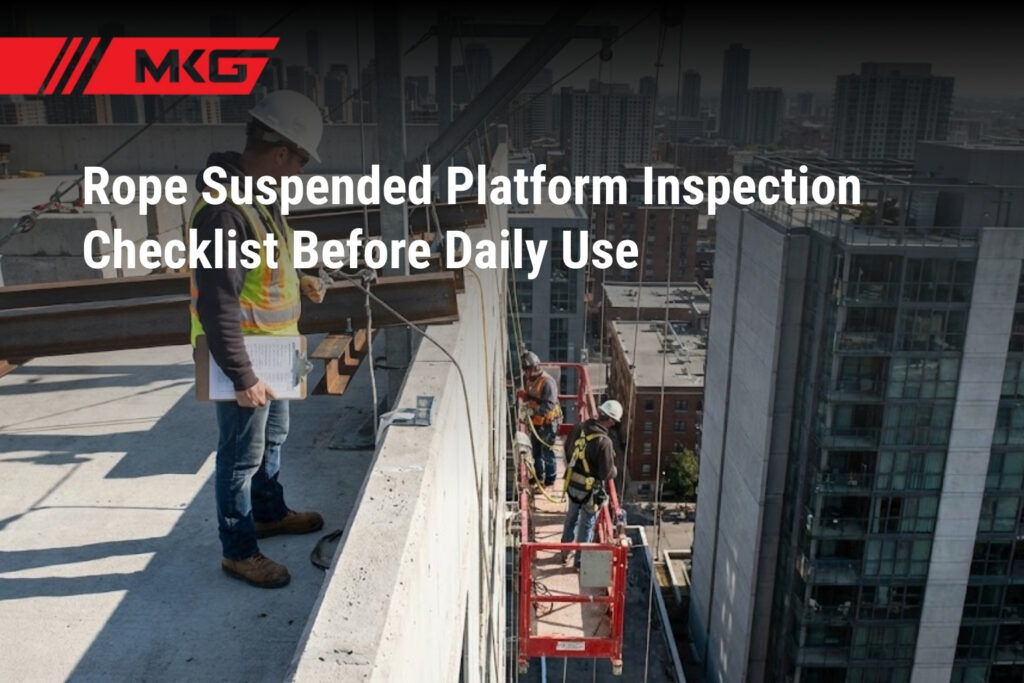
Working at height is inherently risky. When your team is suspended hundreds of feet above the ground on a rope‑suspended platform, the only things between them and a fall are the integrity of the equipment and the training of the operators. Daily inspections are therefore non‑negotiable.
At MKG we manufacture and supply rope‑suspended platforms for India’s construction and façade‑maintenance sector, and we know from experience that most platform failures can be prevented with a simple pre‑use checklist. Below is a practical, step‑by‑step guide on what to check before every shift and why these checks matter.
Why daily inspections matter
A rope‑suspended platform (often called a hanging platform, gondola or swing stage) is a motor‑driven work platform suspended from a roof or other strong structure. Instead of building scaffolding from the ground, workers ride the platform up and down using electric or manual hoists.
Because of this vertical mobility, the platform takes up almost no ground space and is ideal for façade cleaning, painting, plastering and inspection in crowded Indian cities. However, working several stories above the street involves significant risk. Organisations like OSHA and ANSI mandate regular inspections because they prevent falls, ensure the hoist and ropes operate correctly and keep equipment compliant with safety codes.
Daily pre‑use inspections serve several purposes:
- Worker Safety – Checking the platform before each shift prevents falls and equipment‑related accidents.
- Operational Reliability – Inspections ensure hoists, motors and ropes perform without interruption.
- Compliance – Regular checks help you align with international and national safety codes.
Preventive Maintenance – Identifying defects early prevents expensive repairs and downtime.
Pre‑inspection preparation
Before starting any inspection, ensure that only trained and competent persons are assigned to inspect and operate suspended platforms. The Scaffold & Access Industry Association recommends that a competent person supervise the erection, alteration and dismantling of suspended scaffolds. Preparation should include:
- Review the manufacturer’s manual – Read and understand the operating instructions. GoAudits’ inspection template reminds users that manufacturer’s instructions must be read, understood and available for reference. Our MKG platforms come with comprehensive manuals; keep them on site.
- Identify the equipment’s rated capacity – Know the platform’s rated load and never exceed it. MKG’s ZLP 500 supports 500 kg while the ZLP 800 supports 800 kg. Overloading stresses the hoists and ropes, leading to premature failure.
- Gather safety gear – Each operator should wear a full‑body harness connected to an independent lifeline. A proper fall arrest system is a legal requirement. Ensure helmets, gloves and safety shoes are worn.
- Clear the area – Mark the ground beneath the platform as a prohibited zone and post warning signs. VIP Suspended Platform guidelines state that no one should work or stay under the gondola during movement.
Once prepared, proceed through the following checklist. Each section explains what to check and why it’s important.
1. General conditions
Start by looking at the platform and its surroundings. Go Higher Construction’s pre‑operation checklist emphasises verifying that the equipment is undamaged, not overloaded, not altered and used only for its intended purpose. Tick off the following:
- Is the equipment damaged or overloaded? – Examine the platform structure, guardrails and hoists for cracks, dents or rust. A damaged frame may fail under load. Check that the current load is within the rated capacity; overloading can cause wire ropes to snap.
- Has anyone altered the equipment? – Confirm that no parts have been added, removed or modified. Alterations compromise design integrity and may void warranties.
- Is communication available? – Ensure there is a reliable communication method (radio or intercom) between workers on the platform and those on the ground. Clear communication prevents mis‑operation.
- Is a competent supervisor in charge? – The Scaffold & Access Industry Association notes that a competent person must supervise all suspended scaffold systems. Supervisors ensure the platform is erected and used properly.
- Are unattended platforms secured? – When the platform is not in use, secure it to prevent unauthorised operation and disconnect power. Tag it out if defects are found.
- Are labels and hardware intact? – Check that all labels are present and legible and that connection hardware (bolts, nuts, pins) is in good condition with proper locking devices. Missing labels may mean the equipment hasn’t been inspected recently.
2. Rigging and anchorage
The rigging system transfers the weight of the platform to the building. Any fault here could lead to catastrophic collapse. The Go Higher checklist requires confirming that the supporting structure can bear the imposed loads, that equipment is properly designed and assembled, and that counterweights are correct. Your daily checks should include:
- Support structure and counterweights – Inspect the roof beams, cornice hooks or davits. Make sure they are structurally sound and able to support the combined weight of the platform, workers and materials. For counterweighted outrigger beams, verify that the number of counterweights matches the platform’s outreach and hoist load rating.
- Rigging equipment design and assembly – Ensure all rigging components (outriggers, tie‑backs, clamps) are designed for the application and assembled per the manufacturer’s instructions. Improperly assembled rigging can slip or fail.
- Tie‑backs and anchorage – Check that temporary rigging is tied back to a structurally sound anchorage. Anchorage supports used in lieu of counterweights must be tested to support all applied loads.
- Welds and components – Examine welds for cracks or corrosion and ensure all components are undamaged with mounting holes free from deformation. Steel parts should be free from penetrating rust, as corrosion weakens load‑bearing capacity.
- Suspension ropes – VIP Suspended Platform’s checklist points out that the steel wire rope connection must be firm, free of excessive wear or fractures, and that any scrapped rope should be replaced. Look for broken wires, kinks or corrosion. Replace ropes showing any damage.
3. Platform condition
The platform itself must be structurally sound and properly assembled. GoAudits’ template instructs inspectors to verify that the platform is designed for the application, assembled according to manufacturer drawings and that stirrups align with rigging equipment. Your checks should cover:
- Design and assembly – Confirm the platform matches the job (e.g., MKG ZLP 500 or ZLP 800) and is assembled correctly. Improper assembly affects stability.
- Stirrups alignment – Stirrups must line up with the rigging equipment to distribute the load evenly. Misalignment introduces torsion and uneven stress on ropes.
- Load capacity – Ensure the live load does not exceed the platform’s rated load. Overloading can overload hoists and cause rope failure.
- Welds and components – Check all visible welds for cracks or corrosion and verify that components are present and undamaged. Missing parts (like pins or rails) compromise safety.
- Mounting holes and hardware – Verify that mounting holes are free of deformation and that hardware (bolts, lock nuts) is grade 5 or better and in good condition. Loose or worn nuts can loosen during operation.
- Sheaves, bearings and wire rope guides – Inspect stirrup sheaves, bearings and inlet guides for wear. Lubricate bearings as needed to prevent seizing.
- Wire rope reeving – Ensure the wire rope is properly reeved through sheaves. Incorrect reeving causes rope wear and uneven load distribution.
- Deck condition – Make sure the deck is free from excessive debris that could cause slipping hazards or hinder proper operation. Clean away cement, dust or tools at the end of each shift.
- Corrosion and abrasion – The platform must be free from chemical corrosion or excessive abrasion damage. On MKG platforms the galvanized steel and powder coating resist corrosion, but regular cleaning and touch‑up prevent rust.
- Power lines – Maintain a safe distance from live power lines; a minimum clearance of 10 feet is required. Contact the local utility if working near exposed lines. Electrical arcs can jump to the platform if you get too close.
- Weather conditions – Do not operate in unsafe weather. Go Higher’s checklist warns against using suspended platforms if wind speeds exceed 25 mph (40 km/h) for multi‑point platforms or 20 mph (32 km/h) for single‑point cages. VIP’s rules also forbid operation during thunderstorms or strong winds above grade 5. Gusts can sway the platform and overstress ropes.
4. Hoists, wire rope and power systems
The hoists and electrical systems are the heart of a rope‑suspended platform. Failure in these components can lead to uncontrolled descent. Ensure that:
- Proper hoists – Verify that the hoists are correctly selected for the job and installed according to the manufacturer’s instructions. For MKG platforms, the hoist models (LTD 6.3 or LTD 8.0) match the rated loads.
- Read the manual – Confirm that the operating instructions have been read and are available for reference. Operators must know how to perform daily tests and troubleshooting.
- Daily tests – Perform daily tests as specified in the hoist operating manual. These include running the hoist without load, checking brakes, and ensuring smooth control response. Test the hoist by raising a fully loaded platform a few feet to verify the system can hold the load.
- Working order – Check that hoists are in proper working order. Listen for unusual noises or overheating during operation.
- Cables and air hoses – Inspect electric cables and air hoses for cuts, burns or loose connections. VIP’s checklist notes that electric boxes, cables and plugs must be intact and that limit switches should function reliably. Damaged cables can cause shorts or power loss.
- Power supply – Ensure the power supply is adequate for the number and type of hoists. An inadequate supply can cause voltage drops and equipment failure.
- Wire rope condition and length – Inspect the wire rope for wear, frays or corrosion. Make sure the rope is the correct length for the job and properly attached to the support equipment with all fittings checked under load. VIP’s guidelines emphasise replacing any rope showing excessive wear.
- Strain relief and attachments – Confirm that strain reliefs are present and connected. Proper strain relief prevents the cable from pulling out of its connection.
- Emergency stop and secondary brakes – Test the emergency stop and secondary braking systems. MKG platforms have dedicated emergency stop controls that cut power immediately. In an emergency, these features freeze the platform to prevent further movement.
- Operator training – Make sure all operators are properly trained. Untrained users may misinterpret alarms or misuse controls.
- Controlled descent – Verify that the controlled descent function is working properly. Controlled descent prevents sudden drops if power is lost.
5. Fall protection system
Fall protection is your last line of defence if all else fails. Go Higher’s checklist emphasises that no worker should enter a suspended platform without being tied off. For daily inspections:
- Harnesses and lifelines – Check that each worker’s full‑body harness is in good condition, adjusted correctly and inspected. Inspect vertical lifelines for wear, ensuring they are correctly installed with edge protection to an independent anchor capable of holding a 5,000‑pound (2,268 kg) load. Each lifeline should be separate from the platform’s suspension ropes.
- Rope grabs and lanyards – Make sure rope grab devices are correctly installed and operating properly, and that their size matches the lifeline. Inspect shock‑absorbing lanyards and verify correct installation for safe use.
- Fall arrest system – Confirm that fall arrest systems have valid certification tags and no visible damage. Test safety locks; MKG platforms employ LST 20 safety locks that automatically grip the rope if the platform tilts or descends too quickly.
- Emergency rescue plan – Ensure a rescue plan is in place and has been reviewed. Everyone should know how to respond if a worker falls or the platform becomes disabled.
- Use around unguarded areas – Verify that fall arrest equipment will be used around unguarded edges or where a fall of six feet or more exists. This includes while moving to and from the platform.
6. Additional environmental and site checks
Weather and wind
Wind and weather can affect platform stability. Go Higher’s checklist states that wind speeds must not exceed 25 mph (40 km/h) for multi‑point platforms or 20 mph (32 km/h) for single‑point cages. VIP Suspended Platform regulations further prohibit operation in thunderstorms or strong winds above grade 5. Record the wind speed before starting. If a storm approaches during operation, descend to the ground and secure the platform.
High‑voltage lines and obstacles
Maintain a minimum clearance of 10 feet from live power lines. Contact the local utility if unsure. Be aware of antennas, signage, or building projections that could snag ropes or strike the platform. Trim or tie back any loose materials nearby.
Ground and access area
VIP guidelines instruct that no worker should remain under the platform during movement. Mark the area beneath the platform as a prohibited zone and use barriers or caution tape. Keep access paths clear of debris so the platform can be lowered fully at the end of the day.
Weatherproofing and storage
At the end of each shift, lower the platform to the ground and relax the safety lock swing arm. Close the power switch, lock the electrical box and cover equipment to protect it from rain. Proper storage prevents corrosion and prolongs life.
What to do if a defect is found
If any item in the checklist is marked “No” or if you are unsure about a component, do not use the platform. Go Higher’s guidelines instruct workers to tag the platform “DO NOT USE” and contact a supervisor or supplier. Corrective action may include replacing wire ropes, tightening bolts, recalibrating the safety lock or servicing the hoist. Never attempt repairs unless you are qualified. Document the defect and the corrective action taken for future reference.
How MKG supports safer daily inspections
At MKG we understand that equipment quality and safety processes go hand in hand. That’s why our rope‑suspended platforms incorporate features that make daily inspections easier and safer:
- Safety lock system – Our LST 20 safety lock engages immediately if the platform tilts or descends too quickly. Inspecting the lock is straightforward—visual check and functional test ensure it clamps the safety rope when needed.
- Independent safety rope and fall arrest system – Each worker connects to a separate lifeline anchored to the building, protecting individuals if the main platform system fails. Daily checks verify that harnesses, lifelines and rope grabs are in top condition.
- Emergency stop system – A dedicated emergency stop halts all motion by cutting power to the hoists. Operators should test this button during their daily inspection.
- Limit switches – Our platforms include limit switches that automatically stop the platform when it reaches its pre‑set upper or lower travel limits. These devices prevent overtravel and potential collisions with structural features.
- Guardrails and toeboards – MKG platforms incorporate guardrails and toeboards to prevent falls and stop tools from sliding off. Inspections confirm rails are secure and toeboards intact.
- Heavy‑duty ropes and durable construction – We use high‑strength steel ropes (8.3–8.6 mm diameter) and galvanized, painted steel frames to withstand India’s heat, dust and humidity. Inspectors should still check for wear, but our materials offer a strong baseline.
- Clear documentation and training – Every MKG platform is delivered with an easy‑to‑follow manual and training session so your team knows exactly what to inspect and how. We also provide after‑sales support and can arrange refresher training on request.
For more details on the safety features built into our platforms, read our blog onTop 5 Safety Features in Rope Suspended Platforms andChoosing Between Rope‑Suspended Platforms and Scaffolding for insights on when to use each system. Our Vimaan series passenger hoists and tower hoists complement suspended platforms to create a complete vertical access solution.
Conclusion
Daily inspection of a rope suspended platform may feel like a small routine, but in reality it prevents the biggest site risks. A few minutes spent checking ropes, safety locks, electricals, and anchors ensures your team starts the day with confidence instead of uncertainty.
Skipping checks often means discovering problems mid-work – sudden stoppages, unsafe movement, or downtime that delays the entire project. A structured daily inspection, on the other hand, keeps operations smooth, protects workers at height, and avoids costly emergency repairs.
At MKG, our platforms are built for real construction environments – dust, wind, load pressure, and continuous use. But even the best equipment performs at its safest only when operators inspect it before every shift. A disciplined checklist keeps your MKG platform working exactly the way it was designed to – safe, stable, and reliable.
Whether you operate one building or multiple projects, consistent inspection keeps productivity steady, workers secure, and deadlines under control.
Start every shift the right way – inspect first, work with confidence.
info@mkgworld.in
+91 95222 39320
MKG – Built for safety. Built for the future.