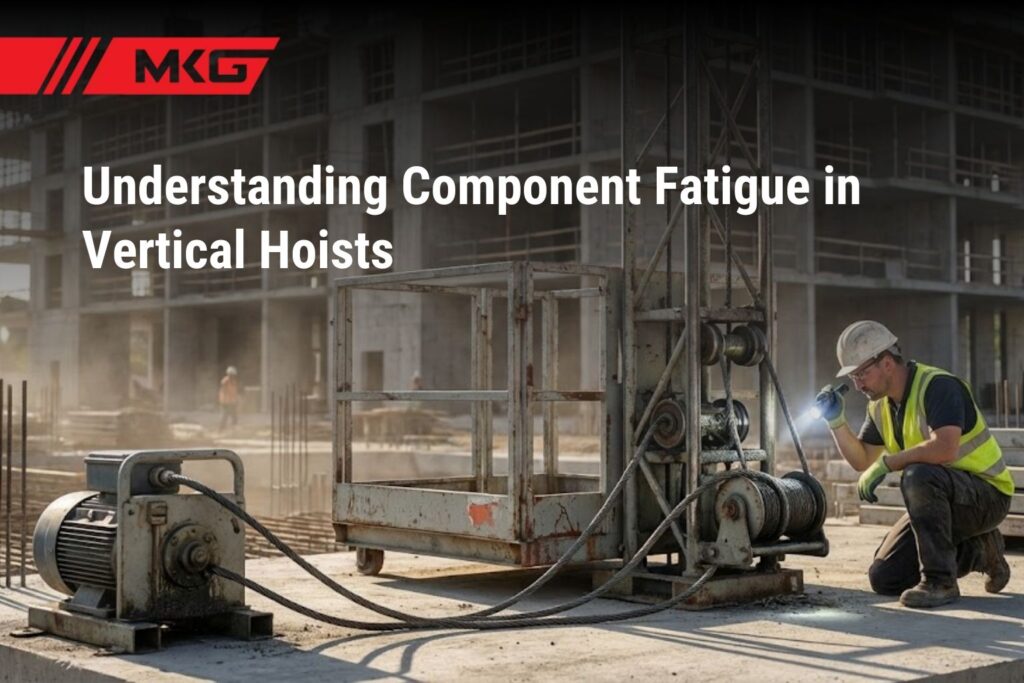
Vertical hoists are the unsung heroes of construction sites and industrial plants. They carry workers and materials up and down tall structures day in and day out. Like any hard‑working machine, the components inside a hoist endure repetitive stress and environmental challenges. Over time, this strain can lead to component fatigue – the gradual weakening and eventual failure of parts due to repeated loading cycles.
Understanding why fatigue occurs and how to prevent it is essential for safety, cost control and productivity. In this guide, we’ll demystify component fatigue in plain language, draw on lessons from engineering research and competitor insights, and explain how our MKG hoists are designed to minimize fatigue.
What Is Component Fatigue?
At its simplest, fatigue is a type of failure that happens when a component is repeatedly stressed, even if each individual stress is below the metal’s ultimate strength. In fact, mechanical fatigue is responsible for 80–90% of pure mechanical failures.
Instead of a single catastrophic overload, small cracks form under cyclic loading and gradually grow until the part fractures. In hoists, components such as load chains, wire ropes, gears, bearings and structural members experience these repeated cycles every time the hoist lifts and lowers a load.
Engineers often categorize fatigue stresses into basic force types: tension, compression, torsion, bending and shear. Each of these forces is present somewhere in a vertical hoist.
For instance, the rack and pinion gears on our Vimaan passenger and material hoist see bending and torsional stresses as they engage with the track. Wire ropes in a builder hoist experience tension and bending when they pass over sheaves. Over thousands of cycles, these stresses can cause microscopic cracks that eventually lead to failure if not managed.
Why Vertical Hoist Components Fatigue?
1. Repeated Bending and Flexing of Wire Ropes and Chains
Wire ropes and chains are subjected to bending every time they pass over a sheave or load sprocket. In a rope, repeated bending causes individual wires to lose their ability to flex, especially if they are constrained or unable to move freely.
Undersized sheaves or improper sheave maintenance restrict this movement and accelerate fatigue. A smaller D/d ratio (sheave diameter to rope diameter) increases bending stress and reduces rope life. For example, increasing the sheave size from 40 times the rope diameter to 55 times can almost double the service life. Conversely, using a sheave with too small a diameter can reduce service life by over 30%.
2. Cyclic Loading of Chains and Load Sprockets
Electric chain hoists exhibit two main loading types. When a chain passes over the load sprocket, Type I loading generates rolling and sliding motion between adjacent links, producing complex stress patterns and surface pitting. In contrast, links that do not pass over the sprocket experience
Type II loading, acting more uniformly but still sustaining tension. Both loading types contribute to fatigue by causing micro‑damage during each cycle. Preventing surface pitting through proper lubrication and using high‑quality, case‑hardened chains can improve fatigue resistance.
3. Overloading and Lack of Capacity Buffer
Operating a hoist close to its rated capacity every time speeds up wear and fatigue. The Jindiao lifting company notes that a hoist used continuously at 100 % capacity experiences significantly more stress and wear than one operated at 75–80 % of its limit. Without a safety margin, repeated high loads accelerate component fatigue and shorten the equipment’s lifespan. This is why our Vimaan hoist offers multiple load capacity options (1 ton, 1.5 ton or 2 ton) and encourages customers to choose a model with capacity headroom for their most demanding use cases.
4. Material and Design Factors
Fatigue resistance depends on both material properties and design. The Department of Energy’s Hoisting & Rigging Fundamentals manual explains that ropes made of many small wires have greater fatigue resistance than ropes made of fewer larger wires because smaller wires can bend more easily. To mitigate fatigue, ropes must not bend over drums or sheaves so small that they kink or excessively bend the wires. Proper factors of safety are applied during rope selection because every rope gradually loses strength due to surface wear and metal fatigue.
Designers also consider the expected number of load cycles. The ASME Below-the-Hook Lifter standard assigns a Service Class based on the number of load cycles a lifter will see. Every time a lifter flexes under load it accumulates fatigue, so Service Class 2 typically accommodates 100,001–500,000 load cycles. Selecting an appropriate service class helps ensure that materials and welds are specified to withstand the anticipated fatigue life.
5. Environmental and Maintenance Factors
Environmental conditions such as dust, moisture and corrosion accelerate fatigue. The OneMonroe guide notes that corrosion or improper installation can hasten hoist ring fatigue. Similarly, the Hoisting & Rigging manual warns that ropes lose strength over time due to surface wear and fatigue and must be inspected regularly. Improper lubrication restricts internal movement and increases wear. Conversely, good lubrication reduces friction and pitting, extending component life. Ensuring components remain rust‑free and aligned is therefore a critical part of fatigue prevention.
Signs of Fatigue in Vertical Hoists
Recognizing fatigue early prevents accidents and costly downtime. Common signs include:
- Broken wires or strands in ropes or chains. As fatigue progresses, wires in a rope will start to break at points of maximum bending stress.
- Surface pitting, cracks or deformation on chains or gears. Fatigue often appears as pits or hairline cracks on chain links.
- Increased slack or jerky movement. Difficulty in smooth lifting may indicate worn bearings or gears.
- Rust or corrosion on structural components. Corrosion accelerates fatigue and should be addressed promptly.
Regular inspection, ideally before each shift, is the best way to spot these signs early. Our blog on maintaining passenger hoists outlines a daily pre‑use checklist that includes inspecting the cage, mast, labels, doors, safety interlocks and electrical controls. These simple checks catch 80 % of common issues before they become serious.
Practical Strategies to Reduce Component Fatigue
Choose Adequate Capacity and Built‑In Safety Margins
Avoid routinely running a hoist at its maximum rated capacity. At MKG, we recommend selecting a hoist model with a buffer of 20–30 % above your average load. For example, if your heaviest load is 800 kg, consider our 1.5‑ton Vimaan, which provides headroom for occasional heavier lifts. A larger capacity reduces strain on the rack, pinion gears and drive motor, extending their fatigue life.
Optimize Sheave Sizes and Maintain Them
Hoists using wire ropes should adhere to recommended D/d ratios (sheave diameter divided by rope diameter). The Bethlehem bulletin shows that increasing the sheave diameter can increase the service life by up to 91 %. A sheave that’s too small dramatically shortens rope life. Our builder tower hoist models use appropriate sheave sizes and high‑quality wire ropes (10 mm or 12 mm diameter) to maximize lifespan. Routine inspection of sheave grooves and bearings also reduces wear.
Lubricate and Clean Regularly
Lubrication is the unsung hero in combating fatigue. Proper lubrication reduces friction between rope wires, preventing pitting and abrasion. Our maintenance blog advises greasing the rack and pinion, pulleys and guide rollers weekly. Cleaning dust and cement splatter prevents abrasive wear and corrosion. Remember to use manufacturer‑approved lubricants and avoid water around electrical components.
Conduct Frequent Inspections and Follow Service Classes
Just as doctors recommend regular check‑ups to catch health issues early, hoist operators should perform daily and weekly inspections. The MKG maintenance guide explains that a 10‑minute daily check can catch most problems. Weekly checks include examining lubrication, tightening bolts, inspecting ropes and testing safety devices. Additionally, adhere to the Service Class guidelines from ASME BTH‑1 by tracking load cycles and scheduling periodic inspections accordingly. The more frequently a hoist is used, the more often it should be inspected.
Train Operators for Smooth, Stress‑Free Use
Mechanical shock and abrupt stops contribute to fatigue. Our maintenance article emphasizes smooth starts and stops and proper communication between operators and ground crew. Overloading not only stresses the hoist but can also trigger emergency brakes and jerky movements that accelerate wear. Training ensures operators respect load limits, use safety devices correctly and recognize early signs of fatigue.
Use High‑Quality Components and Design Features
Material quality matters. The Hoisting & Rigging manual stresses that ropes made of many smaller wires have better fatigue resistance. Similarly, high‑quality load chains are less prone to pitting and fatigue. At MKG, our Vimaan hoist uses Schneider control panels and PBL geared motors. These reputable components ensure durability and a long service life. The hoist also features rack searching limit switches, overload protection, buffer springs and a manual brake release system. Each safety feature reduces the risk of overstressing components.
How MKG Designs Hoists to Resist Fatigue?
At MKG, we don’t just talk about fatigue – we design against it. Our Vimaan passenger & material hoist is built specifically for demanding construction environments. Key features that combat fatigue include:
- Rack & Pinion Mechanism: This design ensures smooth travel and distributes stress evenly.
- Variable Speed Range (20–60 m/min): Allows operators to move heavy loads without sudden jerks that increase stress.
- Advanced Safety Devices: Multiple limit switches prevent over‑travel, and an overspeed governor protects against free fall.
- High‑Quality Motors and Controls: Using PBL geared motors and Schneider control panels ensures reliable performance and reduces maintenance frequency.
- Flexible Load Capacities: Options from 1 ton to 2 tons (twin cage) allow customers to choose the right size with a built‑in safety margin.
For material handling, our builder tower hoist offers robust wire ropes (10 mm and 12 mm), strong frames and brake motors to keep loads secure. The TH‑60 and TH‑200 models can lift 500 kg and 1,000 kg respectively to heights of 60 ft and 200 ft. These specifications help contractors choose equipment that minimizes fatigue by matching capacity to site demands.
Beyond Equipment: Your Role in Preventing Fatigue
Even the best‑designed hoist can suffer from premature fatigue if operators neglect maintenance or push it beyond its limits. Here’s how you can make a difference:
- Follow a Maintenance Schedule. Regularly grease moving parts, inspect ropes and chains for wear, and replace them before they fail. Our blog provides a detailed weekly inspection checklist.
- Respect Environmental Conditions. Use rust inhibitors and protective coatings in humid or coastal environments. Cover hoist components during heavy rain or long idle periods.
- Operate Within Rated Limits. Always know the hoist’s load capacity and avoid overloading. Use safe load indicators when available and distribute weight evenly.
- Train Your Team. Ensure that only trained operators use the hoist. Good communication and awareness reduce errors that lead to excessive stress.
Choose the Right Equipment. Consult with our experts to select a hoist with appropriate capacity and features. A well‑matched hoist experiences less fatigue and lasts longer.
Conclusion
mini lift, or hanging platform, the way you maintain your equipment directly impacts uptime, safety, and long-term value. Choosing between AMC and on-demand maintenance is really about how proactive you want to be.
On-demand maintenance may look flexible at first, but it often means reacting after problems show up. AMC, on the other hand, is about planning ahead – regular inspections, timely servicing, predictable costs, and fewer surprises on site. Over time, that proactive approach usually saves money, reduces downtime, and extends the life of your equipment.
At MKG, we design and build vertical equipment for real construction conditions – heavy loads, long hours, and demanding environments. That’s why we strongly believe maintenance should match the same mindset. A well-structured AMC helps your MKG machines perform the way they were designed to, day after day, without being pushed beyond their limits.
Whether you manage a single project or multiple sites, the right maintenance strategy keeps your timelines intact, your crews confident, and your equipment reliable.
Let’s plan maintenance the smart way – before problems slow you down.
Talk to MKG’s technical experts today to understand how proper inspection, servicing, and component care can extend the life of your vertical equipment.
info@mkgworld.in
+91 95222 39320
MKG – Built for safety. Built for the future.