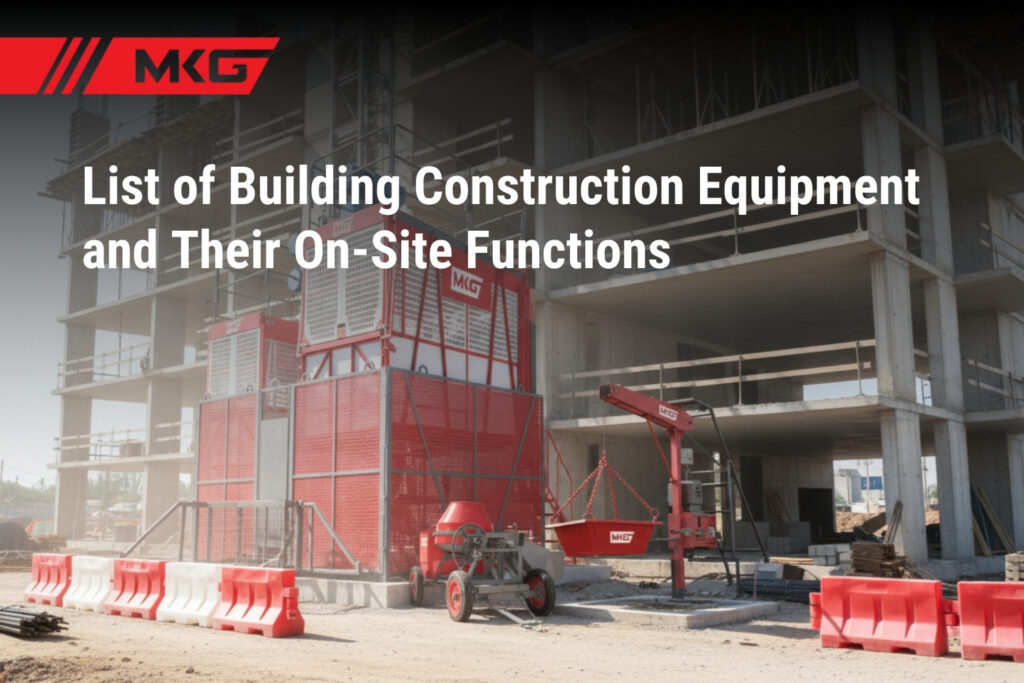
Modern construction projects are complex. Every job site needs machines that dig, lift, mix, cut and finish, and each piece of equipment has a specific function. At MKG, we have built our business around helping contractors choose the right tools. This guide walks you through common construction equipment, explains what each does on site and shows how MKG products fit into the workflow.
Understanding the Rules - The Regulatory Landscape
The first step on any project is preparing the ground. Excavators use a hydraulic boom, bucket and 360‑degree rotating house to dig trenches, demolish old structures and lift heavy materials. The ability to swing without moving the tracks makes them efficient in confined spaces. Many modern units use GPS and fuel‑efficient engines for precise digging.
Bulldozers follow behind the excavator. Their wide blade pushes soil to create level pads and clear vegetation. Rear rippers break up compacted ground and tree roots. Tracks distribute the machine’s weight so it can work on soft or uneven soil without sinking. Today’s dozers also integrate GPS‑assisted blade control for accurate grading. Once the dozer has shaped the ground, soil must be compacted to prevent settlement; we’ll return to compaction equipment later.
Moving materials: loaders and backhoes
After soil is loosened, it must be moved. Wheel loaders scoop and transport sand, gravel or debris, while skid‑steer loaders perform similar tasks in tighter areas using differential steering to pivot within their own footprint. Both machines can accept attachments to expand their capabilities.
For utility projects and smaller sites, backhoe loaders are the ultimate multi‑taskers. They combine a loader at the front and a backhoe at the rear, so operators can dig, lift pipes and fill trenches without switching machines. Compact dimensions and four‑wheel steering mean they navigate urban streets easily. Because backhoes share components with farm tractors, maintenance costs stay low.
To complement these vehicles, MKG offers vertical lifting tools. OurMini Lift transports materials to upper floors with a 250–300 kg capacity. For larger sites, theTower Hoist raises heavier loads through heights up to 200 m. Vertical lifting keeps ground traffic clear and improves safety compared to hauling materials up ramps.
Shaping surfaces: graders, compaction and haulage
Fine grading creates a stable, long-lasting base.
Once rough shaping is done, motor graders use a long, centrally mounted blade (moldboard) to smooth and contour roads or foundations. Adjustable blade angles help form proper drainage slopes, while GPS or laser systems improve grading accuracy and consistency.
Grading protects structures, not just appearance.
Well-graded surfaces direct water away from buildings, reducing erosion and moisture damage. Precise grading also minimises material wastage and prepares the surface for effective compaction, which is critical for load-bearing performance.
Compaction locks the ground in place.
Loose soil settles over time, leading to cracks and failures. MKG offers reliable compaction solutions for different site needs. Our Walk-Behind Roller compacts asphalt and base layers evenly, tamping rammers deliver high-impact force for trenches, and plate compactors provide continuous vibration for soil and granular materials.
Right compaction prevents future failures.
Properly compacted soil supports heavy loads while still allowing drainage. This balance reduces the risk of sinkholes, uneven slabs, and premature surface damage.
Material movement keeps the site flowing.
Dump trucks transport soil, aggregates, and debris across and off the site. Articulated dump trucks handle rough terrain effectively, while rigid models suit paved access roads and highways.
MKG reduces dependence on hauling.
To cut down truck traffic, MKG’s Reversible Concrete Mixer allows concrete to be mixed and discharged directly on site. This reduces congestion, lowers fuel usage, and ensures concrete reaches the pour point fresh and workable.
The outcome: smoother operations, lower costs.
Efficient grading, correct compaction, and on-site mixing work together to improve build quality, speed up execution, and reduce rework—helping projects stay on schedule and within budget.
Lifting heavy loads: cranes and hoists
Large projects require heavy materials such as steel beams and formwork to be hoisted to height. Cranes come in several types: tower cranes mount to the ground and rise alongside tall buildings; mobile cranes travel between jobs; and crawler cranes ride on tracks for stability. Modern cranes incorporate load‑moment indicators and automatic safety systems. They are indispensable for placing heavy items precisely.
Our vertical transport solutions fill the gap between cranes and manual labour. The Vimaan Passenger and Material Hoist moves people and materials up and down the building at speeds up to 60 m/min and carries 1–2 tonnes. Safety features like variable frequency drives, brake motors and limit switches protect workers. Using hoists alongside cranes frees the crane for heavy lifts and streamlines site logistics.
Safety and ergonomics are major concerns when lifting heavy loads. Cranes are designed to carry extreme weights, but using them for smaller moves can clog up schedules. By off‑loading lighter tasks to hoists, crews reduce waiting times and minimise manual handling injuries. Hoists also provide weather‑protected cages for passengers and materials, improving comfort and reducing exposure to dust and rain.
Mixing and reinforcing concrete.
Concrete strength starts with correct mixing.
Concrete mixers blend cement, sand, aggregates, and water into a uniform mix. On large projects, transit mixers supply ready-mix concrete, while stationary mixers batch concrete on site. Consistent mixing keeps material ratios accurate, which directly affects strength and durability.
MKG supports both small and large pours.
Our Concrete Mixer Machine handles up to 500 litres and is mounted on a stable chassis, making it ideal for regular site mixing. For higher-volume work, the Reversible Concrete Mixer uses a reversing drum to mix and discharge efficiently, reducing cycle time and labour effort.
On-site mixing gives better control.
Producing concrete on site allows crews to adjust the mix as conditions change. In hot weather, batching can be managed to limit water loss and maintain workability. This avoids slump loss during long transport and ensures concrete is poured exactly when formwork and reinforcement are ready.
Better timing leads to stronger concrete.
Freshly mixed concrete bonds more effectively with reinforcement and cures more evenly. This results in higher structural strength and fewer defects caused by delays or inconsistent consistency.
Reinforcement accuracy is just as critical.
Steel reinforcement must be cut and bent precisely to fit formwork. Bar cutting machines shear rebar up to 32 mm, while bar bending machines with planetary gear systems bend bars smoothly up to 42 mm, ensuring repeatable and accurate shapes.
Precision improves structural performance.
Consistent cutting and bending reduce site adjustments and prevent stress points in reinforcement. When steel fits exactly as designed, it works in harmony with concrete to carry loads safely and improve the overall reliability of the structure.
Access, finishing and safety
To work safely on façades, workers need stable platforms. Hanging platforms are an efficient alternative to scaffolding; they allow teams to clean glass or install cladding and can be adjusted in length and height. MKG’sHanging Platform comes in models that carry up to 800 kg. Optional anti‑tilt devices and overload cut‑off protect users.
For interior floors, power trowels polish freshly placed concrete to a smooth, hard finish. MKG offers walk‑behind and ride‑on models. Removing trapped air before finishing is important; our conventional vibrators are suited to thin slabs and walls and come in electric and diesel variants. A frequency converter keeps vibration consistent.
Specialised tools: cutting and lighting
Some tasks require specialised machines. Concrete cutters use diamond blades to make joints, openings or cut damaged pavement. OurConcrete Cutter provides petrol‑powered models with adjustable cutting depth and water‑cooled blades to reduce dust and overheating.
On large sites, work often continues after dark. Tower lights illuminate work areas to reduce accidents and keep productivity high. OurTower Light TL9000 uses a telescoping mast with multiple lamps and a diesel generator, and folds for easy transport. It can operate through night shifts without refuelling.
Conclusion
Understanding building construction equipment isn’t just about knowing machine names—it’s about knowing what to use, when to use it, and why it matters on site. From earth-moving and grading to mixing, lifting, cutting, and finishing, every machine plays a defined role in safety, speed, and build quality.
Modern job sites demand equipment that is reliable, compliant, and easy to operate. When the right machines are used at the right stage, projects move faster, material waste reduces, and structural quality improves – without compromising worker safety.
At MKG, we design and manufacture construction equipment that fits seamlessly into every phase of a project. Whether it’s hoists for vertical movement, mixers for consistent concrete quality, compactors for stable foundations, or cutting and finishing tools for precision, our machines are built to perform on real Indian job sites.
Choosing MKG means choosing efficient workflows, safer operations, and long-term durability.
Let’s build smarter, safer construction sites – together.
Talk to MKG’s technical experts today to understand which construction equipment suits your site requirements and project scale.
📧 Email:info@mkgworld.in
📞 Call:+91 9522239320
MKG – Built for safety. Built for the future.