Ask anyone on a building site what matters most and you’ll hear the same answer: everyone getting home safe at the end of the day. Construction equipment has grown faster, stronger and smarter over the years, but those improvements aren’t worth much if the machines don’t protect the people using them. Industry reports show that proper inspection and maintenance can prevent up to 85 % of equipment‑related accidents. When you consider the cost of downtime, legal penalties and human injury, investing in safe and compliant machinery isn’t just the right thing to do – it’s good business.
At MKG, we have spent more than a decade building hoists, concrete mixers, cutting and bending machines for India’s booming infrastructure projects. We see safety and compliance not as a regulatory nuisance but as a core design principle. This article looks at how modern equipment manufacturers ensure safety, the standards involved, and how our own products embody these principles. Throughout we’ll reference independent research and industry best practices to justify each point.
Understanding the Rules - The Regulatory Landscape
A mix of international and local standards defines construction safety rules. In India, hoist operators must be licensed under the Indian BIS and state factory inspectorate guidelines; training must cover emergency procedures, load management and pre‑use checks. These standards exist because history has shown that unguarded machines, faulty interlocks or untrained operators lead to serious injuries.
Why mention these acronyms? Because compliance isn’t a choice – it’s the foundation on which all responsible manufacturers build. Ignoring regulations risks fines, legal action and reputational damage.
More importantly, compliance helps prevent tragic accidents by mandating features such as properly sized personal protective equipment (PPE), fall protection for work above six feet, and machine guards that prevent contact with moving parts. For customers, buying from a compliant manufacturer means you’re investing in equipment that meets these rigorous benchmarks.
Designing Safety into Every Machine
Modern equipment manufacturers embed safety at the design stage rather than bolting it on as an afterthought. Key elements include:
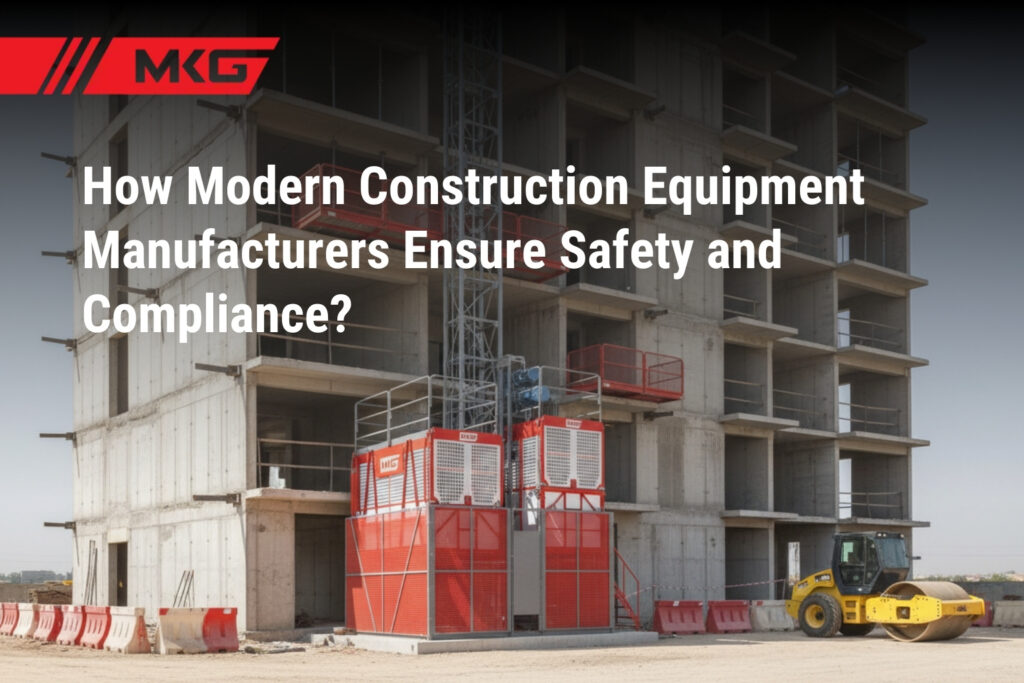
- Physical guards and interlocks: Machine guarding protects operators from moving parts, and door interlocks ensure hoist cages can’t open while in motion. The National Association of Safety Professionals emphasises that such controls reduce risks of entrapment and inadvertent movement. Our Vimaan passenger & material hoist features automatic limit switches, overspeed governors and interlocks that prevent the door from opening mid‑travel.
- Emergency stop and brake systems: V-Comply’s safety guide lists emergency stop buttons and braking systems as mandatory features. On our Vimaan hoist the emergency stop cuts power instantly, while buffer springs and manual brake release provide additional redundancy.
- Load monitoring and overload protection: Overloading is a major cause of hoist failures. Competitor articles on hoist maintenance remind operators to respect load ratings and to use Safe Load Indicators (SLI) or similar devices.
- Ergonomic design and visibility: Comfortable cabins, adjustable controls and panoramic visibility reduce operator fatigue and errors. Conserv Machinery notes that ergonomic cabins and unobstructed sightlines are vital for safety. We design our operator stations to be intuitive and open, so users can focus on the job without strain.
- Quality components: Poor‑quality parts can fail unexpectedly. By using reputable brands like Schneider for control panels and PBL for gear motors, the Vimaan hoist maintains long‑term reliability. Durable parts mean fewer breakdowns and lower risk of sudden failure.
These design choices aren’t marketing fluff; they are required to meet ISO and BIS standards and to protect people. A well‑maintained hoist built with quality components can last 20–30 years, whereas a neglected one might fail in less than a decad.
Harnessing Digital Technologies and IoT
The construction industry is undergoing a technological revolution. New tools help manufacturers and site managers monitor equipment health, predict failures and ensure ongoing compliance:
- Sensors and predictive maintenance: The Heavy Vehicle Inspection (HVI) report notes that digital inspection systems enable automated compliance tracking, real‑time safety alerts and predictive maintenance. Our equipment uses sensors to monitor motor temperature, vibration and usage hours. Alerts prompt timely service before small issues become breakdowns.
- Internet of Things (IoT) connectivity:Cemex Ventures highlights how IoT sensors provide real‑time monitoring and allow remote shutdown if unsafe conditions are detected. We have introduced optional IoT modules on select machines to transmit operational data to site supervisors and our service team.
- Smart user interfaces: Our reversible concrete mixers feature a USB port and printing panel for real‑time data and an automatic water flow controller. Additional options include load‑cell‑based weighing systems, digital batch printing and SCADA compatibility. These features improve accuracy and provide an auditable record of each batch.
- Wearable and PPE technology: Trends in PPE include smart helmets with sensors, advanced gloves and high‑visibility clothing with built‑in LED lights. While these aren’t built into the machine, manufacturers can integrate docking stations for wearable sensors or design cabins that accommodate communications gear.
Smart technology isn’t just for show. Predictive maintenance lowers downtime, digital records help meet documentation requirements, and remote monitoring can prevent catastrophic accidents by shutting down unsafe machines. Adopting these technologies demonstrates a commitment to proactive safety rather than reactive compliance.
Harnessing Digital Technologies and IoT
Even the safest machine can become risky if it’s used without proper training. That’s why safety guidelines stress regular operator training, clear procedures, and strong documentation as the foundation of compliance. These practices protect workers, reduce accidents, improve morale, and help companies avoid penalties while building trust on-site.
At MKG, we ensure that only trained and certified operators run our hoists and mixers. Training covers safe operation, emergency handling, load limits, and daily pre-use checks. We also provide operator manuals, maintenance records, and inspection checklists – because good documentation isn’t just proof of compliance, it’s a practical safety tool.
True safety goes beyond checklists. We promote clear communication between operators and site teams, smooth machine handling, and strict adherence to weather and load limits – helping protect both people and equipment, every day.
Maintenance and Inspection - The Unsung Heroes
Poor maintenance is one of the biggest causes of equipment failure and site accidents. Regular inspections catch small issues early, preventing costly breakdowns and serious safety risks. Think of maintenance as preventive medicine – it keeps machines safe, compliant, and reliable.
- Daily checks should take just 10 minutes: inspect the hoist cage, mast, and anchors for cracks, loose bolts, or rust. Ensure safety labels are visible, test door interlocks and emergency stops, and run one empty cycle to check for unusual noise.
- Weekly inspections go deeper. Lubricate rack and pinion systems, pulleys, and guide rollers. Check wire ropes for wear, test limit switches and safety devices, and confirm rails and rollers move smoothly.
- Cleaning and corrosion control are just as important. Dust, cement, and moisture accelerate wear, so regular cleaning, greasing, and protective coatings are essential – especially during monsoons or coastal projects.
- Load and environmental management matter too. Always stay within rated capacity, distribute loads evenly, and reduce or stop operations during high winds or extreme weather.
At MKG, we support customers with preventive maintenance plans and genuine spare parts, because well-maintained equipment stays safer, lasts longer, and remains compliant with BIS, ISO, and OSHA standards.
External Best Practices and Industry Trends
Looking beyond our own experience, competitor research highlights several trends and best practices that are reshaping construction equipment safety:
- Integrated Risk Assessments: V‑Comply and other safety guides recommend conducting formal risk assessments during equipment design and before each project to identify hazards and implement mitigation measures. This process feeds into ISO 12100 compliance and ensures that every foreseeable risk is addressed.
- Advanced PPE: High‑tech helmets with sensors, gloves with impact protection and LED‑embedded vests improve worker visibility and feedback. Manufacturers can design cabins to store and integrate these devices.
- Automation and Robotics:Articles on industrial equipment trends note that automation, robotics and artificial intelligence are becoming. Autonomous or semi‑autonomous equipment reduces exposure of workers to hazardous tasks and can operate with greater precision. Manufacturers must embed fail‑safes and allow for manual override.
- Environmental Compliance: Increasingly stringent emissions laws require equipment to minimise pollutants and manage waste. Electrification of mixers and hoists, as well as recycling of lubricants and materials, will be key. Our electric versions of the RCM series and concrete mixers respond to this demand.
- Continuous Learning: Regulations change often. Updates in 2025 introduced revised PPE fit standards and stricter injury reporting. To stay compliant, manufacturers must monitor regulatory developments and upgrade designs accordingly.
By following these trends, equipment manufacturers can stay ahead of regulatory changes and deliver safer, more sustainable machines.
Our Commitment - Building Trust Through Safety
At MKG, safety and compliance aren’t just words – they shape everything we do. From the initial design of our Vimaan hoist to the quality control of our concrete mixer machine and bar processing equipment, we prioritise human safety and regulatory compliance. We collaborate with component suppliers who meet international standards; we rigorously test our prototypes; and we provide detailed manuals, training and after‑sales service.
Our hoists are designed, built and serviced in India using indigenous technology that meets global standards. We understand the demands of Indian job sites – from monsoon rains and scorching heat to tight urban spaces and engineer our machines accordingly. Our service teams are available to create preventive maintenance plans, conduct inspections and supply genuine spare parts. We want your investment to last 20–30 years, not fail prematurely due to neglect.
If you’re interested in learning more about selecting the right machinery for high‑rise projects, check out our blog onTop Types of Construction Equipment Used for High‑Rise Building Projects. For detailed maintenance tips, ourpassenger hoist maintenance guide offers step‑by‑step checklists. These resources complement the ideas in this article and help you get the most out of your equipment.
Our Commitment - Building Trust Through Safety
Modern construction equipment isn’t just about power or performance – it’s about responsibility. Manufacturers today must meet strict regulations, adapt to fast-changing technology, and design machines that protect lives while keeping projects on track. When safety and compliance are built into design, training, and maintenance, job sites become more productive, reliable, and accident-free.
At MKG, safety is not an add-on – it’s part of every machine we build. From hoists and mixers to cutting and compaction equipment, our solutions are designed for India’s infrastructure growth with compliance, durability, and operator protection at the core.
When you choose MKG, you’re not just investing in equipment.
You’re investing in peace of mind, long-term reliability, and safer job sites.
Let’s build safer, smarter construction sites – together.
Talk to MKG’s technical experts today to discuss your site needs or choose the right equipment for your upcoming projects.
📧 Email:info@mkgworld.in
📞 Call:+91 9522239320
MKG – Built for safety. Built for the future.