
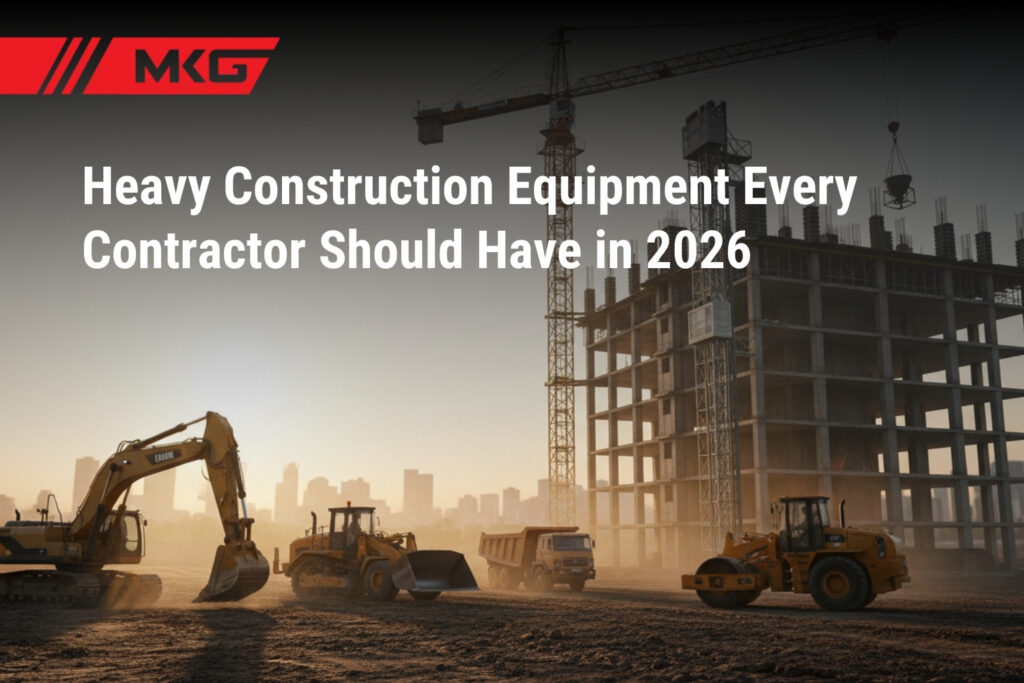
As India’s infrastructure boom continues, contractors face bigger sites, tighter schedules and growing sustainability expectations. 2026 will belong to firms that invest in versatile, efficient and future‑ready heavy equipment. At MKG, we’ve watched the evolution of construction machinery closely – both the cutting‑edge features and the everyday problems contractors face.
In this guide, we’ll unpack the must‑have machines for the coming year, compare them with current market trends and illustrate how our own innovations help meet those challenges.
1. Excavators - the powerhouse of earthworks
Every building starts with digging. Excavators combine a rotating cab, long articulated arm and powerful bucket to dig trenches, foundations and even demolish structures. Recent guides note that modern excavators use wheels or tracks and can rotate 360° to perform tasks ranging from digging and trenching to lifting. Smart hydraulic systems and GPS controls improve efficiency and safety.
2. Bulldozers and dozers - moving mountains with ease
Once earth has been loosened, bulldozers push, level and clear material. A dozer is a machine with a wide blade that pushes and loosens soil and can even break structures. Recent models incorporate hybrid engines and blade control systems for improved fuel efficiency and precise grading. Their tracked undercarriage allows them to traverse soft ground.
3. Wheel loaders and backhoe loaders - carrying and multitasking
After material is excavated or pushed aside, it needs to be moved efficiently. Wheel loaders scoop gravel, soil or debris and transport it around the jobsite. Modern loaders with telematics can track fuel consumption and maintenance. Backhoe loaders combine a rear backhoe with a front loader, giving smaller crews the ability to dig, trench and move material in tight urban sites. Articles highlight how backhoes combine excavator and loader functions, offering exceptional versatility.
Wheel loaders pair well with our tower hoists and mini lifts. MKG’s mini construction lift is designed for mid‑rise projects and can transport up to 250–300 kg of bricks, cement or tools to heights of 30 m. Its compact frame fits where larger loaders or cranes can’t reach, saving labour and time.
For larger structures, our tower hoist moves up to 1 ton of concrete or aggregate vertically, reducing manual lifting and accident risk. Loading the hoist directly from a wheel loader streamlines material handling.
4. Skid‑steer loaders and telehandlers - compact multitaskers
On crowded urban sites, skid‑steer loaders shine. They turn within their own footprint and accommodate attachments such as augers, pallet forks or trenchers. Competitor listings note that skid steers allow quick material handling in confined spaces and are often used for landscaping, snow removal and debris clearing.
Telehandlers (telescopic handlers) combine fork‑lift capability with crane‑like reach. They lift loads to elevated positions and extend forward to place pallets or formwork precisely. Conserv Machinery’s guide emphasises telehandlers’ versatility and popularity on modern jobs.
5. Cranes - lifting the heavy stuff
For vertical construction, cranes are indispensable. Tower cranes hoist steel beams, rebar bundles and precast slabs; mobile and crawler cranes handle infrastructure projects. Modern cranes feature load‑moment indicators and remote operation for safe heavy lifting demands careful coordination.
We integrate lifting capabilities through Vimaan passenger & material hoists rather than manufacturing cranes. Our hoists feature manual brake release and dead‑mast structures for extra safety. For precise lift planning, we encourage contractors to pair cranes with our bar cutting machines – ensuring rebar arrives on site pre‑cut to exact lengths. MKG’s C‑40, C‑45 and C‑50 models automate cutting, delivering high accuracy and output while reducing manual effort.
6. Dump trucks - moving material offsite
No jobsite is complete without dump trucks. These heavy‑duty vehicles transport soil, rubble and asphalt across rough terrain. Guides explain that dump trucks feature large wheels, deep grooves and heavy payloads. Newer models include electric drivetrains for lower emissions and telematics to monitor load volume.
7. Motor graders and compaction equipment - achieving precision
For roadworks and finishing slabs, motor graders create smooth, level surfaces. MechLink emphasises that graders are used for fine grading and shaping after earthwork. Modern graders feature laser or GPS guidance for high precision.
After grading, surfaces must be compacted. Our walk‑behind roller is built with dual‑drum vibration, balanced design and self‑propelled drive. For confined areas like trenches, our tamping rammer delivers impact forces of 13–16 kN with a jump height of up to 65 mm – ideal for compaction depths of 12 inches. Proper compaction improves load‑bearing capacity and prevents settlement. When a grader pairs with our compactors, asphalt and subgrade layers meet strict specifications, reducing maintenance costs.
8. Concrete mixers and fabrication equipment - making strong structures
Concrete isn’t just about mixing; it requires precision and timing. Standard mixers combine cement, sand, gravel and water to create homogeneous concrete, enabling consistent structural strength. Our semi‑automaticconcrete mixer features a 500 L drum, heavy‑duty chassis, hydraulic hopper and pneumatic wheels for mobility, producing 0.35 m³ batches with uniform consistency. Proper mixing reduces segregation and improves finish quality.
On sites requiring even more automation, our reversible concrete mixer provides digital features like USB ports, printing panels and automatic water flow controllers. Optional SCADA connectivity and batch printing help contractors monitor production records – useful for quality audits.
9. Access equipment - safe platforms and hoists
Modern construction demands safe access at height for façade installation, painting and maintenance. Traditional scaffolding is time‑consuming and inflexible; rope‑suspended platforms offer a safer alternative. Our hanging platform accommodates loads of 500–800 kg and can be extended with modular components. Optional anti‑tilt devices, anti‑sway systems and parapet clamping enhance safety, making them suitable for glass installation or industrial plant inspections.
On sites requiring even more automation, our reversible concrete mixer provides digital features like USB ports, printing panels and automatic water flow controllers. Optional SCADA connectivity and batch printing help contractors monitor production records – useful for quality audits.
Conclusion
At MKG, we believe heavy construction equipment is more than just machinery – it’s the foundation of safe, efficient and future-ready job sites. As we move into 2026, contractors need equipment that can keep up with tighter timelines, taller structures and increasing expectations around safety and productivity. From material handling and compaction to concrete processing and vertical lifting, the right machines make all the difference.
Years of on-ground experience have shaped how we design and manufacture our equipment. Every Tower Hoist, Mini Lift, Bar Cutting Machine, Concrete Mixer, Walk Behind Roller, Plate Compactor and Tamping Rammer we build is engineered to handle heavy loads, harsh site conditions and long working hours without compromising reliability or operator safety.
Our role doesn’t end at delivery. With dedicated technical support, easy access to genuine spare parts and expert guidance, we help contractors get long-term value from their investment. With correct installation and routine maintenance, MKG equipment is built to support projects for years – not just one job.
Talk to MKG’s technical experts today to discuss your site requirements or get help choosing the right equipment for your 2026 projects.
Email:info@mkgworld.in
Call:+91 9522239320
Let’s build safer, faster and smarter construction sites – together with MKG.