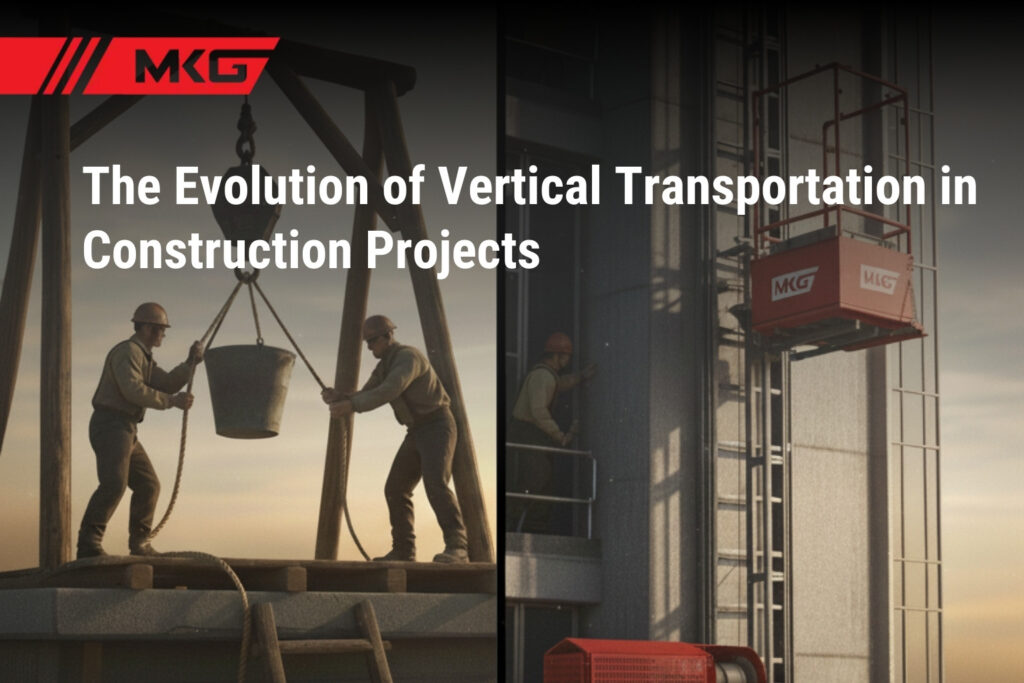
Vertical transportation has always been central to construction. Long before skyscrapers, builders used ropes and pulleys to lift stones. Each improvement enabled taller structures and sped up work. At MKG, our passion for safe, efficient lifting drives our products and informs our view of vertical transportation.
Looking back to the simplest lifts
Ancient engineers knew that lifting heavy loads by hand was slow and dangerous. In Greece and Rome, builders fashioned simple hoists using ropes wound around drums or capstans to raise blocks. Powered by humans or animals, these devices could only lift small loads yet laid the foundation for mechanical lifting. The basic rope‑and‑pulley idea still underpins modern machines, showing how a simple concept can evolve into complex systems.
Steam power and the Industrial Revolution
By the 18th and 19th centuries, cities were booming. Mines deepened and warehouses grew taller, creating demand for better lifting. Steam engines replaced muscle power, allowing hoists and elevators to raise far heavier loads. These lifts freed builders from manual labour, but they were still risky: a snapped rope could send the platform plummeting, and controls were primitive by today’s standards.
Otis and the safety brake
A single invention turned hoists into safe passenger elevators. In 1853, Elisha Otis unveiled a spring‑loaded brake that clamped the platform to the guide rails if the hoisting rope failed. He proved its effectiveness at the New York World’s Fair by cutting the rope in front of a crowd. The platform stayed put, transforming elevators from dangerous freight machines to reliable transportation.
Transition to electric power
Steam soon gave way to electricity. Inventors such as Werner von Siemens introduced electric motors for elevators in the late nineteenth century, providing smoother, faster rides. Electric traction systems with counterweights reduced the energy needed to raise the car. Push‑button controls introduced automation and eliminated the need for human operators. By making lifts easier to use, electricity catalysed their adoption in offices and hotels and opened the door to true high‑rise construction.
Vertical transportation sparks skyscrapers
The skyscraper era would have been impossible without reliable lifts. Early high‑rise buildings in New York and Chicago used banks of elevators to move occupants quickly, enabling towers to soar beyond ten stories. With safe, fast lifts, developers could build structures like the Empire State Building that offered breathtaking views and space efficiency. Elevators allowed dense urban cores by making upper floors accessible; without them, most people would avoid living or working above a few flights of stairs.
Material hoists enter the scene
While elevators carried people, builders still needed to move concrete, bricks and sand. Early jobsite hoists adapted rope‑driven platforms to handle heavy materials, prioritising load capacity over speed. By the early twentieth century, purpose‑built tower hoists appeared, featuring open or semi‑enclosed platforms for easy loading. These machines dramatically improved productivity compared with manual hauling and became a staple on construction sites.
Our role at MKG - meeting material‑handling needs
At MKG, we recognised that moving materials vertically is one of a site’s biggest bottlenecks. Ourbuilder tower hoist uses a robust mast and brake motor to ensure controlled lifting. Contractors can choose models with 500 kg or 1,000 kg capacity and lift loads up to 60 ft or 200 ft. By taking the strain off workers and accelerating material handling, our hoist makes jobsite logistics smoother and safer.
The rise of passenger elevators in construction
Once people trusted elevators, developers saw them as an amenity and productivity booster. By the late nineteenth century, passenger elevators appeared in hotels and offices. Lifts allowed buildings to add more floors without losing tenants to foot fatigue, and they offered an elegant way to travel inside grand structures. Today, a building’s vertical transportation system is carefully planned to balance speed, capacity and energy use.
Combining people and material transport
Construction sites often need a hoist that can carry both workers and bulky items. OurVimaan passenger and material hoist meets this challenge. It uses a rack‑and‑pinion drive for smooth travel and offers load capacities from 1 ton to 2 tons. The fully enclosed cabin protects riders, and a speed range of 20–60 m/min ensures timely transport. Safety features such as limit switches, buffer springs and a manual brake release provide peace of mind.
Mini lifts for small projects
Not every site needs a high‑capacity hoist. Villas, small commercial buildings and interior fit‑outs still benefit from mechanised lifting. OurMini Lift is a compact machine that moves up to 250 kg of materials to heights of around 30 m. Powered by a 3 HP electric motor and operating at roughly 30 m/min, it accelerates work and reduces manual labour. By reducing fatigue and risk associated with carrying heavy loads up stairs, the mini lift makes smaller projects safer and more efficient.
How tower hoists differ from passenger hoists
Understanding the differences between material hoists and passenger hoists helps contractors choose the right solution. Tower hoists have open or semi‑enclosed platforms and are built to carry sand, bricks or concrete; they prioritise load capacity and ruggedness rather than rider comfort. Passenger hoists feature fully enclosed cabins, emergency brakes, interlocks and overload sensors to protect occupants. Our blog onTower Hoist vs. Passenger Hoist explains these contrasts and illustrates why Vimaan combines both functions for mixed projects.
Automation and destination dispatch
As buildings grew taller, simple up‑and‑down controls no longer sufficed. From the mid‑twentieth century onward, elevators adopted computerized dispatch systems that dynamically group passengers traveling to similar floors. These destination dispatch systems reduce the number of stops and lower waiting times, improving traffic flow and saving energy. Automation also means elevators can adjust speed and acceleration depending on passenger load, making rides smoother and extending equipment life.
Smart technology, sustainability and the future
Today’s vertical transportation merges mechanical engineering with digital intelligence. Regenerative drives capture energy during descent and feed it back into the building’s electrical system. Sensors, Internet of Things devices and predictive maintenance software monitor elevator health in real time and schedule service before problems occur.
Industry 4.0 is also reshaping aerial work platforms: scissor lifts now incorporate telematics, load sensors and obstacle detection to improve safety and productivity. Electric and hybrid models are quiet and emission‑free, making them ideal for indoor or environmentally sensitive sites.
Some manufacturers are even testing rope‑less, multi‑directional elevators that use linear motors to move cabins vertically and horizontally. Though experimental, these concepts hint at a future where shafts are shared by multiple cars and buildings become more adaptable.
The human dimension and social impact
Vertical transportation isn’t just about machinery; it affects how we live. Elevators make multi‑storey buildings accessible to people with mobility challenges, allowing elderly or disabled residents to remain independent. By enabling taller buildings, lifts help cities grow upward rather than outward, preserving open space and reducing sprawl. In homes, compact lifts have shifted from luxury items to practical solutions that support ageing in place. These social benefits remind us that technology should serve people first.
Learning from the market
When we analysed articles from our industry peers, certain themes emerged. Many blogs recount the long history of lifts from ancient hoists to safety brakes and electric motors. Others highlight how elevators enabled skyscrapers and changed urban life. Modern posts discuss destination dispatch systems, regenerative drives and smart controls that slash wait times and energy use. Competitors also stress sustainability and accessibility. These perspectives reinforce our focus on safety, efficiency and innovation and motivate us to continually improve.
Why MKG invests in safety and reliability
High‑quality components are the backbone of a dependable hoist. Vimaan uses a Schneider control panel and PBL geared motor for consistent performance. Our tower hoist includes a brake motor for controlled descent. The mini lift’s electric motor delivers smooth, quiet operation. By investing in proven technology and rigorous engineering, we ensure that our products stand up to harsh jobsite conditions while keeping crews safe. Reliability isn’t an option – it’s a responsibility.
Maintenance matters
Even the best equipment needs regular care. We recommend daily visual inspections of passenger hoists to check for cracks, loose bolts and worn labels. Door interlocks and safety devices should be tested before each use, and weekly maintenance should include lubrication and checking limit switches. Our blog onmaintaining your passenger hoist provides a detailed checklist and emphasises that consistent maintenance prolongs lifespan and ensures compliance with safety regulations. Preventive maintenance may seem routine, but it is the most practical way to avoid costly breakdowns and keep projects on schedule.
Conclusion
At MKG, vertical transportation is more than just moving people and materials – it’s the backbone of efficient, modern construction. As hoists have evolved from simple rope systems to today’s advanced rack-and-pinion machines, our focus has remained the same: safety, reliability, and performance. Every Passenger Hoist, Tower Hoist, and Mini Lift we manufacture reflects decades of engineering expertise and a deep understanding of real Indian job-site challenges.
From high-rise towers to infrastructure projects, MKG hoists are designed to handle heavy loads, harsh weather, long working hours, and demanding timelines – without compromising on safety. Our machines help speed up construction cycles, reduce manual strain, and make vertical movement smoother and more predictable for your entire workforce.
And it doesn’t stop at manufacturing. With MKG, you get dedicated technical support, access to spare parts, and expert maintenance guidance to ensure your hoist delivers reliable performance year after year. When installed correctly and maintained routinely, an MKG hoist can support your project for decades – giving you long-term value, consistency, and peace of mind.
Talk to MKG’s technical experts today to discuss your site requirements or book an inspection. Let us help you choose the ideal vertical transportation solution for your next construction project.
Email:info@mkgworld.in
Call:+91 9522239320
Let’s build safer, faster, and smarter – together with MKG hoists.
Frequently Asked Questions
1. Why is vertical transportation so important in modern construction?
Vertical transportation allows workers, tools and materials to move quickly between floors without slowing down the project. It reduces physical strain on labourers, cuts time wasted on manual carrying, and keeps the workflow smooth – especially as buildings grow taller and layouts become more complex.
2. How does the choice of hoist affect project timelines?
The right hoist can significantly speed up construction. A slow or low-capacity machine causes bottlenecks, while a suitable passenger or material hoist ensures continuous movement on site. It helps in maintaining daily targets and prevents delays caused by congestion or manual handling.
3. What safety features should a modern construction hoist include?
A reliable hoist should have overload sensors, an emergency brake system, limit switches, proper door interlocks, and a sturdy cabin or platform. These features protect workers from sudden drops, overshooting floors, or unsafe loading conditions, making everyday operations safer and more predictable.
4. How do vertical transport systems contribute to labour efficiency?
By minimising the physical lifting workers need to do, hoists help reduce fatigue and injury risks. This means teams stay fresher throughout the day, complete tasks faster, and maintain better accuracy – leading to higher productivity and fewer stoppages due to strain-related issues.
5. What factors should builders consider when selecting a vertical transportation solution?
Builders should look at load capacity, travel speed, height requirement, cabin or platform type, power consumption, and safety systems. They should also consider whether the site needs a dedicated passenger hoist, a heavy-duty material hoist, or a combined solution that handles both without compromising safety.