
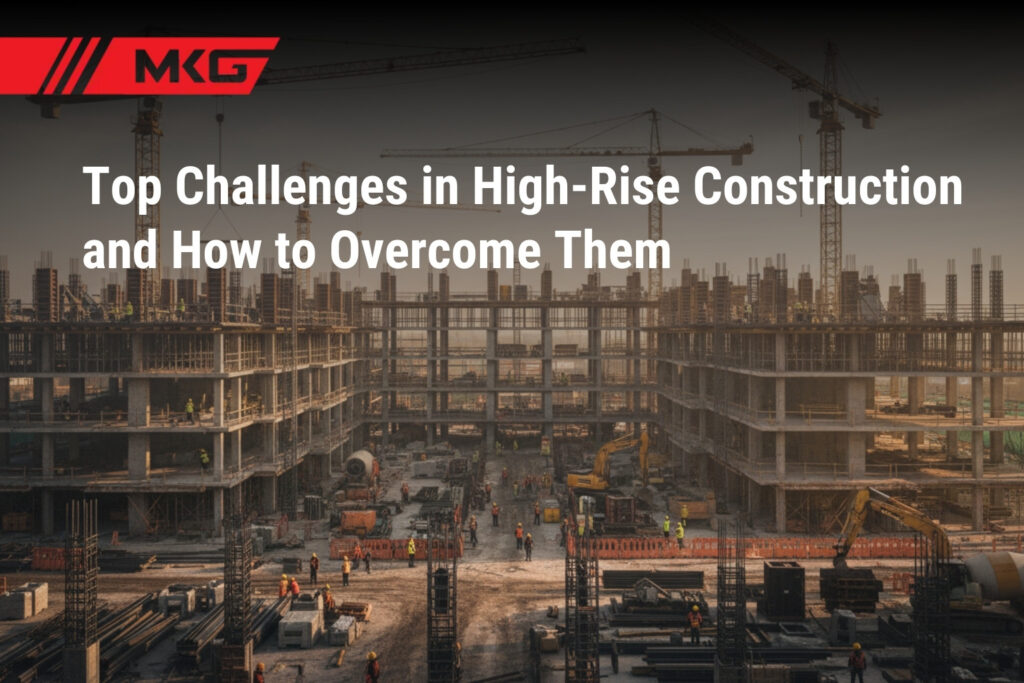
Modern skylines in India are filled with towers that stretch higher than ever. From residential towers in Mumbai to commercial blocks in Delhi, high‑rise construction is not just about stacking floors – it’s about solving a host of engineering, logistic and safety challenges.
Every level brings unique complications: moving heavy materials hundreds of feet in the air, coping with fierce winds and earthquakes, keeping workers safe and obtaining all the necessary approvals. Despite these hurdles, high‑rise construction is surging because dense cities need to maximise every square metre of land.
Below, we break down the biggest obstacles that builders face and explain practical solutions, highlighting how MKG products – such as our builder hoist and Vimaan passenger & material hoist – help create safer, faster and more economical projects.
1. Site logistics and material management
Urban plots are typically cramped, surrounded by roads and adjacent buildings. The limited space means there is little room to store materials or position heavy equipment. A study of high‑rise projects notes that congested sites make crane placement difficult, and moving vast quantities of steel, concrete and facade elements vertically is a continual puzzle. Inefficiency here drives costs up and delays schedules.
MKG’s builder Tower hoist is designed for precisely this problem. Instead of labourers manually hauling bricks, sand and concrete up temporary staircases, the hoist lifts up to 1 tonne of material to heights of 200 ft (using the TH‑200 model) and keeps loads steady with a brake motor.
Two models – the TH‑60 (500 kg to 60 ft) and TH‑200 (1 t to 200 ft) – offer flexibility for different project sizes. Because hoists are modular, they can be extended as the building grows, minimising congestion and keeping vertical logistics smooth.
2. Structural loads and design complexity
Once buildings climb past twenty floors, gravity isn’t the only force at work. High‑rise structures must withstand strong winds, seismic tremors and the weight of hundreds of occupants. Engineers note that tall buildings behave like giant sails; wind can cause swaying that makes occupants uncomfortable or even damages the structure.
Earthquakes add lateral forces that the foundation and frame must resist. Complex structural systems like outrigger trusses, mega‑columns and tuned mass dampers are often necessary to distribute these loads.
While MKG doesn’t design building frames, our equipment must integrate safely with them. We fabricate hoist towers and platforms from high‑strength steel, and our hoists anchor securely to the building’s structural core. Our builder hoist uses wire ropes up to 12 mm in diameter and steel columns fabricated from thick angles.
This robustness ensures the hoist remains stable even when wind gusts hit the building, preventing pendulum‑like movements that could endanger workers. Because hoists climb with the structure, they’re compatible with complex systems like outriggers or belt trusses.
3. Vertical transportation bottlenecks
In a high‑rise, vertical transportation is the lifeline for workers and materials. During construction, limited numbers of hoists and temporary elevators can cause long waits and slow the project. After completion, poorly designed elevator banks create discomfort for residents and tenants. One high‑rise specialist notes that inefficient vertical transportation reduces worker productivity and can lead to tenant complaints.
MKG’s Vimaan passenger & material hoist tackles vertical bottlenecks head‑on. Unlike simple material platforms, Vimaan has enclosed cages, rack‑and‑pinion drive and variable frequency drives (VFDs) to provide smooth, controlled rides. It offers load capacities of 1 ton, 1.5 ton or 2 ton and speeds between 20–60 m/min, making it suitable for transporting both people and supplies. Safety is paramount: the hoist has limit switches on doors and travel points, overload protection and buffer springs.
For space‑constrained sites, Vimaan’s twin‑cage version allows one cage to carry workers and the other materials simultaneously. This dual setup nearly doubles throughput, a necessity in cities like Mumbai where hundreds of workers need to move up and down each day. Our blog on How to Choose the Right Hoist explains that modular hoists extend floor by floor and are a necessity for India’s high‑rise towers.
4. Safety at height and worker protection
Working hundreds of feet above ground exposes crews to falls, falling objects and other hazards. Inadequate safety can lead to accidents, project delays and legal liabilities. A construction risk analysis notes that falls from height and objects dropped from upper floors are major risks in high‑rise projects. Safety lapses can cause severe injuries and damage reputations.
Safety drives every MKG design. The Vimaan passenger and material hoist uses a rack‑and‑pinion mechanism with a geared brake motor to ensure secure stops, even under maximum load. It comes with overspeed governors, limit switches, and emergency stop buttons at multiple locations.
Our builder hoist features a strong frame and brake motor and we stress that pre‑use inspections catch dents, rust or loose bolts before they become dangerous. Our article Tower Hoist Safety Inspections demonstrates how a quick daily check of mast sections, platforms, gates, wiring and brakes greatly reduces the risk of incidents. Regular inspections are essential because frayed ropes and worn racks are among the top causes of hoist failures.
We also ensure compliance with Indian BIS standards. Our Passenger Hoist Maintenance guide explains that a well‑maintained hoist can last 20–30 years, whereas neglect shortens its life and introduces safety risks. By following our checklists – from daily visual sweeps to monthly rust inspections – contractors can keep workers safe and projects on track.
5. Regulatory approvals and compliance
Navigating the maze of building codes, environmental rules and permit processes is often a project in itself. High‑rise construction requires compliance with local and national regulations related to structural stability, fire safety, waste disposal, noise and environmental impact. The process includes multiple permits and can involve community consultations.
MKG products are designed to meet or exceed Indian standards such as BIS and relevant occupational safety regulations. When selecting a hoist, our How to Choose the Right Hoist article recommends checking whether the manufacturer provides compliance documentation and whether overload protection and interlocks meet codes. We include limit switches, emergency brakes and safety signage as part of every hoist, helping site managers satisfy inspectors quickly.
6. Fire safety and emergency preparedness
High‑rise construction sites are particularly vulnerable during a fire because they are in a semi‑finished state. An excerpt from High‑Rise Buildings: Understanding the Vertical Challenges warns that buildings under construction often lack exterior walls and fire‑rated partitions, exposing elevator shafts and hoists to smoke and flame. Site managers must also consider how to evacuate workers from upper levels when the only vertical transport may be a temporary hoist.
MKG hoists incorporate emergency stop mechanisms, overspeed governors and manual brake releases, which are crucial during a fire. Our operators receive training on when to use hoists during an evacuation and when to switch to stairwells. Because our hoists can be installed early in the project, they also support emergency planning: they serve as reliable vertical arteries that can assist with evacuating injured workers or delivering firefighting equipment to upper floors, provided the situation is safe to use them.
7. Environmental sustainability and energy efficiency
Tall buildings consume large amounts of energy and materials. Construction and operation create significant carbon emissions and waste. Sustainability is a growing concern among developers and regulators. For example, experts note that high‑rise projects must balance the demand for height with sustainable practices like renewable energy, low‑embodied‑energy materials and green certifications. Milestone PLM Solutions similarly stresses the importance of energy‑efficient building systems and renewable energy sources to reduce a skyscraper’s carbon footprint.
MKG hoists are built for longevity. By investing in durable components and emphasising preventive maintenance, we extend equipment life and reduce waste. Our use of high‑efficiency motors and VFDs in the Vimaan hoist reduces energy consumption during operation.
Because our hoists support off‑site prefabrication – by lifting heavy modules quickly into place – they indirectly contribute to more sustainable construction practices. Additionally, we are exploring ways to integrate energy‑recovery systems into our hoists to further reduce power use.
Conclusion
At MKG, safety isn’t an afterthought – it’s the foundation of everything we design. Our Tower Hoists, Material Hoists, and Passenger Hoists are built to deliver consistent lifting performance even in the most demanding job conditions. Each product is crafted to meet Indian site realities, ensuring efficiency, reliability, and safety from ground level to the top floor.
Every MKG solution is tested to withstand extreme site conditions – heavy loads, dust, rain, and continuous use – while maintaining peak efficiency. Plus, our expert service team provides ongoing maintenance, spare parts, and technical guidance so your operations never slow down.
With proper setup and periodic inspections, an MKG Hoist can serve your site for 20–30 years, giving you lasting performance and peace of mind.
Talk to MKG’s technical team today to discuss your project needs or request a site visit. We’ll help you choose the right hoist to make your next high-rise project safer, faster, and more productive.
Email: info@mkgworld.in
Call:+91 95222 39320
Let’s make India’s skylines rise smarter – with MKG by your side.
Frequently Asked Questions
1. What are the most common problems associated with high-rise buildings?
High-rise projects face multiple hurdles beyond design and safety – such as complex utility installations, vertical logistics for materials, wind-load resistance, and foundation settlement over time. Each factor demands precise engineering coordination, as even small misalignments can create costly long-term issues.
2. What is the biggest challenge for tall skyscrapers today?
The most pressing challenge is achieving both height and sustainability. As cities adopt green building standards, developers must balance the structural demands of tall towers with energy-efficient materials and systems – without compromising safety or comfort.
3. How do construction teams handle emergencies at extreme heights?
Modern high-rises include pre-planned emergency access routes, hoists with manual override functions, and evacuation lift systems. Fire-resistant cores and staged refuge areas also allow safe evacuation. Regular hoist inspections – like those MKG promotes – further ensure reliability during critical situations.
4. What technologies make high-rise construction more efficient today?
Automation, Building Information Modeling (BIM), and smart hoist systems have revolutionized project scheduling and site logistics. They help track real-time material movement, minimize idle time, and prevent safety lapses – key for faster and safer completion.
5. What are the main stages involved in constructing a high-rise?
Typically, there are seven key stages: planning, design, foundation work, structural framing, installation of vertical transport systems, façade and finishing, and final inspection. Each stage demands precise timing – especially for material lifts and passenger hoists, which are critical for smooth progress on upper floors.