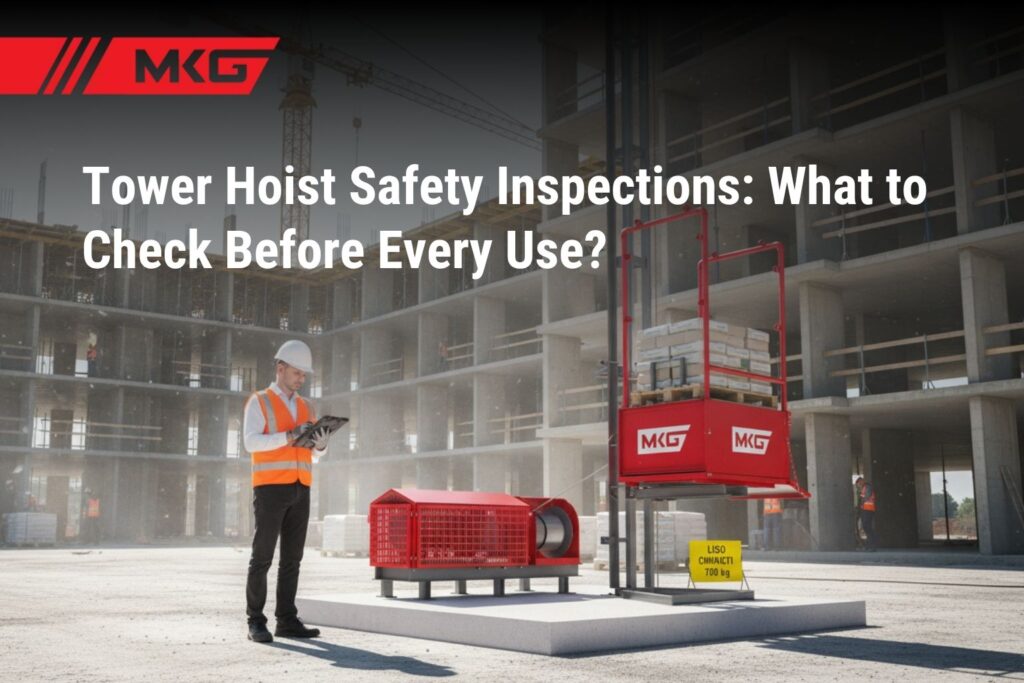
On a busy building site, your tower hoist is a lifeline – it lifts bricks, sand and concrete so your crew can focus on the build. A neglected hoist, however, can injure workers and stall the project. Pre‑use inspections help spot wear and damage early. Industry guidance notes that routine inspections reduce risk and downtime and lengthen equipment life, so those ten minutes at the start of a shift save hours later.
Understanding your tower hoist
A tower hoist (sometimes called a builder hoist) is a vertical material lift made up of mast sections, a platform or bucket, a hoist mechanism and safety devices. MKG’s builder hoist uses a brake motor and sturdy frame to move bulk materials smoothly. Two models are offered – the TH‑60, rated at 500 kg to 60 ft, and the TH‑200, rated at 1 t to 200 ft. Regardless of brand, the same safety principles apply.
Before you begin: a quick visual sweep
Treat every pre‑use inspection like a pilot’s walk‑around. Look for dents, cracks or rust on the mast, cage and anchoring points. Check that bolts are tight and that all safety labels remain legible. Cracks and corrosion weaken metal, so finding them early prevents failure. This quick visual sweep catches many faults before they become dangerous.
Check mast sections and anchorage
The mast is the spine of the hoist. Inspect each mast section for bends, buckling or missing bolts. Verify that connections are tight and that the mast is plumb – an out‑of‑plumb mast can cause misalignment and jerky travel. Pay special attention to anchorage points at the base and ties to the building; loose anchors compromise stability.
Examine the platform and gates
The platform or bucket carries your load, so its integrity is critical. Inspect the floor and rails for cracks or deformations and ensure welds are sound. Test the gates to ensure they latch properly; interlocks must prevent the hoist from moving with a gate open. Damaged gates or defective interlocks are major safety risks because they could allow a load to drop or a worker to fall.
Inspect the hoistway and base enclosure
A clear hoistway is as important as a sound machine. Make sure the path is free of debris and obstructions. Check base enclosure gates and interlocks for proper operation. Removing obstructions reduces the chance of the bucket snagging; working interlocks keep people out of harm’s way.
Doors and safety interlocks
Operate every cage and landing door. The hoist must not move unless doors are fully closed. This is more than a rule – faulty interlocks can allow door‑open movement, which is a major hazard. Checking doors each day catches wear in hinges and ensures the interlocks still cut power when they should.
Wiring, controls and limit switches
Power cables, controls and limit switches are the nervous system of the hoist. Inspect cables for cuts or frays and verify buttons (up, down, stop) respond properly. Test the emergency stop and limit switches so they trip reliably. Loose or damaged wiring can cause erratic movement; faulty limit switches can allow over‑travel – both conditions must be corrected immediately.
Mechanical components: motors, gearboxes and brakes
Listen to the motor and gearbox as the hoist runs. They should hum smoothly; grinding or buzzing noises often signal misalignment or worn gears. Check for oil leaks, overheating or smoke; an overheated motor or leaking gearbox is a red flag. Test the brake – when you release controls, the bucket should stop without drifting. Delayed stopping indicates brake wear and needs attention.
Ropes, chains and rack‑and‑pinion
Your hoist’s lifting medium bears the load, so inspect it closely. Look for broken strands, kinks or rust on wire ropes or chains. Check that ropes are reeved correctly and that rack‑and‑pinion teeth engage without excessive wear. Frayed ropes and worn racks are among the top causes of hoist failures; replacing them early avoids accidents.
Guide rollers and rails
Guide rollers keep the platform aligned as it travels. Inspect rollers for even wear and ensure they are correctly positioned. Misaligned rollers create jerky rides and stress the mast. Guide rails should be straight, free from dents and properly lubricated. Smooth guides reduce vibration and lengthen the life of the hoist.
Overspeed governor and other safety devices
Modern hoists are fitted with overspeed governors, load indicators and emergency brakes. Visually check the overspeed device and test limit switches as part of the weekly inspection. Make sure emergency stop buttons and overload protection devices work. These are your last line of defence if something goes wrong, so never skip this step.
Signage, labels and load ratings
Safety signage communicates crucial information. Confirm that load‑capacity labels, operating instructions and warning signs are present and legible. The rated capacity should be visibly marked and easy for operators to see. Without clear labels, crews may overload the hoist or forget important operating rules, which raises the risk of accidents.
Site and environment checks
Look beyond the machine. Clear the area around the hoist of slip or trip hazards and ensure lighting is sufficient for safe operation. Inspect for proper fencing at ground level, as required by some regulations. A clean work area prevents accidents during loading and unloading and stops debris from falling into moving parts.
Perform an empty test run
Before carrying the day’s first load, run the hoist empty through its full travel range. Listen for grinding or jerky movement, and check that brakes stop smoothly without excessive drift. Test that the platform stops at all landings and that limit switches cut power when triggered. An empty test run highlights issues that might not be visible during a static inspection.
Operator training and personal protective equipment
Listen to the motor and gearbox as the hoist runs. They should hum smoothly; grinding or buzzing noises often signal misalignment or worn gears. Check for oil leaks, overheating or smoke; an overheated motor or leaking gearbox is a red flag. Test the brake – when you release controls, the bucket should stop without drifting. Delayed stopping indicates brake wear and needs attention.
Ropes, chains and rack‑and‑pinion
Your hoist’s lifting medium bears the load, so inspect it closely. Look for broken strands, kinks or rust on wire ropes or chains. Check that ropes are reeved correctly and that rack‑and‑pinion teeth engage without excessive wear. Frayed ropes and worn racks are among the top causes of hoist failures; replacing them early avoids accidents.
Guide rollers and rails
Guide rollers keep the platform aligned as it travels. Inspect rollers for even wear and ensure they are correctly positioned. Misaligned rollers create jerky rides and stress the mast. Guide rails should be straight, free from dents and properly lubricated. Smooth guides reduce vibration and lengthen the life of the hoist.
Overspeed governor and other safety devices
Modern hoists are fitted with overspeed governors, load indicators and emergency brakes. Visually check the overspeed device and test limit switches as part of the weekly inspection. Make sure emergency stop buttons and overload protection devices work. These are your last line of defence if something goes wrong, so never skip this step.
Signage, labels and load ratings
Safety signage communicates crucial information. Confirm that load‑capacity labels, operating instructions and warning signs are present and legible. The rated capacity should be visibly marked and easy for operators to see. Without clear labels, crews may overload the hoist or forget important operating rules, which raises the risk of accidents.
Site and environment checks
Look beyond the machine. Clear the area around the hoist of slip or trip hazards and ensure lighting is sufficient for safe operation. Inspect for proper fencing at ground level, as required by some regulations. A clean work area prevents accidents during loading and unloading and stops debris from falling into moving parts.
Perform an empty test run
Before carrying the day’s first load, run the hoist empty through its full travel range. Listen for grinding or jerky movement, and check that brakes stop smoothly without excessive drift. Test that the platform stops at all landings and that limit switches cut power when triggered. An empty test run highlights issues that might not be visible during a static inspection.
Conclusion
At MKG, safety isn’t an afterthought – it’s built into every design. Each Tower Hoist we manufacture is engineered to deliver consistent lifting performance while ensuring maximum safety for your crew and materials. Designed and manufactured in India, our hoists meet global construction standards and are perfectly suited for Indian work conditions – from high-rise towers to large infrastructure sites.
Every MKG hoist is made to withstand the toughest job site conditions – heavy loads, dust, rain, and daily use – without sacrificing efficiency or safety. Plus, our dedicated technical team ensures you always have access to maintenance support, spare parts, and expert guidance for trouble-free operation.
With proper installation and routine inspections, an MKG Tower Hoist can reliably serve your project for 20 – 30 years, giving you productivity, performance, and complete peace of mind.
Talk to MKG’s technical experts today to discuss your project requirements or schedule a site inspection. Let us help you choose the right hoist for your next build.
Email:info@mkgworld.in
Call:+91 9522239320
Let’s make your construction sites safer, faster, and smarter with MKG hoists.
Frequently Asked Questions
1. Why is daily tower hoist inspection important?
Daily inspections help spot early signs of wear, loose parts, or operational faults before they turn into safety hazards. It keeps workers safe, prevents breakdowns, and ensures smooth lifting throughout the project.
2. What should I check before using a tower hoist?
Before every use, check the rope condition, platform locking, mast stability, brakes, limit switches, control panel, lubrication points, and emergency stop function. Also ensure the site is clear and the operator is trained.
3. Who should perform tower hoist safety checks?
Pre-use checks should be done by a trained operator or site safety supervisor. For periodic inspections and servicing, certified technicians (like the MKG service team) should handle it to maintain safety and warranty standards.
4. How often should a tower hoist be serviced?
A tower hoist should undergo preventive maintenance every 30–60 days depending on usage and site conditions. MKG recommends routine service by authorised technicians for long life and reliable operation.
5. What happens if a hoist fails inspection?
If any issue is found – like rope wear, brake delay, or loose joints — stop the hoist immediately. Do not operate until the fault is fixed by a trained technician. Continuing operation can cause accidents and equipment damage.