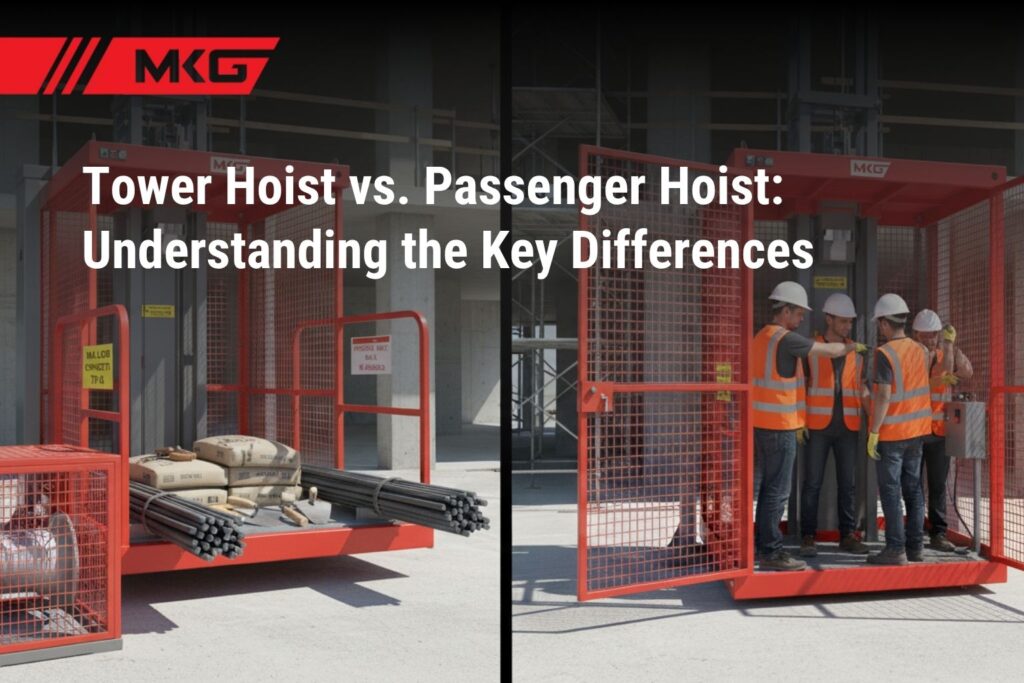
On any building site, one of the first challenges you encounter is getting heavy supplies and crew members from the ground to the working level. If you’ve ever carried bricks up a staircase or squeezed through scaffolding with a bag of cement, you know it’s slow, tiring and dangerous. That’s why modern construction relies on mechanical hoists to do the heavy lifting. However, not all hoists are created equal. Two of the most commonly confused machines are tower hoists (sometimes called builder or material hoists) and passenger hoists. Understanding the differences between them will help you choose the right tool for your project.
At MKG we design both types: our Builder Tower Hoist is purpose‑built for moving heavy materials, while Vimaan is our state‑of‑the‑art passenger and material hoist for transporting workers and goods. In this guide, we’ll demystify these machines in plain language, compare their features and performance, and explain when you should choose one over the other. Where possible we’ll link to our own products and resources as well as external references so you can dig deeper.
What is a tower hoist?
A tower hoist is a compact lifting system used to move bulk materials such as sand, bricks and concrete vertically on a construction site. It’s sometimes called a builder hoist or material hoist, which hints at its main purpose: lifting stuff, not people. Unlike a passenger lift, a tower hoist often has an open or semi‑enclosed platform that makes it easy to dump and unload materials. material hoists as having open or semi‑enclosed platforms, heavy‑duty lifting capability and prioritising load capacity over speed. Because no one rides inside, safety features like enclosed cabins or emergency communications are usually unnecessary.
How a tower hoist works
Mechanically, a tower hoist uses a frame (mast) that is anchored to the building or ground. A motorized winch pulls a bucket or platform up and down this mast via steel rope, chain or a rack‑and‑pinion mechanism. The rack‑and‑pinion system – a gear turning on a toothed rail – provides stable, jerk‑free travel. Modern tower hoists may use an electric motor or a diesel engine to drive the gear train. Because tower hoists carry loads that can weigh hundreds of kilograms, they operate at relatively low speeds (around 10‑30 m/min) to maintain control. Their capacity can exceed 1,000 kg, making them ideal for moving pallets of bricks or tubs of mortar.
MKG Builder Tower Hoist – our take on material lifting
At MKG we’ve refined the tower hoist for the Indian market. Our Builder Tower Hoist comes in two models:
- TH‑60 – lifts up to 500 kg with a 0.2 m³ bucket to 60 ft height. You can choose a diesel engine or an electric motor as the prime mover
- TH‑200 – a more powerful machine that handles 1,000 kg and raises materials to 200 ft. It uses a larger 0.3 m³ bucket and a 12 HP diesel or 15 HP electric motor for extra torque.
Why these numbers matter: when you’re lifting sand or concrete, weight adds up quickly. A cubic metre of wet concrete weighs roughly 2,400 kg, so even a 0.3 m³ bucket carries about 720 kg. Having a hoist rated for 1,000 kg ensures you’re operating within a safe margin. We also fit our hoists with brake motors and robust steel frames, which improve control and stop the platform instantly if you release the controls. These engineering details might sound technical, but they mean the difference between a smooth lift and a dangerous overload.
Typical uses for a tower hoist
Tower hoists are workhorses for mid‑rise buildings, residential complexes, and commercial projects where you need to lift bulk materials repeatedly. Because the mast sections are lightweight and modular, the equipment is easy to erect and dismantle. One supplier notes that tower hoists are portable, space‑saving and suited to mid‑rise construction. In practice this means you can move the hoist around a site as the building grows and reuse it on future projects. When vertical transport is needed for heavy loads but there are no passengers involved, a tower hoist is the most cost‑effective solution.
What is a passenger hoist?
A passenger hoist – also called a personnel hoist, construction elevator or passenger‑cum‑material hoist – is a vertical transport system designed specifically to carry people. On many high‑rise sites you’ll see a fully enclosed cabin running up a mast attached to the side of the building. Passenger hoists have enclosed cabins, emergency braking systems, overload sensors and operate at higher speeds (60–200 ft/min). These features ensure passengers travel safely and quickly between floors.
Passenger hoists are often dual‑purpose: they also carry materials, but they must meet stricter safety standards because human life is involved. Personnel hoists require specially trained operators and have stricter safety requirements.
How a passenger hoist works
Modern passenger and material hoists use a rack‑and‑pinion drive or wire rope system mounted on a mast. The cabin’s interior is similar to a lift car: it has walls, windows and a roof to protect passengers from weather and falling objects. Safety features include:
- Emergency brakes and overspeed governors – these devices sense if the cabin travels too fast and engage a brake to prevent free‑fall.
- Door interlocks – the cabin won’t move unless doors are fully closed, preventing passengers from exiting mid‑travel.
- Overload sensors – if the load exceeds the rated capacity, the system stops and signals the operator.
- Redundant braking – multiple brake systems ensure a fail‑safe stop.
Passenger hoists operate faster than material hoists – typically 20–60 m/min in the case of our Vimaan hoist – to reduce waiting time for workers. The cabins may also include lighting, ventilation and smooth start/stop controls for comfort. Because of these safety and comfort features, passenger hoists cost more and require regular certification to comply with regulations such as ISO 16368 or the Indian BIS standards.
For detailed tips on keeping your hoist in top condition, read our guide onhow to maintain your passenger hoist for maximum lifespan.
MKG Vimaan – safety, reliability and speed
Our Vimaan Passenger and Material Hoist is a versatile solution for high‑rise projects in India. Key specifications:
- Load options: we offer 1 ton, 1.5 ton or 2 ton capacities, with single or twin‑cage configurations
- Speed: Vimaan travels at 20–60 m/min, balancing efficiency with safety
- Drive mechanism: rack‑and‑pinion ensures smooth and stable travel.
- Safety systems: advanced VFD safety device to regulate speed, a geared brake motor, limit switches for doors and travel points, rack searching limit switch, upper & lower limit switches, buffer springs and a manual brake release. For site alerts we install a ground enclosure with hooter, and the dead mast with half rack at the top acts as a fail‑safe
- Long‑term reliability: we use high‑grade components from reputable brands like Schneider and PBL, making the hoist trouble‑free and easy to maintain.
These features aren’t marketing fluff. An overspeed governor, for instance, is not optional when carrying people – gravitational potential energy increases with height, and if a cabin were to drop even a few metres, the impact energy could be life‑threatening. Having redundant brakes and limit switches ensures that if one system fails, another intervenes. In physics terms, you’re dealing with forces measured in thousands of newtons (for a 2‑ton load), so redundancy is literally a life saver.
Key differences between tower hoists and passenger hoists
Now that we understand the basics, let’s compare these two types of hoists head‑to‑head. Each difference matters because it affects safety, cost, speed and suitability for your project.
1. Purpose and design
- Tower hoist: Designed exclusively for materials. Open or semi‑enclosed buckets or platforms make loading and unloading quick. Because no people ride in the platform, there’s no cabin roof or windows, and safety regulations are less stringent. The focus is on high load capacity and mechanical durability.
- Passenger hoist: Designed to transport workers and can also carry materials. It uses a fully enclosed cabin to protect people and may include seating, lighting and ventilation. Safety features like door interlocks, overspeed governors and emergency communication systems are mandatory. The design must comply with strict international and local safety standards.
2. Load capacity and speed
- Load capacity: Tower hoists can handle heavier loads – often exceeding 4,000 kg on industrial units, because their structure is simpler and they lift slowly. Our TH‑200, for example, carries 1,000 kg. Passenger hoists typically carry 1,000–3,200 kg, because part of the weight allowance is reserved for passengers and cabin hardware.
- Speed: Material hoists move at low speeds (about 10–30 m/min) to ensure stability under heavy load. Passenger hoists operate faster, with speeds of 20–60 m/min in our Vimaan model and large industrial hoists can reach 60–200 ft/min. Faster travel reduces downtime for workers and improves productivity.
3. Safety and regulatory requirements
- Material hoists: Safety measures focus on structural integrity – strong frames, sturdy ropes and a brake motor to control descent. Regulations are less stringent because no passengers are aboard, though operators must still perform pre‑use checks and follow load limits.
- Passenger hoists: Must comply with standards such as ISO 16368 or EN 12159. Equipment includes multiple braking systems, overspeed governors, door interlocks and emergency stop buttons. Operators often require a high-risk work license, and the hoist must undergo regular inspections and certification.
4. Installation and mobility
- Tower hoist: Quick to assemble, portable and space‑saving. These small site hoists can be relocated easily, making them ideal for mid‑rise buildings or projects that move from site to site. The mast sections are lighter and can be erected with basic scaffolding or a small crane.
- Passenger hoist: Requires semi‑permanent installation with mast sections anchored securely to the building frame. Assembly can take several days and may require a tower crane. Once erected, it stays in place until the project is complete.
5. Cost and maintenance
- Initial cost: Tower hoists are more affordable. Passenger hoists require enclosed cabins, multiple safety systems and precision gears, which drive up the price.
- Maintenance: Material hoists have fewer components and therefore lower maintenance costs. Routine checks involve inspecting ropes, lubricating moving parts and ensuring the brake motor functions. Passenger hoists require more frequent inspections, testing of safety interlocks and calibration of overspeed governors.
6. Training and operation
- Material hoists: Operators should be familiar with load limits, emergency stops and routine inspections. Formal training may not require a high‑risk licence, but best practice involves a competency course to ensure safe loading and unloading.
- Passenger hoists: Operators must obtain a high‑risk work licence in many jurisdictions. Training covers hazard identification, emergency procedures, and compliance with local regulations. This training ensures the operator can handle emergencies and protect passengers.
7. Applications and project suitability
- Tower hoist applications: Best for residential and commercial buildings, small to medium‑rise construction, warehouses, and any site where large quantities of materials need to be lifted but people can use stairs or scaffolding. Some industrial sites use material hoists for heavy machinery or inventory movement.
Passenger hoist applications: Essential on high‑rise construction, bridge or tower projects and industrial facilities where moving workers quickly is critical. They also improve safety and productivity on multi‑storey projects and infrastructure works.
How to choose the right hoist for your project
|
Factor |
Tower Hoist |
Passenger Hoist |
Why / Basis |
|
Project height |
Best for low to mid-rise (≤10 storeys). |
Best for tall buildings (>10 storeys). |
Climbing causes fatigue; powered lifts maintain efficiency. |
|
Load capacity |
High – ideal for heavy materials (bricks, concrete). |
Moderate – limited by cabin design. |
Open platform allows higher load; enclosed cabins restrict weight. |
|
Safety & comfort |
Workers climb stairs – risk of slips, exhaustion. |
Safer and less tiring for workers. |
Reduces strain and injury; improves morale. |
|
Regulations |
Usually optional. |
Often required above certain heights (e.g., ISO 16368, OSHA). |
Based on safety laws and accident prevention data. |
|
Cost & timeline |
Cheaper, faster setup. |
Costlier but saves time on long projects. |
Efficiency offsets cost over time. |
|
Site space |
Small footprint, easy to move. |
Needs more space and stable foundation. |
A larger structure requires stronger support. |
Conclusion
At MKG, safety isn’t just a part of the process – it’s our promise. Every Tower Hoist and Passenger Hoist we build is engineered to deliver dependable performance while keeping your crew and materials safe. Our equipment is manufactured in India to meet global quality standards, perfectly suited for diverse Indian construction environments – from residential towers to heavy-duty infrastructure projects.
Our hoists are designed for tough site conditions – handling heavy loads, dust, rain, and daily wear without compromising safety or speed. Backed by MKG’s dedicated service team, you also get preventive maintenance, technical support, and access to genuine MKG parts – ensuring smooth, long-term operation.
When properly installed and maintained, an MKG Hoist can serve your project efficiently for 20–30 years, giving you high performance and peace of mind.
Talk to MKG’s technical experts today to schedule a site visit, discuss your project requirements, or get guidance on choosing the right hoist for your next job.
Email:info@mkgworld.in
Call:+91 9522239320 – Let’s make your construction sites safer, faster, and smarter with MKG hoists.
Frequently Asked Questions
1. How often should a construction hoist be serviced or inspected?
For optimal performance and safety, construction hoists should be inspected monthly and serviced every 6 months, depending on usage intensity. MKG’s service team offers preventive maintenance and safety audits, ensuring smooth, long-term operation on site.
2. What safety certifications or standards should a quality hoist meet?
Reliable hoists must comply with IS standards (Indian Standards) and international benchmarks like EN 12159 or ISO 9001-certified processes. These ensure structural strength, braking reliability, and load stability — standards that all MKG Hoists are engineered to meet.
3. Can tower hoists be customised for specific project needs?
Yes. MKG Tower Hoists can be customised based on height, load capacity, and site layout. Optional attachments, advanced control systems, and varying bucket sizes can help adapt the hoist to your exact project demands.
4. What’s the average power consumption of a construction hoist?
Power consumption depends on motor capacity, lifting height, and frequency of use. Generally, passenger hoists use 7.5–15 kW motors, while tower hoists may require 5–10 kW. Choosing an energy-efficient hoist from MKG can help reduce operating costs without compromising performance.