
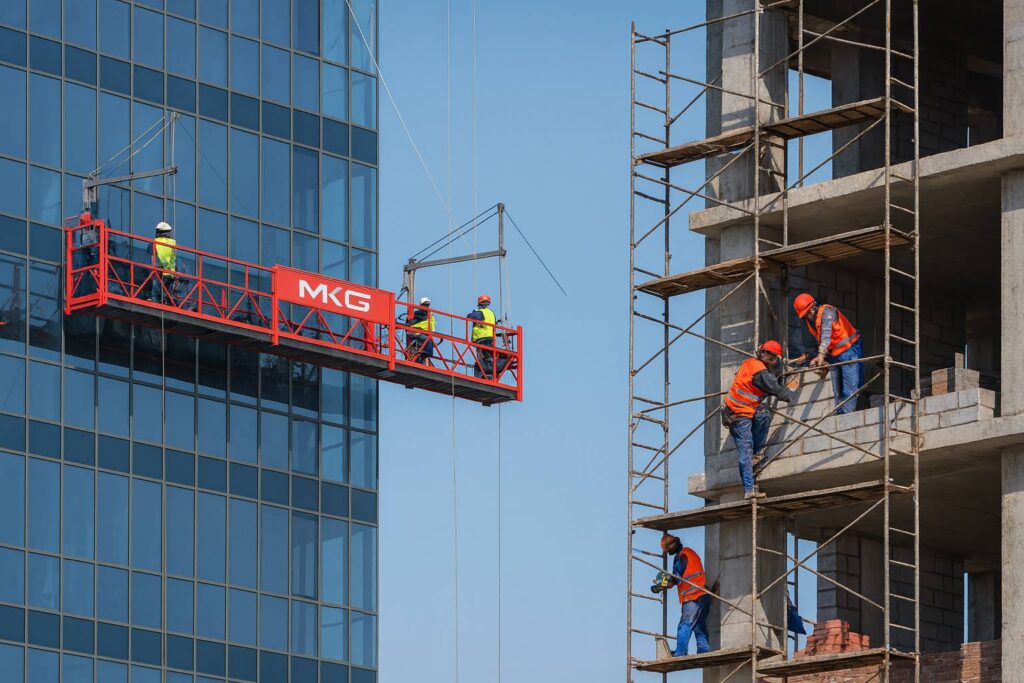
Choosing between Rope Suspended Platforms (RSPs) and Traditional Scaffolding is not just a technical decision – it affects your project’s cost, safety, and deadlines. In India’s fast-growing infrastructure sector, every day saved can mean faster possession for clients, lower labour bills, and happier investors.
Pick the wrong system, and you could face delayed concrete pours, blocked site access, or even safety risks for workers. Pick the right one, and you get a smoother workflow, fewer stoppages, and better control over expenses.
That’s why contractors, builders, and project managers across Maharashtra, Gujarat, Karnataka, and other states are rethinking their approach, looking for solutions that balance speed, flexibility, and compliance with safety norms.
What Is a Rope Suspended Platform?
A Rope Suspended Platform (RSP) / Hanging platform – also called a gondola, cradle, or swing stage , is a temporary, motor-driven work platform that hangs from the roof or any strong overhead structure. Instead of building scaffolding from the ground up, this system lets workers go up and down along the building facade with the help of electric or manual hoists.
Because of its vertical mobility and quick setup, it’s widely used for facade cleaning, painting, plastering, inspections, repairs, and glass installation on high-rise buildings. The platform takes up almost no ground space, making it perfect for crowded city projects where space is a big challenge.
Modern RSPs, like MKG’s Hanging Platforms, are built with galvanized steel for durability, come with safety features like emergency brakes, anti-tilt mechanisms, and separate lifelines, and are designed to carry both workers and light materials safely at heights.
What Is Traditional Scaffolding?
Traditional (supported) scaffolding is a ground-supported, temporary framework built from the bottom up to create stable, multi-level platforms for work at height. It’s assembled with steel/aluminium tubes or modular frames, planks/boards for standing, and bracing to keep everything rigid and safe.
How it’s built (simple): Upright standards carry the load to the ground; ledgers and transoms tie the frame together; modular frames or tube-and-coupler systems shape the structure; bracing, base plates/jacks, guardrails, and toe-boards add stability and fall protection.
Where it shines (practical): Use it when you need high load capacity, big teams, and long-duration work, think brickwork, plastering, cladding, heavy repairs, or complex elevations on Indian sites. It handles workers + heavy materials together, but it needs crew time and ground space to set up correctly.
Side-by-Side Comparison & Key Decision Factors
Picking between a Rope Suspended Platform (RSP) and Traditional Scaffolding isn’t just about availability – it’s about what works best for your height, budget, safety, and deadlines. Here’s a combined table + quick decision guide to help you choose confidently:
Comparison Table
Factor | Rope Suspended Platform (RSP) | Traditional Scaffolding |
Setup Time | Quick, small crew – no ground-up build; hoists rigged on roof/beam. | Time-intensive – frame/tubes, bracing, decking assembled from base. |
Cost (Job Length) | Lower for short/targeted tasks – fewer materials, faster mobilisation. | Better for long projects – higher initial labour/materials spread over time. |
Safety Core | Requires certified operators + fall-arrest; strict rope/anchor/hoist checks. | Guardrails, solid base, bracing; strict assembly and inspection routines. |
Load Capacity | Light–medium – people + tools/light materials. | High – supports multiple workers and heavy materials/equipment. |
Space / Footprint | Minimal ground space – ideal for tight urban sites. | Needs ground area for bases, storage and movement paths. |
Mobility / Adjustment | High vertical mobility – raise/lower and reposition quickly. | Low mobility once built – changes need partial dismantling. |
Weather Sensitivity | Wind-sensitive – swaying risk; stoppages in adverse weather. | Generally steadier once braced; still pause in extreme weather. |
Crew & Skill Need | Smaller crew, higher skill – competent rigging/ops mandatory. | Larger crew, broader skills – assembly, bracing, inspections. |
Quick Decision Guide
1. Height & Access Needs
Ask yourself: “Do I have a high-rise façade or a multi-level job?”
- Choose RSP if you need vertical mobility on tall buildings , perfect for façade cleaning, inspections, or partial repairs.
- Choose Scaffolding for projects where you need workers on multiple levels simultaneously, like bricklaying, plastering, or installing cladding.
2. Project Duration
“Is this a quick maintenance job or a months-long construction project?”
- RSPs make sense for short-term or targeted work , they set up quickly and save labour hours.
- Scaffolding is worth it for long-duration jobs, where its stable, permanent-like setup supports continuous work.
3. Safety & Compliance
“Do I have trained operators and proper safety systems?”
- RSPs require certified operators, strong anchors, and regular rope/hoist checks.
- Scaffolding needs correct assembly, guardrails, bracing, and regular inspections to avoid collapse or overload accidents.
4. Budget & ROI
“Will setup and labour costs eat into my profit?”
- RSPs are cost-effective for quick jobs since they use fewer materials and less manpower.
- Scaffolding costs more upfront but becomes cheaper per day on long projects where frequent access is needed.
5. Space Constraints
“Do I have enough ground space?”
- RSPs use almost no ground space, making them ideal for tight Indian sites, busy roads, and metro areas.
- Scaffolding needs clear base space and can block footpaths, vehicle access, or shopfronts if not planned properly.
6. Flexibility & Mobility
“Will my work area shift often?”
- RSPs are easy to reposition – you can move up/down without tearing everything down.
- Scaffolding is fixed once built – changing its height or position means dismantling and rebuilding sections.
Practical On-Site Applications
Knowing when to use Rope Suspended Platforms (RSPs) versus Traditional Scaffolding makes all the difference in real projects. Here are practical examples that match what builders, contractors, and maintenance teams actually face on-site in India:
Rope Suspended Platform (RSP) – Best Fit
- High-Rise Glass Façade Cleaning & Painting: Perfect for tall commercial towers in cities like Mumbai or Bengaluru where quick setup and minimal ground disruption matter.
- Façade Installation & Repairs: Used during glazing or targeted plaster repairs where only certain sections need access.
- Bridge & Industrial Maintenance: Ideal for reaching undersides of flyovers, chimneys, cooling towers, or silos without blocking roadways or plant operations.
- Wind Turbine & Signage Work: Provides safe vertical mobility for niche jobs like turbine blade inspection or installing high-rise hoardings.
Traditional Scaffolding – Best Fit
- Large-Scale Masonry & Civil Work: Multi-level, stable platforms support bricklayers, plasterers, and heavy materials through an entire building cycle.
- Historic or Heritage Restoration: Needed when craftsmen must reach every detail of temples, monuments, or heritage facades safely and over long periods.
- Full-Scale Renovation: Suitable for jobs requiring simultaneous access across multiple floors , like replacing cladding, major structural repairs, or demolition prep.
Shipyards & Heavy Industry: Used for shipbuilding or large vessel repairs where strength and multi-team access are critical.
Conclusion
At MKG, we don’t just sell platforms – we build reliable, Make in India solutions that match the pace of today’s infrastructure boom. Our Hanging Platforms (ZLP 500 & ZLP 800) are engineered with steel platforms, galvanized finishes, and advanced safety features like anti-tilt, overload cut-off, and emergency locks. These are designed for India’s real-world project conditions – from high-rise towers in Mumbai to industrial sites in Gujarat.
Because we’re based in Raipur with a network across Maharashtra, Gujarat, Karnataka, Kerala, Andhra Pradesh, and more, our focus is not just delivery but end-to-end support – installation guidance, operator training, and after-sales service. That means your crew spends less time troubleshooting and more time getting the job done safely.
Our platforms are available in modular sections (1m, 1.5m, 2.5m), making them easy to transport and adapt to different façade widths. With load capacities up to 800 kg and 100 m working height, MKG platforms are suitable for façade cleaning, painting, glazing, inspection, and maintenance jobs that demand safety and efficiency.
Talk to MKG’s Experts Today
Plan your next project setup, get inspection guidance, or choose the right platform for your site conditions.
Email us:info@rajat-group.com
Call us:+91 88899 00105
Let’s keep your project running safely, efficiently and on time.
Frequently Asked Questions
1. Which is safer – rope suspended platforms or traditional scaffolding?
Both can be safe when installed and used correctly. RSPs need certified operators, strong anchors, and fall arrest systems, while scaffolding requires solid ground, proper bracing, and regular inspections. Safety depends more on correct setup and maintenance than the system itself.
2. What is the cost difference between RSPs and scaffolding?
RSPs are generally cheaper for short-term jobs because they require fewer materials and less labour to set up. Scaffolding may have a higher initial cost but becomes cost-effective for long, continuous projects where the structure remains for weeks or months.
3. Can rope suspended platforms handle heavy materials like scaffolding?
No. RSPs are designed for workers, tools, and light materials – usually up to 500–800 kg. If your job needs heavy material handling (bricks, concrete, steel sections), scaffolding is the better choice due to its higher load-bearing capacity.
4. Where are rope suspended platforms commonly used in India
They are popular for façade cleaning, painting, glass installation, and maintenance on high-rise towers in cities like Mumbai, Pune, Bengaluru, and Hyderabad – especially where ground space is limited.