Construction today isn’t just about putting bricks and steel together. In India, where cities are expanding and infrastructure projects are racing against deadlines, every hour on site counts. A small delay in one stage – like rebar cutting or bending – can hold back the entire project, pushing timelines and inflating costs.
Manual methods, though traditional, often struggle to keep up with today’s demand. Workers take longer to process steel bars, mistakes creep in, and safety risks remain high. On a large site, these issues don’t just slow down progress – they affect quality, budgets, and even trust with clients.
That’s why improving productivity on construction sites has become a non-negotiable. It’s not about working harder, but about working smarter. Modern machines like bar cutting and bending equipment give builders the edge – they save time, reduce waste, improve accuracy, and make work safer for everyone on site.
In this blog, we’ll look at how these machines speed up rebar processing, bring consistency and precision, cut down wastage, improve worker safety, and even support faster project delivery – all of which directly boost site productivity.
Speed and Throughput - 5x to 10x Faster Than Manual Work
On Indian construction sites, time is often the biggest bottleneck. Manual rebar work slows projects down – workers usually manage only 10–20 cuts or bends per hour, and fatigue or measuring errors are common. This not only delays foundations and columns but also creates rework, adding extra days to the schedule.
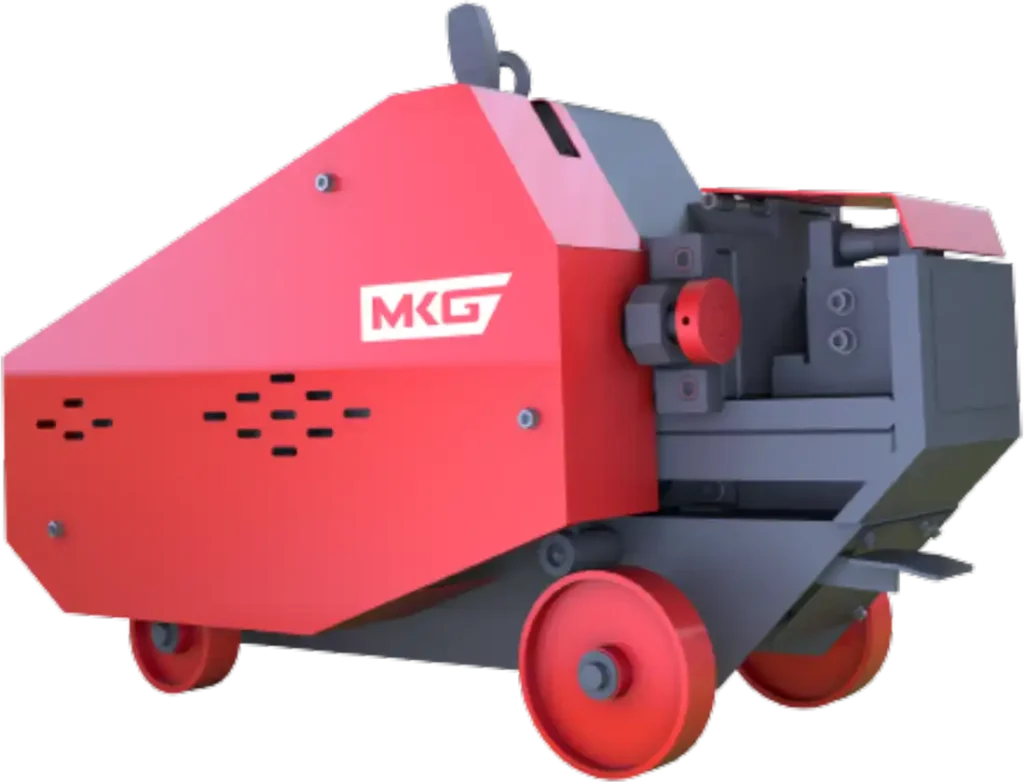
With automated machines, the difference is dramatic. Take MKG’s Bar Cutting Machines (C-40, C-45, C-50) – they can cut up to 50 mm rebar at motor speeds of 2880 RPM, easily processing 100–200 bars per hour with consistent accuracy.
Similarly, MKG’sBar Bending Machines (B-40, B-45, B-50) deliver uniform bends up to 50 mm, using gear-driven precision to handle high volumes without slowing down. What takes hours with manual tools is done in minutes, and machines can keep running 24/7 without fatigue.
Precision and Accuracy for Better Structural Integrity
In construction, a few millimeters can decide whether a structure lasts for decades or starts showing cracks within years. Rebar is the backbone of concrete, and if bars are cut too short, bent at the wrong angle, or placed unevenly, the entire structure can lose strength. Manual processing often carries this risk – cuts are usually off by 5–10 mm, and bends vary depending on the worker’s technique or fatigue. These small errors add up, leading to rework, weak joints, or even safety issues later.
This is where automated bar cutting and bending machines prove their worth. MKG’s Bar Cutting Machines (C-40, C-45, C-50), for example, can cut up to 50 mm bars with high motor RPM, delivering consistent results every time. Similarly, MKG’s Bar Bending Machines (B-40, B-45, B-50) use gear-driven systems to maintain exact angles and bend radii. The outcome? Every piece of rebar comes out uniform, fitting perfectly into the formwork without adjustments on site.
Safety and Labor Efficiency on Site
Rebar work is risky – cuts, back strain, and crush injuries are common when done manually. MKG’s Bar Cutting and Bending Machines reduce these hazards with enclosed blades, hydraulic systems, and consistent, hands-free operation, cutting injury risks by up to 80–90%.
On the labor side, what earlier needed 6–8 workers can now be handled by 1–2 operators. Training is quick, machines don’t tire, and output stays steady. This not only lowers costs but also frees skilled workers for higher-value tasks like placement and finishing.
For contractors, the result is safer sites, leaner teams, and faster project delivery – a win on every front.
Material Optimization and Waste Reduction
Steel is one of the biggest costs on any site, and every wrong cut or bend turns straight into waste. With manual methods, even small measuring mistakes or angle errors add up; projects often lose 10–15% of their rebar this way. That’s not just scrap lying around; it’s money gone and timelines stretched.
MKG’s Bar Cutting and Bending Machines solve this with software-driven precision. The cutters measure bars to exact lengths, while the benders keep every angle uniform. Offcuts that would usually be discarded can be reused for stirrups or spacers, thanks to optimized cutting patterns. On many projects, this alone reduces scrap by 15–30%.
Just-in-time fabrication also helps. Instead of over-ordering or storing large stock that risks rusting or damage, machines cut and bend steel as needed. This means less wastage, cleaner sites, and lower storage costs.
For contractors, the impact is twofold: direct savings on steel bills and a greener, more sustainable process. In today’s competitive market, saving material isn’t just about profit – it’s about building smarter and proving efficiency to clients.
Compliance and Quality Assurance on Site
In construction, there’s no room for guesswork – every rebar cut and bend must match the design exactly. In India, site inspections are strict, and even a small deviation from the Bar Bending Schedule (BBS) can cause rework, delays, or even rejection of work.
MKG’s Bar Cutting and Bending Machines help avoid these risks by producing steel that’s uniform, precise, and aligned with IS codes and project specifications. Whether it’s the length of a bar, the angle of a hook, or the radius of a bend, the machine ensures every piece is consistent. This accuracy means rebar cages fit perfectly into the formwork, maintaining proper concrete cover and long-term durability.
What also sets machines apart is traceability. Modern systems can generate digital logs of the bars processed, which serve as proof during audits and third-party checks. For contractors, this not only speeds up approvals but also builds trust with clients who know the work is backed by verifiable quality.
In simple terms, machines take the uncertainty out of rebar work. They ensure compliance with codes, reduce inspection failures, and give both builders and clients the confidence that the structure is safe, durable, and built to standard.
Conclusion
At MKG World, we know that construction projects in India demand more than just speed; they demand reliability, safety, and long-term value. That’s why our Bar Cutting and Bending Machines are engineered to deliver precision, reduce waste, and improve site productivity while staying compliant with Indian standards. With us, you don’t just get machines, you get solutions that make your projects faster, safer, and smarter.
Whether it’s rebar processing for a housing project, a metro rail, or a high-rise tower, our machines are built to handle tough site conditions and deliver consistent results. Every model is designed to be durable, efficient, and easy to operate, backed by after-sales support that ensures your site keeps moving without delays.
If you’re planning your next project and want dependable equipment that combines performance with compliance, MKG is here to support you.
Email us: info@rajat-group.com | sales@rajat-group.com
Call us: +91 88899 00105
Get in touch today and discover how MKG can help you cut costs, save time, and build with confidence.
Frequently Asked Questions
1. What is the lifespan of a bar cutting and bending machine?
Most industrial-grade machines last between 10–15 years with proper maintenance. With MKG’s Bar Cutting and Bending Machines, you not only get this durability but also the assurance of easy servicing, readily available spare parts, and strong after-sales support. Regular lubrication and timely replacement of wear parts like blades and rollers become hassle-free, making MKG machines a truly long-term investment for any contractor.
2. What is the primary purpose of bar bending in construction?
The main purpose of bar bending is to shape steel reinforcement so it fits the design of beams, slabs, and columns. This ensures the concrete structure can handle loads safely and efficiently.
3. What is the use of bar cutting machine?
A bar cutting machine is used to cut steel bars quickly and accurately to the required length. It saves time, reduces manual effort, and ensures consistency compared to hand-cutting methods.
4. What is the use of bending machine?
A bending machine is used to shape steel bars into hooks, stirrups, or complex designs needed for reinforcement. It ensures uniform bends, which improves structural integrity and reduces human error.
5. Why is rebar processing important in construction?
Rebar processing ensures that reinforcement steel is cut, bent, and placed correctly. Properly processed rebar improves the strength, durability, and safety of the entire concrete structure.