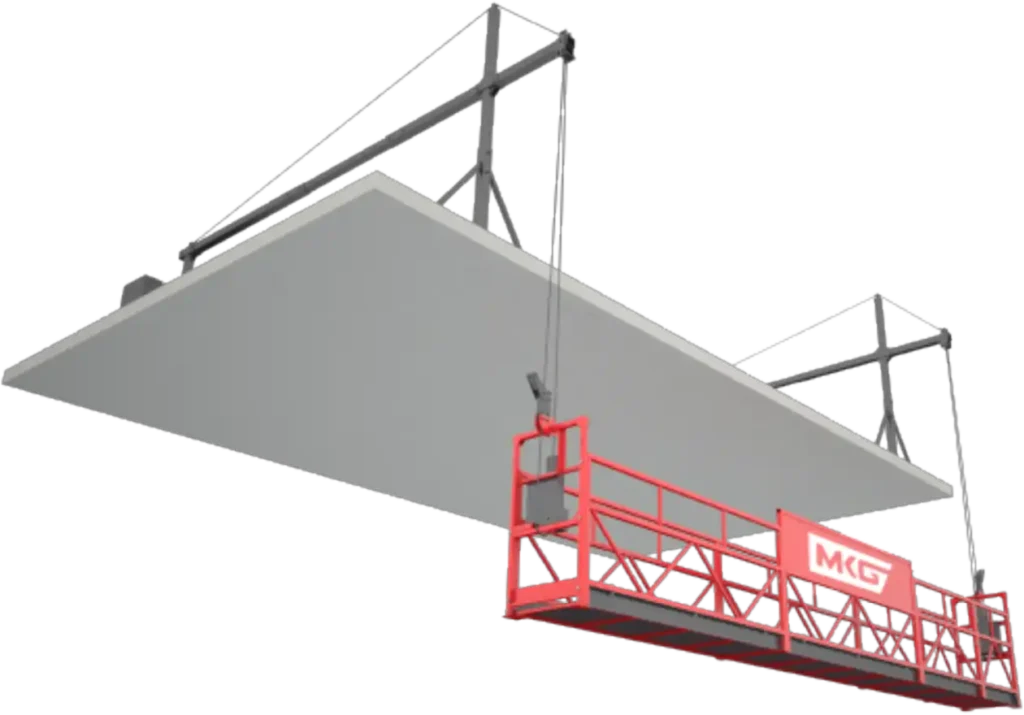
When it comes to working on high-rise buildings – whether it’s constructing a new tower, repairing an old façade, painting exteriors, or cleaning glass walls – rope suspended platforms (also called hanging platforms, gondolas, or suspended scaffolds) are the go-to solution. These platforms give workers safe, stable, and quick access to areas that are otherwise difficult to reach.
But here’s the thing – when you’re 20, 50, or even 100 meters above the ground, safety isn’t just important, it’s non-negotiable. One small failure can lead to life-threatening accidents, which is why both equipment quality and safety systems matter as much as the work itself.
In this article, we’ll break down the Top 5 Safety Features you should look for in a rope suspended platform – what they are, why they matter, and how they protect workers in real-world conditions. We’ll also touch on globally recognized safety benchmarks like OSHA and ANSI/ASSP A10.28-2018, so you know what “safe” really means in both Indian and international standards.
1. Safety Lock System
A safety lock system is a critical backup built into rope suspended platforms to prevent uncontrolled drops. Its function is simple but vital: if the platform tilts beyond a safe angle, descends too quickly, or the lifting system fails, the lock instantly grips the safety rope and secures the platform in place.
This mechanism uses precision-engineered jaws or cams that clamp the rope the moment abnormal movement is detected. In advanced models, sensors add another layer of intelligence by monitoring speed and tilt – triggering the lock automatically if the platform exceeds safe limits. Once engaged, the lock must be manually reset, ensuring the fault is identified and corrected before operations continue.
In high-rise work, where seconds can decide between a close call and a serious accident, such a system provides reassurance that even if the main hoist fails, there’s a completely independent safeguard. For India’s rapidly growing high-rise sector, a dependable safety lock is not just an added feature – it’s a compliance requirement and a life-saving necessity.
2. Safety Rope & Fall Arrest System
A safety rope and fall arrest system is designed to protect each worker individually, even if the platform itself becomes unstable. The setup includes an independent lifeline – usually a high-strength steel wire or synthetic fibre rope, anchored securely to the building or structure, completely separate from the platform’s suspension ropes.
Each worker connects to this lifeline using a certified full-body harness that distributes the force of a fall across the torso, thighs, and shoulders, reducing the chance of injury. Attached to the harness is a fall arrest device, a guided mechanism that locks instantly if the worker slips, trips, or loses balance.
This system acts as a personal safeguard, ensuring that even if the platform fails, the individual remains secured to a safe anchorage point. In India’s expanding high-rise construction and maintenance sector, where workers operate hundreds of feet above the ground, such protection is not optional – it makes safety personal and guarantees that every worker has an independent line of defence.
3. Emergency Stop System
An emergency stop system is a dedicated control that halts all platform movement instantly when activated, giving workers immediate authority over unsafe situations. Whether it’s a sudden mechanical fault, a rope snag, strong winds, or unexpected obstacles, the principle is simple, stop first, assess the issue, and only continue when it’s safe. In practice, pressing the emergency stop disconnects power to the hoists, freezing the platform in place.
Many modern platforms also include a direct mechanical brake or locking feature, ensuring the system can still stop safely even if the electrical circuit fails. To make it effective, the controls are strategically placed within easy reach on the platform and, in some cases, at the hoist or ground level so that anyone can trigger it quickly.
In high-rise operations, even a delay of a few seconds can decide whether a problem is contained or escalates into an accident. For Indian construction and maintenance sites, where weather shifts, debris, or power fluctuations are frequent, a reliable emergency stop isn’t just an added safety tool – it’s the difference between a close call and a serious incident.
4. Limit Switches
Limit switches are built-in safety devices that act like invisible stop signs for rope suspended platforms. They automatically halt movement when the platform reaches its pre-set upper or lower limit, preventing it from travelling too high, descending too low, or colliding with parts of the building.
The system works by using position sensors that detect when the platform reaches its safe range; once triggered, the switch cuts power to the hoist and stops further movement immediately. Both upward and downward travel are protected, ensuring the platform always stays within its safe operating zone without relying solely on operator control.
This feature is especially important because, without it, workers would have to depend entirely on manual judgment, which increases the risk of overtravel. That can damage the hoist, ropes, or platform, and even cause unsafe contact with the structure. On Indian construction and maintenance sites, where multiple tasks happen at the same time, limit switches provide a dependable safeguard that keeps operations smooth, predictable, and safe.
5. Guardrails and Toeboards
Guardrails and toeboards are permanent safety barriers built into the edges of a rope suspended platform, designed to protect both workers on the platform and people below. The guardrail forms a sturdy frame, usually made of steel or aluminium, around all open sides, preventing anyone from accidentally stepping or falling off.
Along the platform floor, the toeboard acts as a raised edge that stops tools, materials, or debris from sliding off during work. Because they are fixed components, these features provide constant protection without relying on worker action or judgment.
This is especially critical in India’s construction and maintenance sector, where falls from height remain one of the leading causes of accidents. Guardrails serve as a physical shield for workers, while toeboards ensure that even small objects don’t become dangerous hazards to people working below.
Together, they not only improve day-to-day safety but also ensure that platforms meet global standards such as OSHA and ISO, as well as Indian safety codes, making them an essential requirement rather than an optional feature.
Key Factors to Consider When Choosing the Right Rope Suspended Platform
Selecting the right rope suspended platform goes beyond price – it’s about making sure the platform matches your project requirements, safety needs, and long-term usage. Here’s what you should keep in mind:
1. Project Scope
- For small-scale tasks like patch repairs or painting, a manual platform may be enough.
- But for high-rise construction, façade cleaning, or heavy maintenance, a motorized system is the safer and more productive choice. The MKG ZLP 500 (5m, 500kg load) and ZLP 800 (7.5m, 800kg load) are designed for exactly these larger, more demanding projects.
2. Budget
- Manual platforms may suit short-term, low-budget jobs.
- For frequent or large-scale projects, investing in a motorized platform like ZLP 500 or ZLP 800 is more cost-effective. They reduce downtime, increase worker productivity, and handle heavier loads, making them a long-term value purchase.
3. Frequency of Use
- If you only use a platform occasionally, manual options may work.
- But for daily or frequent use, motorized models with durable steel ropes (8.3–8.6mm) and heavy-duty hoists (LTD 6.3 / LTD 8.0) will deliver consistent performance without excessive wear and tear.
4. Work Environment
- Check if your site has a stable power supply – MKG platforms run on 415V, standard for Indian projects.
- Think about load types: the ZLP 500 handles up to 500kg, ideal for lighter jobs, while the ZLP 800 supports 800kg, perfect when you need more workers, tools, or materials on the platform.
5. Safety Requirements
- Always choose platforms that meet international standards (OSHA, ANSI/ASSP) and Indian codes.
- MKG platforms are fitted with LST 20 safety locks, reliable limit switches, guardrails, toeboards, and counterweights (25kg blocks for balanced stability). These features make them compliant, dependable, and safe for real-world use.
If you’re working in construction, real estate, or infrastructure, the MKG ZLP series is a practical choice. The ZLP 500 suits medium projects with lighter loads, while the ZLP 800 is built for heavy-duty, high-rise operations where maximum safety and efficiency are non-negotiable.
Conclusion
At MKG, we don’t just supply equipment – we deliver complete high-rise access and lifting solutions trusted by contractors across India. Whether it’s rope suspended platforms for safe façade work, Vimaan Series passenger and material hoists for smooth vertical movement, or builder and tower hoists for heavy-duty lifting, our products are built to meet the toughest site challenges.
If you’re planning your next high-rise project and want reliable, compliant, and efficient solutions, we’re here to help.
Email us: info@rajat-group.com | sales@rajat-group.com
Call us: +91 88899 00105
Get in touch today and let MKG provide the right solution for your construction or maintenance needs.
Frequently Asked Questions
Before use, ensure the platform is installed by trained personnel, ropes are inspected for wear, and counterweights are correctly placed. MKG provides clear setup guidelines with the ZLP 500 and ZLP 800 to help contractors avoid common mistakes.
Most platforms, including the MKG ZLP series, are designed for up to 100 meters, making them suitable for high-rise towers, commercial complexes, and residential projects.
Yes – MKG platforms are built with steel structures, weather-resistant painting, and heavy-duty ropes (8.3–8.6mm) to withstand India’s heat, dust, and humidity, ensuring durability on-site.
Absolutely. MKG offers modular platform lengths (5m and 7.5m options) and optional features like anti-tilt devices and overload protection, so you can match the setup to your specific site needs.
Along with platforms, you need lifting solutions for workers and materials. MKG offers the Vimaan Series for passenger hoists and material hoist lifts and separate tower hoists for heavy-duty material handling – giving you a complete high-rise access and lifting system.